Masters 子部
While the Confucian canon and histories conveyed important matters such as moral cultivation and state administration, books in the Masters category often discussed matters that seemed less significant to compilers of the Si Ku Quan Shu. The Arts, for example, were viewed as ‘petty skills’–notwithstanding that art connoisseurship was an integral part of contemporary upper-class life.
The parameters of the Masters category are relatively blurry. Traditionally, everything that did not fit into the other three categories ended up being incorporated, including such varied disciplines as military science, philosophy, agriculture, medicine, mathematics, astronomy, and religion. Nonetheless, the category was not all-encompassing: many books were omitted from the Si Ku Quan Shu and contemporary bibliographies due to their perceived vulgarity.
Buddhism and Daoism (an indigenous Chinese religion) were commonly included in the Masters category. They were treated differently in the traditional classification system, as unlike the more secular, outward-looking Confucianism, they deal with matters of personal spirituality. However, this in no way diminished their influence–by the late fifth century, Buddhism was so prominent that it was assigned a separate category in the contemporary bibliography, The Seven Treaties.
Key Objects
-
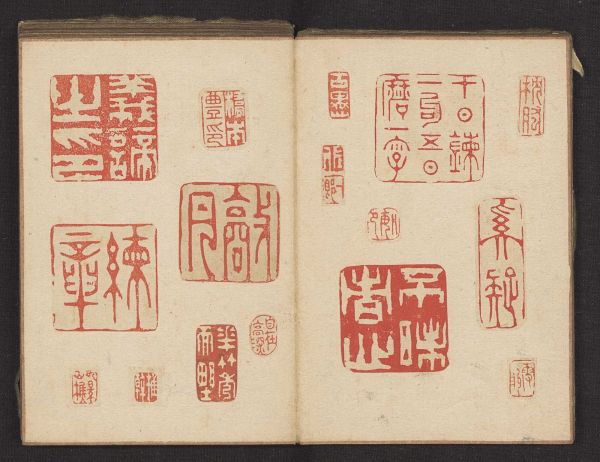
Hakura Katei (engraver)
Kyoto, Japan, 1779-1887
Katei's Seal Album–Album of Japanese Artists’ Seals, c.1800-1899
Inked stamps
Japan: unknown publisher
A small book of Japanese artists’ seals by Meiji-period artist and engraver Hakura Katei. Katei learned calligraphy during his childhood, and after a brief period working as a government official, travelled to Edo to study various artistic techniques. For a time earned a living by specializing in the creation of In, the carved tops of seals, and his work became prized by the Imperial Prince Kuninomiya Asahiko.
The use of printed ink seals as a means of affixing a signature arose first in China (as opposed to wax seals, which were used in Europe), but the practice quickly spread across East and South-east Asia. In Japan, seals were originally used only by the emperor and his closest officials from 57 CE; by 750, they had entered common usage among nobles, government employees and businesses.
Rare Books Collection, Archives and Special Collections
UniM Bail SpC/ARTBOOK 702.81 JAPA
-
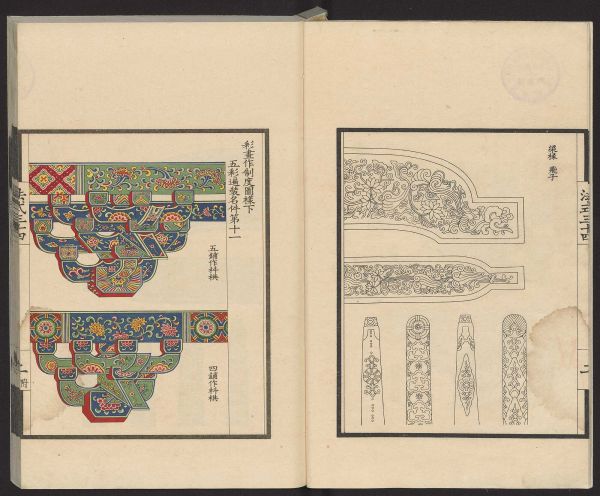
Li Jie
Henan, China, 1035-1110
State Building Standards, 1925
Woodblock imprint
Wujin: Chuanjing Publishing House
State Building Standards was written by the assistant director of the office of public works and construction, Li Jie, who worked in the Imperial court of the Northern Song dynasty for thirteen years. His reference work on architecture, including standards, information and diagrams on how to build structures, the materials needed, and how many people it would take to construct them was influential at the time: the Song dynasty was not only a period of artistic growth, it also saw the rise of the civil service, and allowed anyone with talent to participate in the civil service exams. Li’s book, originally written in 1103, was re-discovered by academic Zhu Qiqian in 1919 and is one of the earliest and most complete texts from the time.
Donated by the Friends of the Baillieu Library
Rare Books Collection, Archives and Special Collections
UniM Bail SpC/RB 37B/2 37B/9
-
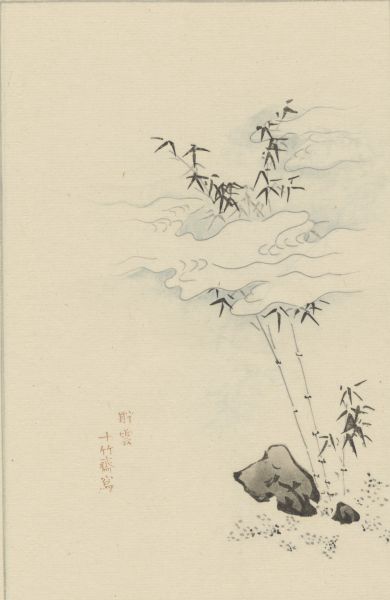
Hu Zhengyan (compiler)
Anhui, China, 1580-1671
The Ten Bamboo Studio Album of Letter Paper, 1983
Woodblock imprint
Kowloon, Hong Kong: China Academic Information Society
Zhengyan established the Ten Bamboo Studio in the first quarter of the 1600s, employing his brothers, sons, and other artisans to publish mainly academic texts. Zhengyan was also a printmaker, calligrapher, seal carver and artist, known for his innovative multi-colour printing techniques. His most famous work is this four-volume manual, which anthologises over three hundred prints by around thirty different artists, himself included, it depicts landscapes, animals, plants and figures. It was reprinted often during subsequent centuries. A proponent of the Ming dynasty, Zhengyan largely withdrew from public life after the fall of the Ming and rise of the Qing dynasty in the 1640s.
Rare Books Collection, Archives and Special Collections
UniM Bail SpC/BX f 761.20951 HU
-
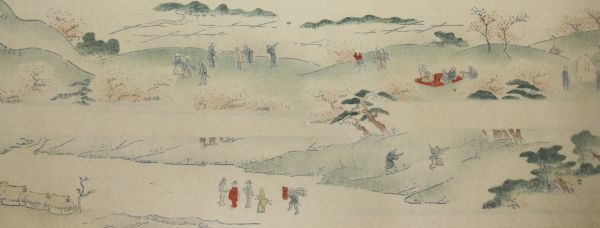
Kitao Masayoshi (Kuwagata Keisai) (artist)
Tokyo (Edo), Japan, 1764-1824
Kobayashi Mohē(engraver)
Japan, active c.1785
Guide to Fifty Famous Edo sites, 1785
Woodblock print
Meisho zue–illustrations of famous places–emerged in seventeenth century Japan as a response to the relaxation of restrictions on travel. Unlike travel prints and guidebooks, which displayed scenes of individual sites or portraits of people encountered along the way, meisho zue took a holistic approach, depicting panoramic landscapes occupied by scenes of human activity. This enabled audiences to gain both knowledge of the topography of a site and to understand daily life in its geographic context. Masayoshi, a representative artist of this new genre, sketched the townscape of Edo (now Tokyo) with fifty colour illustrations in this magnificent scroll, conveying the prosperity of the city and the enjoyable lifestyle of its citizens.
Purchased through the Garlick Memorial Trust, 2022
Rare East Asian Collection, Archives and Special Collections
-
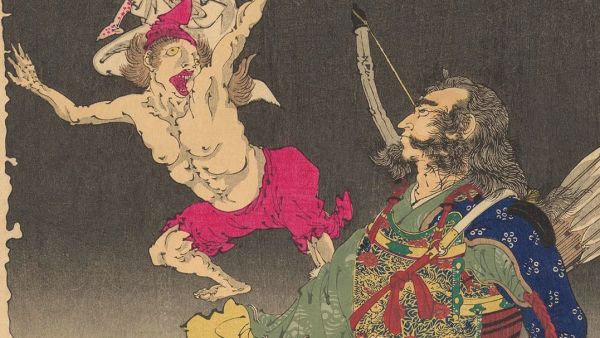
Tsukioka Yoshitoshi (artist)
Tokyo (Edo), Japan, 1839-1892
Sasaki Toyokichi (publisher)
Tokyo (Edo), Japan, active c.1855-1898
Tametomo's Ferocity Drives Away the Smallpox Demons, 1890
from the series Thirty-six Ghosts and Strange Apparitions
Woodblock print
The samurai Minamoto no Tametomo is reputed to have had both a savage character and almost supernatural powers: his left arm, for example, was longer than his right, making him a mighty archer. Following his involvement in the Hōgen rebellion (1156), he was exiled to Okinawa. When smallpox, perceived as a predominantly Western virus, threatened the island, Tametomo’s reputation and fierce stance was supposed to have scared away the away the demons of disease.
Purchased through the Library Endowment Trust, 2022
Print Collection, Archives and Special Collections
2022.0009
-
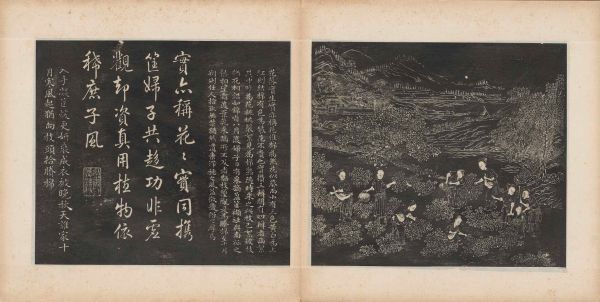
Fang Guancheng (compiler)
Anhui, China, 1698-1768
The Imperially Inscribed Illustrations of Cotton, c.1770-1795
Stone rubbing
These stone rubbings, presented in unusual concertina format, display illustrations with corresponding descriptions about the production of cotton in China. Fang Guancheng, the governor-general of the Zhili metropolitan region, made the images and some of the text, but further poetic additions were contributed by Emperor Qianlong. Each intricately carved image and accompanying words conveys an idealised depiction of pastoral life, focusing on each step in the cotton-making process from sowing seeds to dyeing the finished textile.
Rare East Asian Collection, Archives and Special Collections
UniM Bail SpC/EA gf 8136 Y264
-
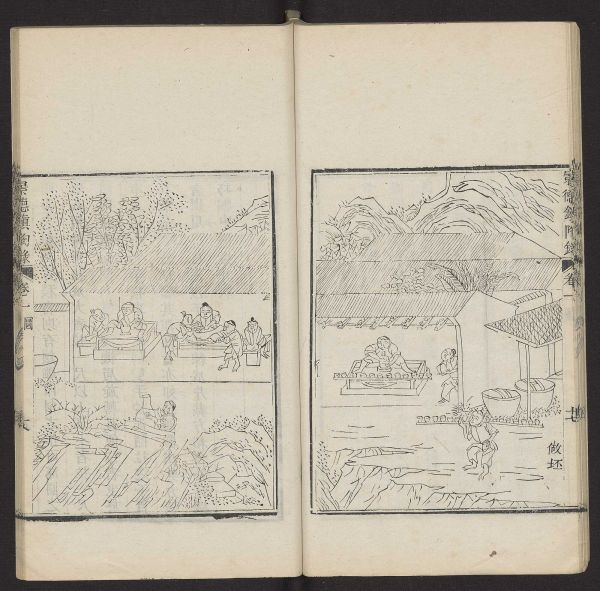
Lan Pu
Jiangxi, China, d.1796
The Potteries of China, 1891
Woodblock imprint
China: unknown publisher
Known as the country’s ‘Porcelain Capital’, Jingdezhen had a long-held reputation for producing the finest porcelain in imperial China. This book was compiled by Lan Pu, a local scholar. It records the history of the city, information about the porcelain manufacturing process (including the purchase of the ingredients and the sale of the final products), as well as an introduction to renowned kilns elsewhere throughout Chinese history.
Rare East Asian Collection, Archives and Special Collections
UniM Bail SpC/EA 8560 L432
-
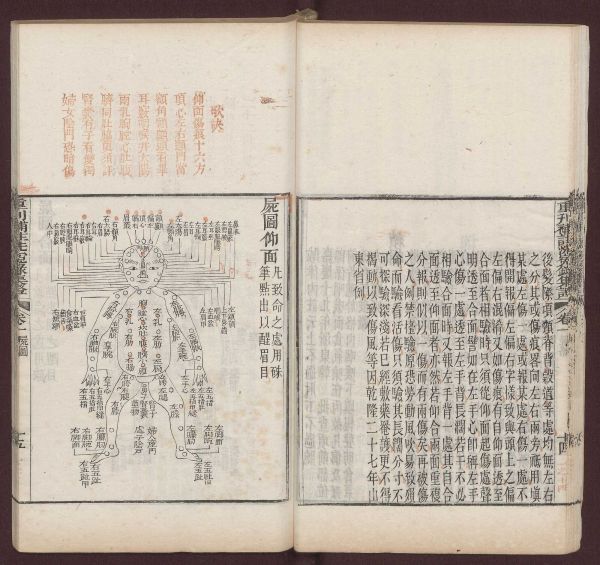
Song Ci
Chinese 1186-1249
The Commentary on Collected Cases of Injustice Rectified, 1872
Woodblock color printing
This is the first ever systematically written book of forensic science in the world. It was compiled from evidence based on many historical cases, as well as the personal experiences of the author, who served as provincial judicial commissioner in Guangdong, Jiangxi, Guangxi, and Hunan, in charge of penal and prison affairs. The earliest extant print edition is from the Yuan Dynasty. This Qing Dynasty edition was supplemented and annotated by contemporary officials like Ruan Qixin and Wang Youhuai, whose judicial experiences were also incorporated into the edition.
Purchased through the Garlick Memorial Trust, 2022
Rare East Asian Collection, Archives and Special Collections
UniM Bail SpC/EA RA1063.4 WANG 1872
-
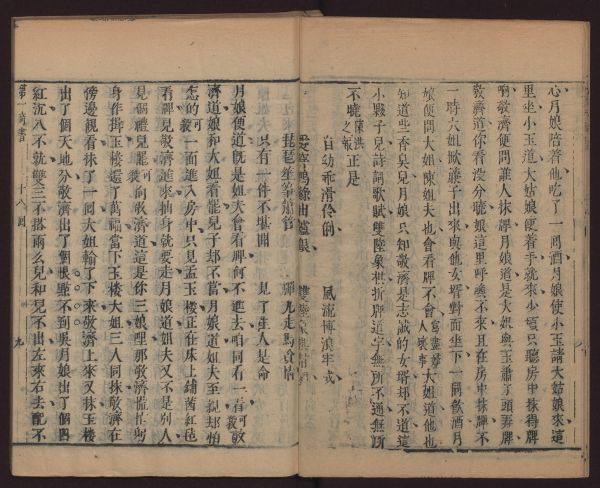
Lanling Xiaoxiaosheng (pseudonymous author)
China, active c.1596-1610
Zhang Zhupo (commentator)
Jiangsu, China, 1670-1698
The Plum in the Golden Vase, 1695
Woodblock imprint
China: Hall of the Crane Chirping in the Marsh
Described as “the most marvellous book” by the famous Qing book commentator Zhang Zhupo, The Plum in the Golden Vase was one of the most controversial novels in imperial China. It was revolutionary in its use of everyday language, its structure and content. It was circulated as a partial manuscript as early as 1596, and amazed contemporary literati, who competed to read the new chapters. However, its authorship is still a mystery, probably due to its explicit and excessive sexual content, still shocking despite an easing of social norms and Confucian ideology during the late Ming dynasty.
Rare East Asian Collection, Archives and Special Collections
UniM Bail SpC/EA 5758 T814