Medicine and forensics
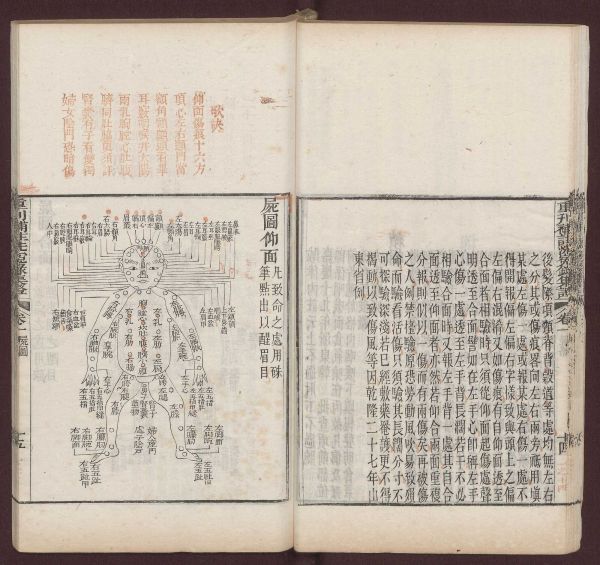
In 1247 Song Ci produced the world’s first book on forensic science, displayed here. Published four centuries before a European manual on the subject, Collected Cases of Injustice Rectified set standards for the use of medicine and entomology to solve crimes, and exerted profound influence not only in China, but also in neighbouring countries. Notably, it was exported directly from China to Japan, and was in popular use there for several centuries.
One explanation as to the early maturity of forensic science in China was that the state-sanctioned legal system did not subscribe to supernatural causes for crime or disease. Confucian scholars were traditionally sceptical of religion, despite its acceptance by the wider population, including many medical practitioners, whose techniques were held to have originated from wu, or shamans.
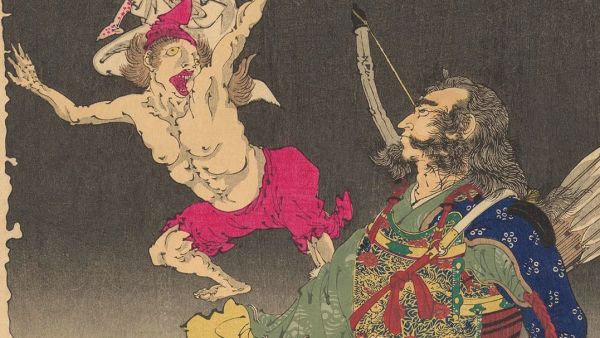
Excavated evidence suggests that in early Chinese medicine, illness was associated with demons, and magic was required to exorcise it: a belief shared in many traditions. For example, the Japanese woodblock print on the wall to your left illustrates the samurai Minamoto no Tametomo (1139-1170), whose preternatural skill with a bow reputedly scared away the demons of smallpox from the island of Okinawa, and whose name was invoked as a means of warding off the disease.
Read more about Chinese medicine in Contradictory Images of Indigenous Medical Practices in Chinese Historical Books: The Example of Guangxi.
-
Tsukioka Yoshitoshi (artist)
Tokyo (Edo), Japan, 1839-1892
Sasaki Toyokichi (publisher)
Tokyo (Edo), Japan, active c.1855-1898
Tametomo's Ferocity Drives Away the Smallpox Demons, 1890
from the series Thirty-six Ghosts and Strange Apparitions
Woodblock print
The samurai Minamoto no Tametomo is reputed to have had both a savage character and almost supernatural powers: his left arm, for example, was longer than his right, making him a mighty archer. Following his involvement in the Hōgen rebellion (1156), he was exiled to Okinawa. When smallpox, perceived as a predominantly Western virus, threatened the island, Tametomo’s reputation and fierce stance was supposed to have scared away the away the demons of disease.
Purchased through the Library Endowment Trust, 2022
Print Collection, Archives and Special Collections
2022.0009
-
Song Ci
Chinese 1186-1249
The Commentary on Collected Cases of Injustice Rectified, 1872
Woodblock color printing
This is the first ever systematically written book of forensic science in the world. It was compiled from evidence based on many historical cases, as well as the personal experiences of the author, who served as provincial judicial commissioner in Guangdong, Jiangxi, Guangxi, and Hunan, in charge of penal and prison affairs. The earliest extant print edition is from the Yuan Dynasty. This Qing Dynasty edition was supplemented and annotated by contemporary officials like Ruan Qixin and Wang Youhuai, whose judicial experiences were also incorporated into the edition.
Purchased through the Garlick Memorial Trust, 2022
Rare East Asian Collection, Archives and Special Collections
UniM Bail SpC/EA RA1063.4 WANG 1872