Art and the Merchant Classes
According to the Analects, “Confucius seldom spoke about profit”. Those who discussed revenue before righteous behaviour he classified as villains. This principle had a marked impact on Chinese society, leading to the inferior social status of merchants. It wasn’t until the Song dynasty that positive portrayals of merchants in literature became more common. By the mid-to-late Ming dynasty, interaction between merchants and the educated classes had become normalised, as demonstrated by the two Chinese landscape scrolls displayed here.
As a professional artist rooted in the prosperous city of Suzhou, Qiu Ying’s paintings were targeted at an audience of wealthy merchants. Motifs like misty mountains, lofty pavilions, and solitary hermits, which traditionally appealed to the literati, became popular among the mercantile classes as a means of demonstrating their cultural capital.
This handscroll was commissioned by Wang Tingne (1573-1619), a successful businessman. Wang advertised his wealth and taste through this depiction of the grand beauty of his private garden. The fact that the scroll was executed as a woodblock print suggests that it was intended for mass-production and profit.
Read more information about Chinese paintings in Immersive Visit to a Garden: Visual Logic of the ‘Garden of the Jade Surrounded Hall’.
-
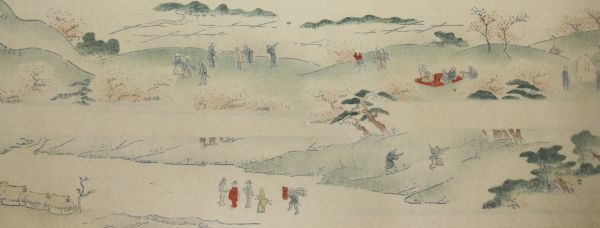
Kitao Masayoshi (Kuwagata Keisai) (artist)
Tokyo (Edo), Japan, 1764-1824
Kobayashi Mohē(engraver)
Japan, active c.1785
Guide to Fifty Famous Edo sites, 1785
Woodblock print
Meisho zue–illustrations of famous places–emerged in seventeenth century Japan as a response to the relaxation of restrictions on travel. Unlike travel prints and guidebooks, which displayed scenes of individual sites or portraits of people encountered along the way, meisho zue took a holistic approach, depicting panoramic landscapes occupied by scenes of human activity. This enabled audiences to gain both knowledge of the topography of a site and to understand daily life in its geographic context. Masayoshi, a representative artist of this new genre, sketched the townscape of Edo (now Tokyo) with fifty colour illustrations in this magnificent scroll, conveying the prosperity of the city and the enjoyable lifestyle of its citizens.
Purchased through the Garlick Memorial Trust, 2022
Rare East Asian Collection, Archives and Special Collections