Petty Talks
Vernacular narratives were generally excluded from the Masters category of the Si Ku Quan Shu. Logically, they belong to the subcategory xiaoshuo: petty talks, or novels. In Treatises on Arts and Letters, the earliest extant bibliography of the Book of Han (82 BCE), xiaoshuo was viewed as an inferior and trivial genre, but nevertheless still worth studying as a means for rulers to understand public sentiment. Over time, the subcategory came to comprise a broad range of topics, including ghost stories, jokes, anecdotes, and witty remarks, published for an educated audience who saw value in them thanks to the succinct, literary style in which they were written.
During the Tang and Song dynasties vernacular short stories flourished and were well-received by the general populace; by the Ming and Qing dynasties, longer, chaptered, works like The Plum in the Golden Vase–the first Chinese vernacular novel focusing on everyday life–enjoyed great esteem. However, texts like this were labelled by Confucian scholars as vulgar, or even obscene, and were generally excluded from contemporary bibliographies. From a modern perspective, while works such as these might be classified as literature, bibliographers of the time failed to allocate vernacular fiction to a category at all.
-
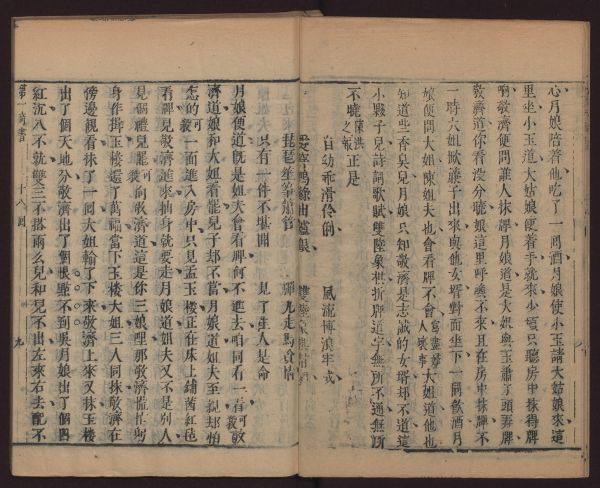
Lanling Xiaoxiaosheng (pseudonymous author)
China, active c.1596-1610
Zhang Zhupo (commentator)
Jiangsu, China, 1670-1698
The Plum in the Golden Vase, 1695
Woodblock imprint
China: Hall of the Crane Chirping in the Marsh
Described as “the most marvellous book” by the famous Qing book commentator Zhang Zhupo, The Plum in the Golden Vase was one of the most controversial novels in imperial China. It was revolutionary in its use of everyday language, its structure and content. It was circulated as a partial manuscript as early as 1596, and amazed contemporary literati, who competed to read the new chapters. However, its authorship is still a mystery, probably due to its explicit and excessive sexual content, still shocking despite an easing of social norms and Confucian ideology during the late Ming dynasty.
Rare East Asian Collection, Archives and Special Collections
UniM Bail SpC/EA 5758 T814