Literature 集部
The concept of literature in ancient China was not monolithic, and the popularity of certain genres rose and fell over time. For example, poetry, which ‘articulates what the mind is intent upon’, was more highly valued than lyrics, which articulate private sentiments. Genres like drama and vernacular fiction were completely left out of the Si Ku Quan Shu, and were only re-classified as important when the modern canon of traditional Chinese literature was reconfigured under Western influence in the early twentieth century.
The history of early publishing in China was rife with complications, such as the difficulties inherent in transmitting texts, and destructive wars during dynastic successions. Literary production was exposed to further hurdles: anthologies of literature were often complied posthumously by students, friends, family members, or later admirers of the author, who tended to filter out works they saw as inappropriate for their image. Additionally, works of literature were regularly subject to political censorship. To the compilers of the Si Ku Quan Shu, ‘people in ancient China did not gain fame from literary composition’, and therefore little effort was made to preserve their works. It is estimated that less than one in ten literary works from the early period has survived to the present day.
Key Objects
-
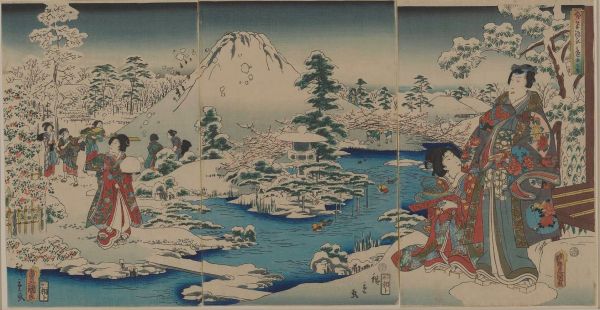
Utagawa Kunisada (artist)
Tokyo (Edo), Japan, 1786-1865
Utagawa Hiroshige II (artist)
Tokyo (Edo), Japan, 1829-1869
Sagamiya Tokichi (publisher)
Tokyo (Edo), Japan, active c.1855-1866
Snow in the Garden, 1859
from the series Genji by Collaborating Brushes
Woodblock print
Following the success of his illustrations for A Rustic Genji and A Modern Collection of Genji, Kunisada collaborated with Hiroshige to create even more sumptuous Genji themed imagery; Kunisada (best known for his kabuki prints) executed the figures, and Hiroshige (famous for landscapes) the scenery. Artistic collaborations like this one were not uncommon during this period: government censorship was on the rise, and popular projects such as this were generally undertaken as a means of demonstrating solidarity between artists. The triptych depicts Genji on the right panel with his consort, while in the distance servants play in the snow, constructing a replica of Mt Fuji. The emphasis here is on the beauty of the season rather than illustrating a specific episode from Tanehiko’s Rural Genji, which also features snowball scenes.
Purchased through the Library Endowment Trust, 2022
Print Collection, Archives and Special Collections
2022.0010.001, 2022.0010.002, 2022.0010.003
-
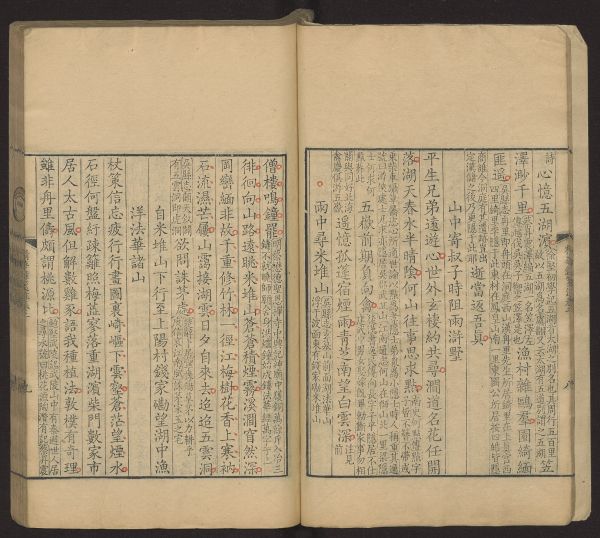
Wang Shizhen (author)
Shandong, China, 1634-1711
Jing Rong (annotator)
China, active c.1710-1734
Annotations to Selected Works of Yuyang Shanren, 1712
Woodblock imprint
China: Flying Phoenix Hall
One of the most well-known poets during the early Qing dynasty, Wang Shizhen’s fame was established during the Kangxi era (1654-1722), when the ‘extensive learning and great literary talent’ exam was held in Beijing, around 1678. His poems were renowned for their graceful and restrained aesthetics. Nevertheless, this beautifully printed anthology, a selection of Wang’s best poem and prose works, suffered from censorship as it was prefaced by poet and politician Qian Qianyi (1582-1664), whose works was banned by the government.
Rare East Asian Collection, Archives and Special Collections
UniM Bail SpC/EA f 5461 C890
-
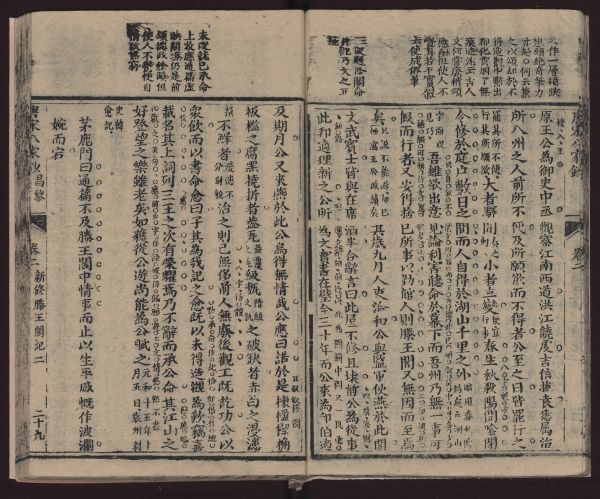
Han Yu, et al.
Henan, China, 768-824
Commentaries on Works of the Eight Great Prose Masters of the Tang and Song dynasties, 1835
Woodblock imprint
Unknown publisher
Works of the Eight Prose Masters was the anthology complied by Mao Kun (1512-1601). After their lifetimes, the works of these masters were recognized as representing one of the highest achievements of Chinese prose writing and deemed as essential readings for young scholars who dreamt of passing the imperial exams. Mao compiled the anthology in response to a competing contemporary advocacy that scholars should learn prose composition from pre-Qin period authors. Due to its widespread popularity, the anthology was re-printed and commented on many times after its compilation.
Rare East Asian Collection, Archives and Special Collections
UniM Bail SpC/EA 5237.4 P560
-
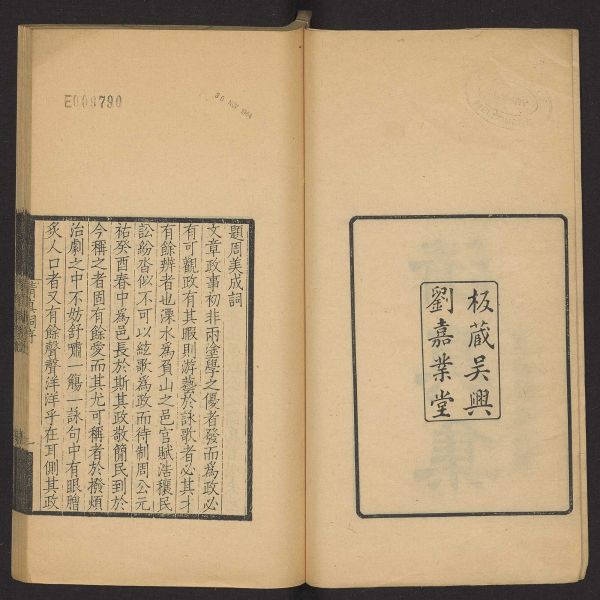
Zhou Bangyan
Zhejiang, China, 1056-1121
Slivers of Jade, n.d.
Woodblock imprint
Printed with blocks collected by Jiaye Hall
Slivers of Jade is an anthology of lyrics–a poetic format which flourished during the Song dynasty, and which was intended for performance by singers–by well-known literati Zhou Bangyan. Zhou’s lyrics were renowned for their careful craftsmanship, subtle nuances of feeling, and for being eminently singable. He was particularly skilled at composing his own tunes, and his competence as a musician was officially recognized through his close involvement with the Bureau of Music .
Rare East Asian Collection, Archives and Special Collections
UniM Bail SpC/EA 5599 C750
-
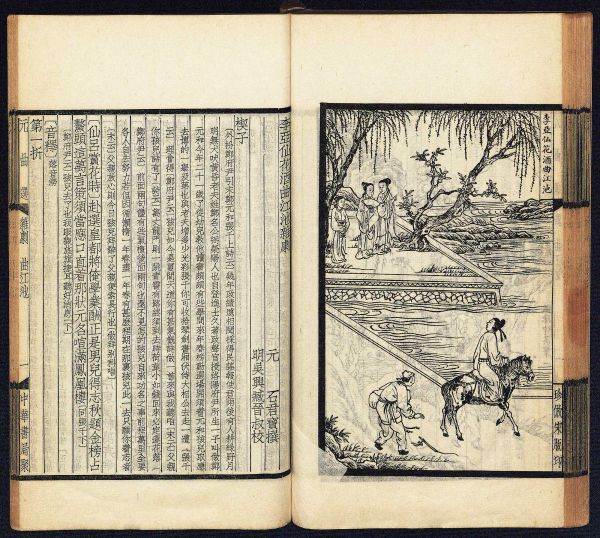
Zang Maoxun (compiler)
Zhejiang, China, 1550-1620
Selected Plays from the Yuan Dynasty, c.1927-1936
Woodblock imprint
Shanghai: Zhonghua Book Company
Imperial exams were cancelled during the Yuan dynasty, after Kublai Khan’s conquest of the Song dynasty and the institution of Mongol rule in 1271. Seeking another form of recognition, scholars instead devoted themselves to writing zaju, one of the major forms of Chinese drama. Unfortunately, no contemporary manuscripts have survived. Completed in 1615 by Zang Maoxun, a dramatist himself, Selected Plays is the most well-known anthology of Yuan drama. It contains one hundred works, which accounts for approximately two-thirds of the Yuan plays that are still extant. Rich illustrations were added to further attract increasingly literate audiences in the seventeenth century.
Harry Simon Collection, donated by the Asia Institute, 2009
Rare East Asian Collection, Archives and Special Collections
UniM Bail SpC/EA Harry Simon 5665 T242
-
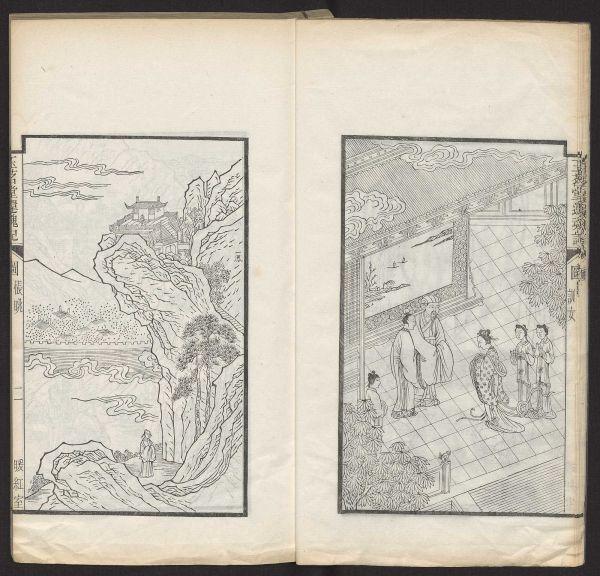
Tang Xianzu
Jiangxi, China, 1550-1616
The Peony Pavilion, 1914
Woodblock imprint
China: Nuanhong Studio of Liu (Shiheng)
This Ming dynasty drama was adapted from earlier sources and tells the story about the sixteen-year-old Du Liniang encountering a stranger, the scholar Liu Mengmei, in the dream she experiences during a stroll in the family garden in spring. She pines away and dies of lovesickness, but is subsequently resurrected with the help of the real Liu. Originally written for staging as Kunqu opera, one of the traditional theatre arts, its perfect integration of lyricism, musicality, choreography–as well as its resonance among young, and especially female, audiences–made it one of the most successful dramas in Chinese history.
Harry Simon Collection, donated by the Asia Institute, 2009
Rare East Asian Collection, Archives and Special Collections
UniM Bail SpC/EA Harry Simon 5686 H310
-
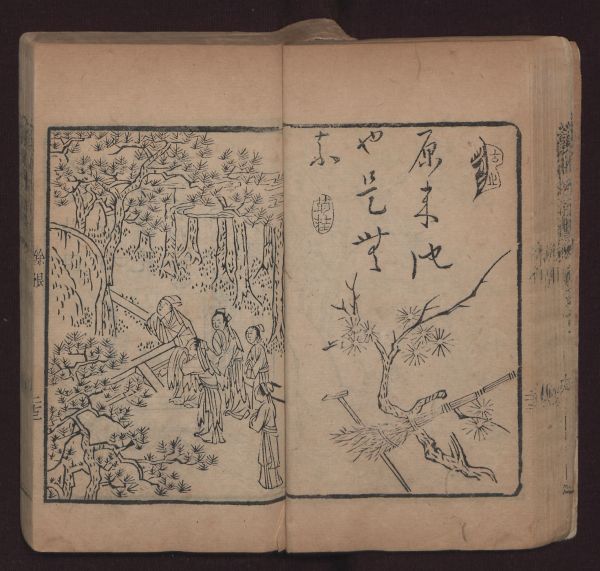
Gao Ming
Zhejiang, China, c.1305-1371
Illustrated Tale of the Pipa, 1735
Woodblock imprint
China: unknown publisher
Adapted from historical stories and earlier works, this Yuan dynasty drama was highly praised by Ming emperor Zhu Yuanzhuang, as it encouraged fidelity and filial piety. It tells the story of heroine Zhao Wuliang, who cared for her in-laws when her husband, Cai Bojie, went to the capital for the imperial exam and re-married there upon graduation. After the death of the in-laws during famine, Zhao travels to the capital to reunite with her husband, making a living on her journey by playing the pipa (lute) along the way.
Rare East Asian Collection, Archives and Special Collections
UniM Bail SpC/EA 5676 P110M
-
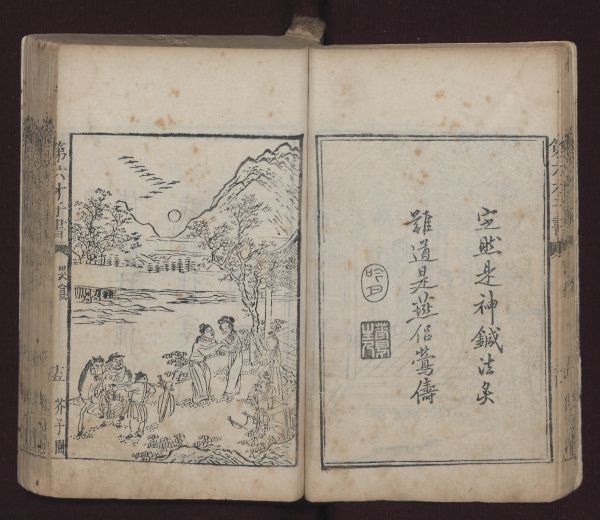
Wang Shifu
Beijing, China, c.1260-1336
Romance of the Western Chamber, 1720
Woodblock imprint
China: printed with blocks collected by the Mustard Seed Garden
A Yuan dynasty (1271-1368) adaptation of The Story of Yingying–a Tang dynasty tale–Romance of the Western Chamber is one of the most well-known Chinese love stories. The plot revolves around a young couple, Zhang Sheng (Scholar Zhang) and Cui Yingying, who have a love affair without parental approval, and whose activities are therefore labelled as immoral and licentious. The Tang and Yuan versions have different endings, reflecting a shift in audiences: in the Tang tale, Zhang abandons Cui, as elopement was scorned by the upper classes amongst whom the tale circulated. In the Yuan drama, the couple get married, such happy endings were much more popular among the general public, who were the primary consumers of the period.
Rare East Asian Collection, Archives and Special Collections
UniM Bail SpC/EA 5668 H100C1