Drama
Traditionally, most Confucian scholars joined the civil service through participation in the Imperial examinations. However, during the Yuan dynasty (1271-1368), under Mongolian rule, the examinations were abolished, and scholars lost this pathway to advancement. Their talents were therefore redirected towards the emerging literary genre of vernacular lyrics and drama.
The great success of drama at this time, and throughout the subsequent Ming and Qing dynasties, was not accidental. It held a calculated appeal for its target audience: an increasingly literate general populace, in particular women. Additionally, thanks to a greater emphasis on material culture during the Ming dynasty, books became more affordable and accessible.
Despite their popularity, successive governments had conflicting attitudes toward dramas: on one hand, they were encouraged for their didactic value, the Illustrated Tale of the Pipa, for instance, praised fidelity and filial piety, and was endorsed by the Ming Emperor Zhu Yuanzhang (1328-1398). On the other, the ruling class and their Confucian officials were wary of the genre’s power to transform existing social customs. For example, The Peony Pavilion, which advocated free love, especially for women, was censored and labelled as obscene by the Qing dynasty.
Read more information about illustrated Chinese drama in Text and Picture: Wen 文 and Tu 图 in Chinese Culture.
-
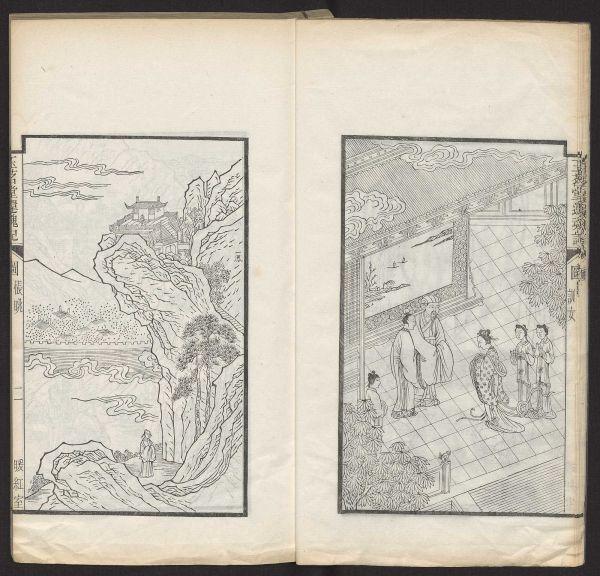
Tang Xianzu
Jiangxi, China, 1550-1616
The Peony Pavilion, 1914
Woodblock imprint
China: Nuanhong Studio of Liu (Shiheng)
This Ming dynasty drama was adapted from earlier sources and tells the story about the sixteen-year-old Du Liniang encountering a stranger, the scholar Liu Mengmei, in the dream she experiences during a stroll in the family garden in spring. She pines away and dies of lovesickness, but is subsequently resurrected with the help of the real Liu. Originally written for staging as Kunqu opera, one of the traditional theatre arts, its perfect integration of lyricism, musicality, choreography–as well as its resonance among young, and especially female, audiences–made it one of the most successful dramas in Chinese history.
Harry Simon Collection, donated by the Asia Institute, 2009
Rare East Asian Collection, Archives and Special Collections
UniM Bail SpC/EA Harry Simon 5686 H310
-
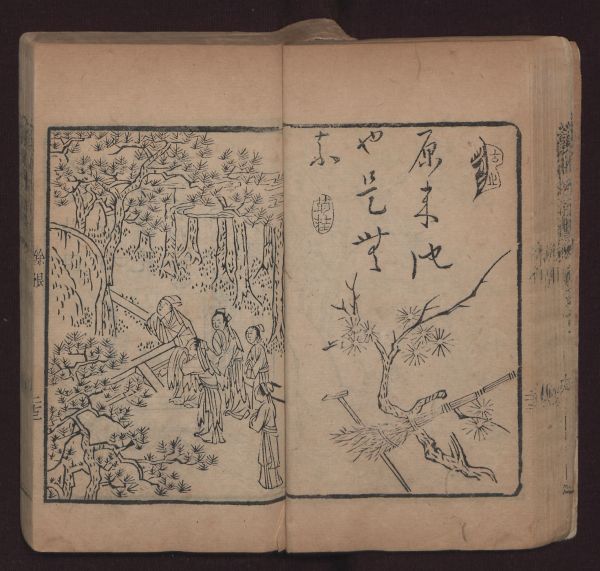
Gao Ming
Zhejiang, China, c.1305-1371
Illustrated Tale of the Pipa, 1735
Woodblock imprint
China: unknown publisher
Adapted from historical stories and earlier works, this Yuan dynasty drama was highly praised by Ming emperor Zhu Yuanzhuang, as it encouraged fidelity and filial piety. It tells the story of heroine Zhao Wuliang, who cared for her in-laws when her husband, Cai Bojie, went to the capital for the imperial exam and re-married there upon graduation. After the death of the in-laws during famine, Zhao travels to the capital to reunite with her husband, making a living on her journey by playing the pipa (lute) along the way.
Rare East Asian Collection, Archives and Special Collections
UniM Bail SpC/EA 5676 P110M
-
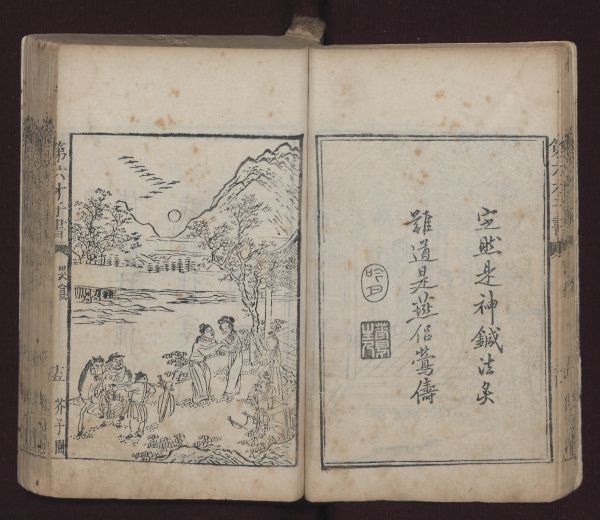
Wang Shifu
Beijing, China, c.1260-1336
Romance of the Western Chamber, 1720
Woodblock imprint
China: printed with blocks collected by the Mustard Seed Garden
A Yuan dynasty (1271-1368) adaptation of The Story of Yingying–a Tang dynasty tale–Romance of the Western Chamber is one of the most well-known Chinese love stories. The plot revolves around a young couple, Zhang Sheng (Scholar Zhang) and Cui Yingying, who have a love affair without parental approval, and whose activities are therefore labelled as immoral and licentious. The Tang and Yuan versions have different endings, reflecting a shift in audiences: in the Tang tale, Zhang abandons Cui, as elopement was scorned by the upper classes amongst whom the tale circulated. In the Yuan drama, the couple get married, such happy endings were much more popular among the general public, who were the primary consumers of the period.
Rare East Asian Collection, Archives and Special Collections
UniM Bail SpC/EA 5668 H100C1