Malcolm Fraser in the Cold War
The Cold War, in the shape of the ideological, political and military world-wide contest between liberal capitalism and communism, was fundamental to Fraser’s early career. Indeed, he asserted several times that the threat of communism drove him into politics, and this preoccupation is borne out in the early records.
Although Fraser was not overtly political until his return from Oxford, his father’s influence in this area is clear. John Neville Fraser was involved in clandestine anti-communist movements in the Western District after they moved there in 1943. These political links assisted Fraser in his preselection in 1953 for the Liberal Party. He won his second election campaign in 1955 following the anti-communist split in the Labor Party, with the Anti-Communist Labor Party candidate preferencing Fraser over the Labor candidate.
In Fraser’s preselection speech, delivered on 11 November 1953, he declared that anti-communism and his devotion to Australia were his core motivating politics; “One is the complement of the other & each provides market for the other.”
That Fraser viewed the Cold War largely through the lens of what impact it might have on Australia is shown in his attitude to China, and to the Vietnam War. He believed that China was a threat to Australia equivalent to the Soviet Union and the Vietnam War was a sign of that danger. His “cold war warrior” attitude was confirmed by his ardent support for the Vietnam War as Minister for the Army (1966-68) and Minister for Defence (1969-71).
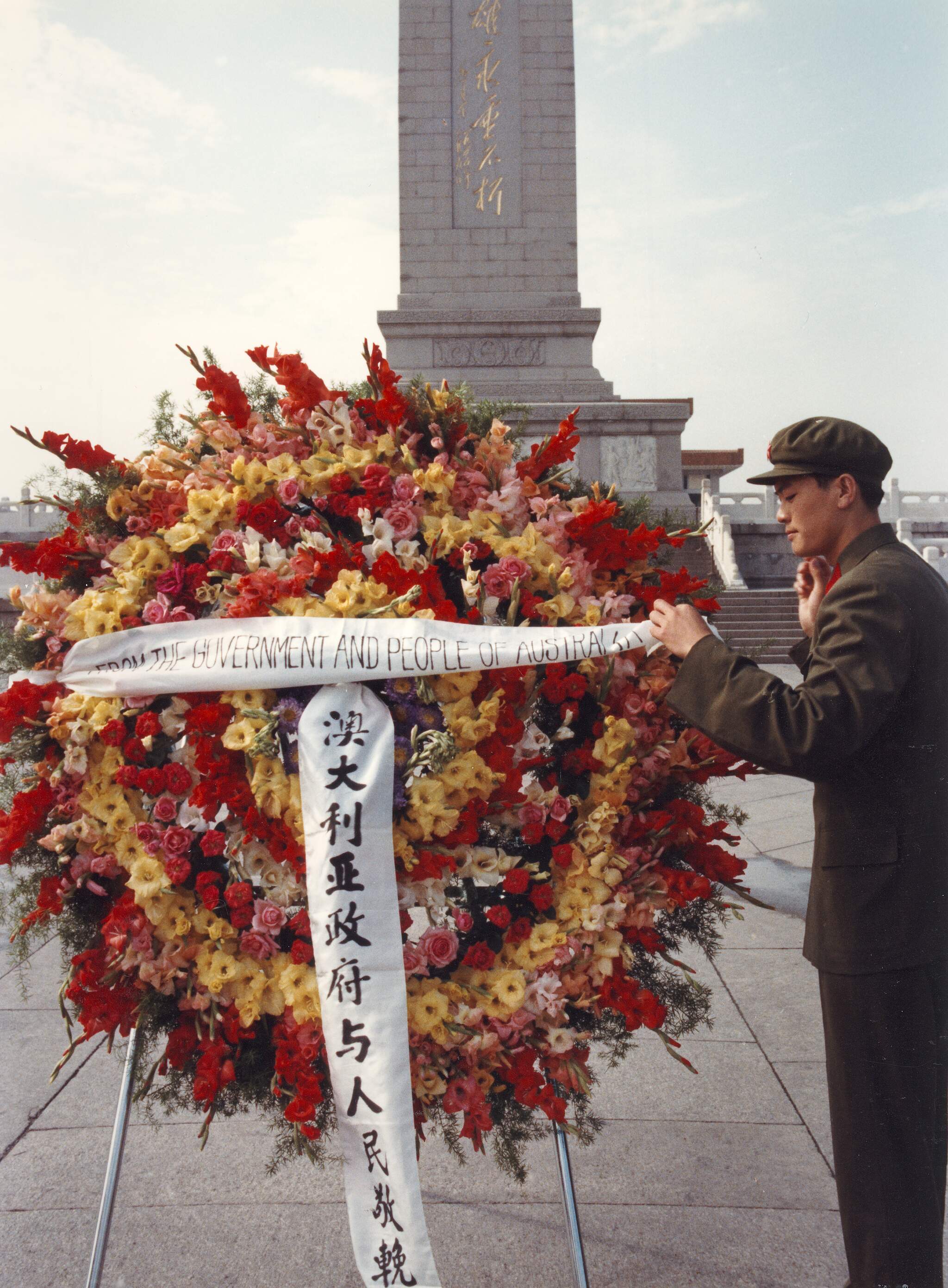
The ideological battle was eventually tempered by support for pragmatic engagement with China following his return to the backbench, a shift that would remain for his years as Leader of the Opposition. As Prime Minister he continued Whitlam’s policy of engagement. Indeed, Fraser was the first Prime Minister of Australia to use his first official overseas engagement to visit Japan and China rather than traditional allies Britain and the United States. Australia became the first country to implement a bilateral aid agreement with China, and Fraser established the Australia-China Council in 1978.
The Cold War also featured during Fraser’s Prime Ministership. Following the USSR invasion of Afghanistan in 1979, Fraser sought to offer military support to the US and supported the boycott of the 1980 Moscow Olympic games. There were also numerous discussions about US use of Australian defence facilities, and regional surveillance support, found in the National Archives’ cabinet papers.
The research guide below gives a sample of the records that can be used to understand Fraser’s role in the Cold War. For more records, search the featured collection for keywords such as Vietnam, China, communist/communism and so on.
References
ABC News, “Documents reveal Australia’s cold War concerns”, 2011
Malcolm Fraser and Margaret Simons, Malcolm Fraser: The political memoirs, The Miegunyah Press, 2010.
Margaret Simons Interview recordings
UMA-ITE-2019010900159 includes discussion of Soviet Union and the Cold War.
UMA-ITE-2019010900104 includes discussion of the threat of the Cold War and Fraser’s becoming Minister for the Army.
UMA-ITE-2019010900173 includes a discussion of Menzies’ view on the Communist Party Dissolution Bill
Electorate correspondence
UMA-ITE-2005010702056 Includes letters from Malcolm Fraser outlining views on Australian government’s policy on Rhodesian independence, as well as several copies of 'On Target: A Weekly Commentary on the Cold War
InterAction Council
The InterAction Council was established in 1983 to bring former heads of state or government together to “foster international co-operation and action”. Fraser was the co-chairman of the Council from 1998 to 2005. The papers held by UMA thus date from just a few years after the fall of the Soviet Union, thus many of the speeches and articles explore the question of what would replace the bi-polar international order. These are two examples, but the born-digital records are fully text-searchable on the catalogue.
UMA-ITE-2020004700416 Includes various speeches and articles from former world leaders, including this one by Mikhail Gorbachev “New Global Politics for a Changing World’
See more at the series InterAction Council Annual Plenary Meetings 2020.0047, including speeches by Fraser.
Electorate Talks
UMA-ITE-2007002300298, The comparison of governments, 1954
UMA-ITE-2007002300356, The Hungarian Uprising, 1957
UMA-ITE-2007002300385, Indonesia, 1958
UMA-ITE-2007002300433, Red China, 1959
UMA-ITE-2007002300432, Communism, 1959
UMA-ITE-2007002300442, Peace Conference (World Peace Council), 1959
UMA-ITE-2007002300421, Events in Tibet, 1959
UMA-ITE-2007002300419, Australians and Asia, 1959
UMA-ITE-2007002300467, Dissent from the Summit, 1960
UMA-ITE-2007002300028, Events at Home and Abroad, 1961
UMA-ITE-2007002300184 SE Asia and the World Power Struggle, 1964
UMA-ITE-2007002300182, Relations with Indonesia, 1964
UMA-ITE-2007002300150, International affairs, South-East Asia and Communism, 1964
Other talks
Liberal Democracies: Challenge and Response, Delivered at Beyond '84: The 1985 London Conference on Communism and Liberal Democracy at the Royal Garden Hotel, London - Wednesday 20 March 1985
The World We Live In – 1984, Stanley Burbury Lecture Theatre, University of Tasmania - Thursday 12 July 1984
UMA-ITE-2007000800020, Interview with the Financial Review, 1973, Relating to industrial relations, union movement, industrial democracy, communism etc
First Parliamentary Speech on International Affairs, 15 March 1956 (Hansard)
Subject files
UMA-ITE-2007002300577, Subject files: China and Communism 1965-70
UMA-ITE-2015016500214, Reference file: Australian Communist Party & ACP Act 1950 (including Dixon's Judgment 1951), 1950-51
UMA-ITE-2006001500042, General correspondence maintained as leader of the Opposition, file S