Travel
Before the fifteenth century, travel in China was a privilege belonging to the ruling classes. Their journeys were not purely for the purpose of sight-seeing, but more often for research: to gain empirical knowledge of an area, or to record its produce and local customs. This resulted in the publication of gazetteers, or directories, such as the Records of Chang’an, which provided scholarly descriptions of historical sites. By the middle to late Ming dynasty (mid-fifteenth to the early seventeenth century), thanks to eased social controls, a greater proportion of the population began to gain more leisure time, allowing them to travel more freely and engage in tourism.
Later in the seventeenth century, under the Tokugawa Shogunate (1603-1868) Japan’s centuries-old restriction on travel was relaxed. Consequently, a large urban populace began to embrace art and literature that celebrated journeying. Utagawa Hiroshige, for instance, revitalized the decaying ukiyo-e tradition with tender, lyric landscapes like Rain over Nihonbashi.
-
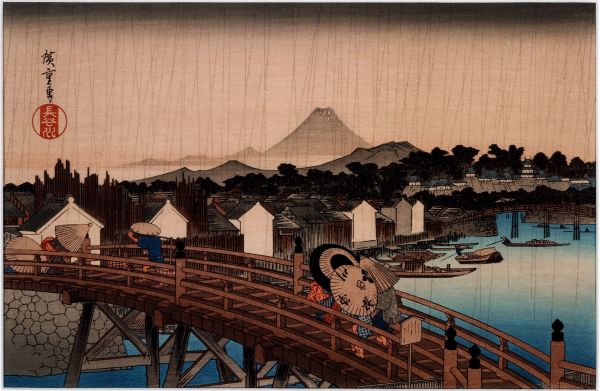
Utagawa Hiroshige (artist)
Tokyo (Edo), Japan, 1797-1858
Sanoya Kihei (Kikakudo) (publisher)
Tokyo (Edo), Japan, active c.1800-1875
Rain Over Nihonbashi, c.1832-1836
from the series Famous Places in the Eastern City
Woodblock print (nishiki-e)
Hiroshige is venerated as the last great master of ukiyo-e printmaking and is the figurehead for later artists who emulated his style. Rain over Nihonbashi captures the spontaneity of everyday life, showing travellers caught in a shower crossing the Nihonbashi River. Hiroshige conveys the essence of the weather, human motion, and the beauty of the natural environment despite the rigid limitations of the woodcutting process. In the background, the famous landmarks Mt Fuji and Edo castle offer further attractions for the viewer.
University of Melbourne Art Collection
0000.0828
-
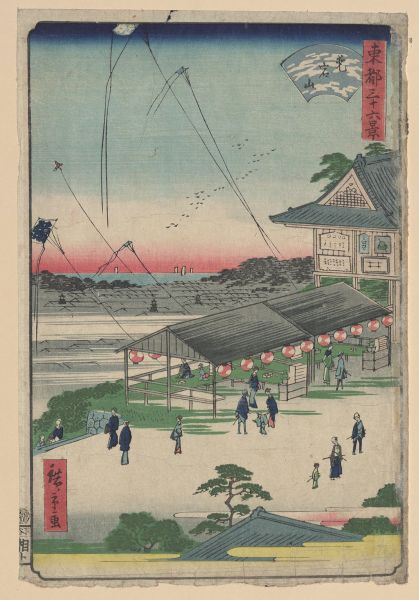
Utagawa Hiroshige II (artist)
Tokyo (Edo), Japan, 1829-1869
Sagamiya Tôkichi (Ai-To) (publisher)
Tokyo (Edo), Japan, active c.1855-1866
Mount Atago, 1861-1862
from the series Thirty-six views of the Eastern Capital
Woodblock print (nishiki-e)
Born Suzuki Chinpei and changing his name to Shigenobu during his apprenticeship, the artist we know as Hiroshige II inherited his teacher and adopted father’s name following the latter’s death in 1858. In his woodcuts, Hiroshige II reflected the compositional elements of his teacher, such as unusual viewpoints, as in this image, in which we survey the scene as if from a rooftop. The inclusion of kites and lanterns in this print suggests a festival, perhaps celebrating the New Year.
Gift of Dr J. Orde Poynton, 1959
Print Collection, Archives and Special Collections
1959.6070
-
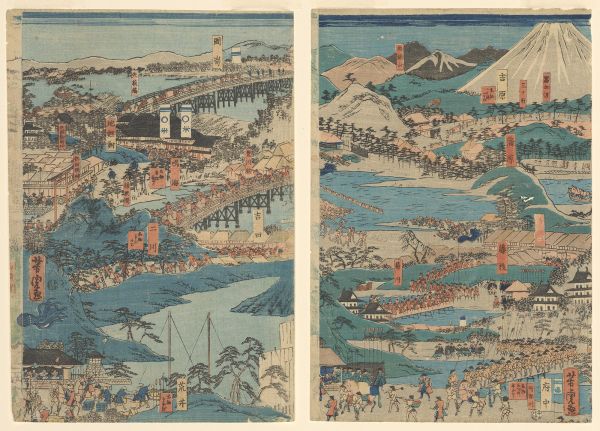
Utagawa Yoshitora (artist)
Tokyo (Edo), Japan, active c.1836-1887
Daikokuya Kinnosuke (Kinjirô) (publisher)
Tokyo (Edo), Japan, active c.1863-1875
Famous Places on the Tokaido Road, c.1864
Woodblock print (nishiki-e)
These two woodcuts are part of a dodecaptych, or a print made up of twelve individual sheets, which together show sights along the road between Edo (now Tokyo) and Kyoto. These prints follow the work of another artist of the Utagawa school, Hiroshige, who made a series of 53 prints of the Tokaido Road after his 1832 journey. These coastal scenes were instantly popular and created a new genre of landscape and travel art; many artists produced pictures from the Tokaido road which could be purchased by travellers and admirers eager for a record of these scenes.
Gift of Lesley Kehoe and Kaneko Noriaki, 2021
Print Collection, Archives and Special Collections
2021.0010.001; 2021.0010.002