History 史部
The compilation of histories has been a long-standing tradition in China, instituted during the pre-Qin period in order for rulers to learn from the past and perpetuate their reign. From the Han period, when a new dynasty was established, the new government would typically sponsor the compilation of the history of the superseded dynasty, which was then labelled as the official narrative. This process was used to defend the legitimacy of each new dynasty.
Outside the court, histories were compiled by private scholars. These complement the official narratives, although their degree of credibility was known to vary too. The Honest History of the Yongli Era (1646-1683), retains valuable records from the Ming-Qing transition that were otherwise deliberately missed out in the official History of Ming (1368-1644), which was sponsored by the Qing government.
A prominent subcategory of History was Geography. The practice of compiling geographic books was not only beneficial for state administrative governance, but also for military purposes and establishing territorial authority. The Comprehensive Geography of the Great Qing Dynasty (1686-1842), for instance, was edited several times after its initial publication to reflect expanding territory and the changing of prefectures due to population growth.
Key objects
-
Utagawa Hiroshige (artist)
Tokyo (Edo), Japan, 1797-1858
Sanoya Kihei (Kikakudo) (publisher)
Tokyo (Edo), Japan, active c.1800-1875
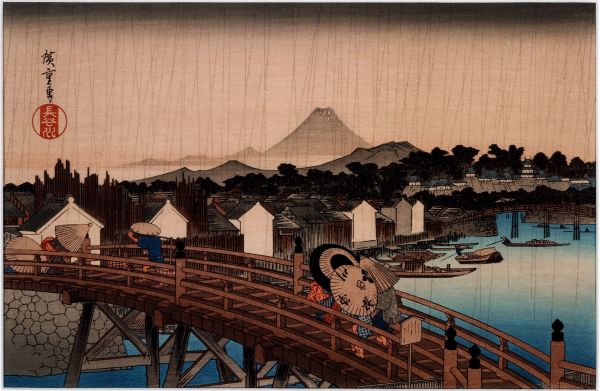
Rain Over Nihonbashi, c.1832-1836
from the series Famous Places in the Eastern City
Woodblock print (nishiki-e)
Hiroshige is venerated as the last great master of ukiyo-e printmaking and is the figurehead for later artists who emulated his style. Rain over Nihonbashi captures the spontaneity of everyday life, showing travellers caught in a shower crossing the Nihonbashi River. Hiroshige conveys the essence of the weather, human motion, and the beauty of the natural environment despite the rigid limitations of the woodcutting process. In the background, the famous landmarks Mt Fuji and Edo castle offer further attractions for the viewer.
University of Melbourne Art Collection
0000.0828
-
Utagawa Hiroshige II (artist)
Tokyo (Edo), Japan, 1829-1869
Sagamiya Tôkichi (Ai-To) (publisher)
Tokyo (Edo), Japan, active c.1855-1866
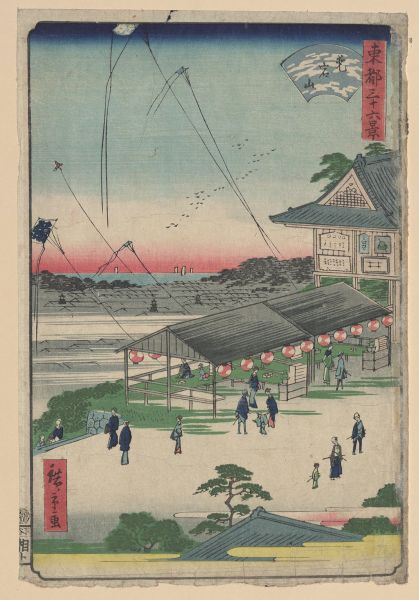
Mount Atago, 1861-1862
from the series Thirty-six views of the Eastern Capital
Woodblock print (nishiki-e)
Born Suzuki Chinpei and changing his name to Shigenobu during his apprenticeship, the artist we know as Hiroshige II inherited his teacher and adopted father’s name following the latter’s death in 1858. In his woodcuts, Hiroshige II reflected the compositional elements of his teacher, such as unusual viewpoints, as in this image, in which we survey the scene as if from a rooftop. The inclusion of kites and lanterns in this print suggests a festival, perhaps celebrating the New Year.
Gift of Dr J. Orde Poynton, 1959
Print Collection, Archives and Special Collections
1959.6070
-
Utagawa Yoshitora (artist)
Tokyo (Edo), Japan, active c.1836-1887
Daikokuya Kinnosuke (Kinjirô) (publisher)
Tokyo (Edo), Japan, active c.1863-1875
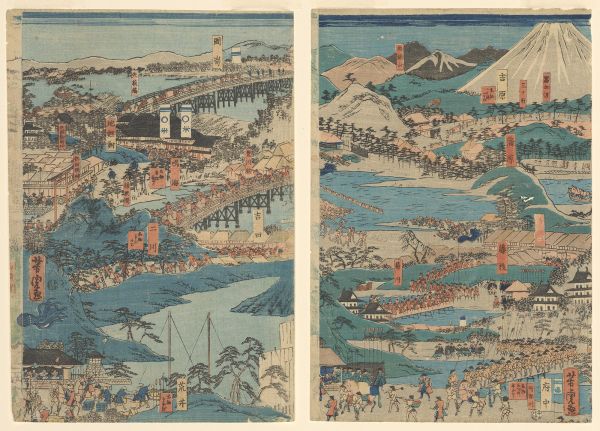
Famous Places on the Tokaido Road, c.1864
Woodblock print (nishiki-e)
These two woodcuts are part of a dodecaptych, or a print made up of twelve individual sheets, which together show sights along the road between Edo (now Tokyo) and Kyoto. These prints follow the work of another artist of the Utagawa school, Hiroshige, who made a series of 53 prints of the Tokaido Road after his 1832 journey. These coastal scenes were instantly popular and created a new genre of landscape and travel art; many artists produced pictures from the Tokaido road which could be purchased by travellers and admirers eager for a record of these scenes.
Gift of Lesley Kehoe and Kaneko Noriaki, 2021
Print Collection, Archives and Special Collections
2021.0010.001; 2021.0010.002
-
Xu Jiyu
Shanxi, China, 1795-1873
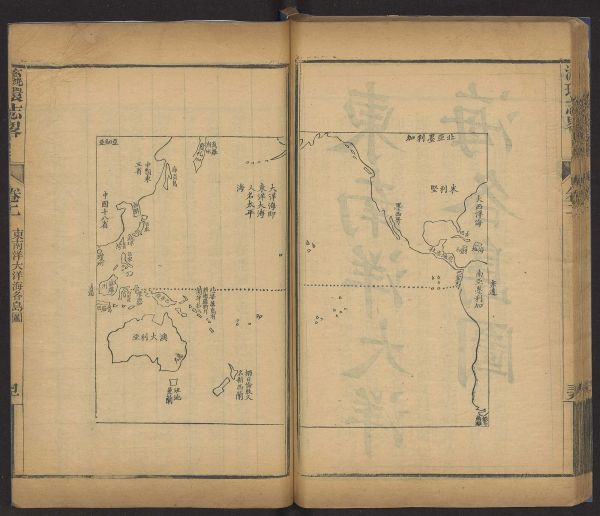
A Short Account of the Maritime Circuit, 1866
Woodblock imprint
China: printed with the blocks collected by the Minstry of Foreign Affairs of the Qing Dynasty, originally written in 1848; revised in 1866
Jiyu Xu was part of the Westernisation movement arising in China after the First Opium War in 1848. He was a ranking government official and geographer during the late Qing dynasty, dropping in and out of power in the period between 1850-1869 as the political landscape changed. Convinced China needed to learn from the West in order to consolidate its place in world affairs, in A Short Account of the Maritime Circuit, Xu gathered information garnered from Westerners while living in port towns in Fujian Provence. The book systematically describes world geography and includes many maps. Despite his intention to strengthen China’s political fortunes through his writing, Xu’s works found more influence overseas, particularly in Japan, than they did at home.
Rare Books Collection, Archives and Special Collections
UniM Bail SpC/BX f 912 XU
-
Unknown artist
Chinese
The complete map of the capital of Canton, c.1870
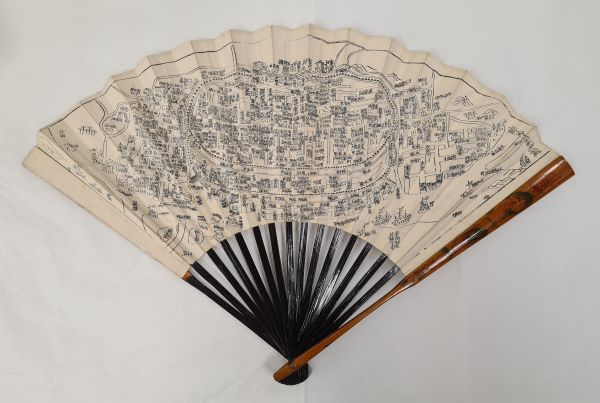
Canton (now Guangzhou) was one of the first Chinese port cities opened to foreign merchants; from the eighteenth century onwards, Cantonese artisans produced folding fans for export to Europe as ‘China trade’ items. These embellished fans, usually made of scented wood or ivory, and decorated with landscapes or flowers, were especially popular among the European upper classes. The lacquered bamboo used in this fan, however, would have required significantly less complicated manufacturing and cheaper materials to produce, indicating that it was probably intended for sale to a less affluent market. However, unlike other known extant fan maps from the era, which often show coloured charts of Imperial China, this monochrome map is unusual in that it depicts the inner city of Canton.
Purchased through the Garlick Memorial Trust, 2022
Rare East Asian Collection, Archives and Special Collections
NK4870 COMP 1870 CHI
-
Wei Shou
Hebei, China, 506-572
Book of Wei, 1956
Photoprint
Taipei: Twenty-five Dynastic Histories Compilation House
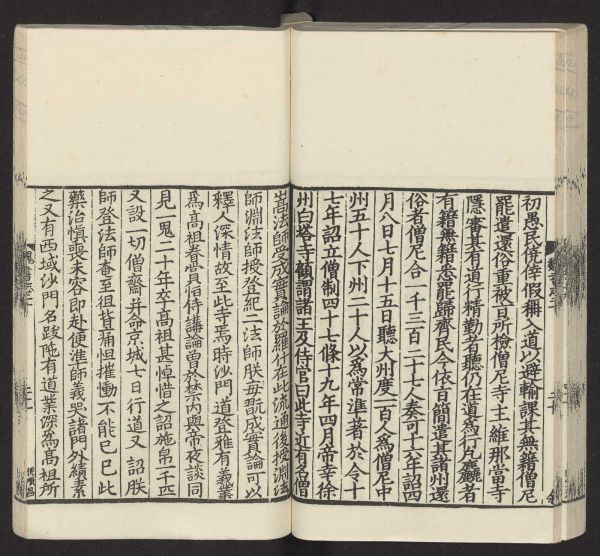
One of the twenty-five officially sanctioned Chinese dynastic histories, the Book of Wei is the first extant history dedicated to nomadic minorities. It retains historical materials from the fourth to the sixth centuries relating to Northern Wei, a regime originating in Xianbei, a nomadic state located in modern-day Mongolia. Reflecting the growing popularisation of Buddhism, the Book of Wei also included the Treatise on Buddhism and Daoism. This 1956 edition was produced as a seventieth birthday gift to Chiang Kai-shek, then President of the Republic of China.
Donated by Mr Jiang Jiadong, 1979
Rare East Asian Collection, Archives and Special Collections
UniM Bail SpC/EA 2455.25 J245 v.273
-
Chen Shou
Sichuan, China, 233-297
Records of the Three Kingdoms, 1670
Woodblock imprint
Kyoto: Fushimiya Uemura Tōemon: Akitaya Yamamoto Heizaemon
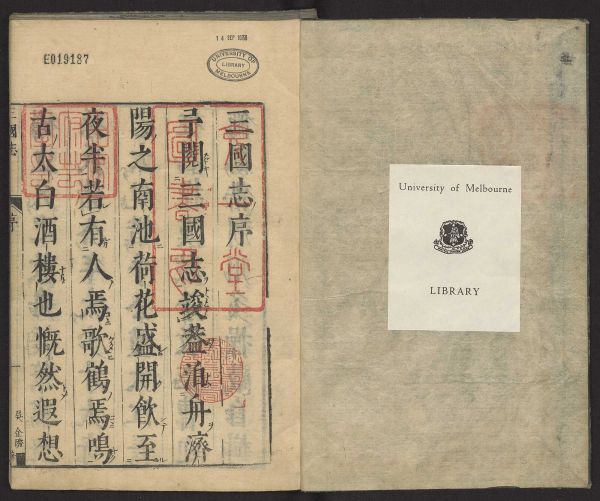
Edo Japan (1603-1867) saw the publishing industry flourish, and with it an increase in literacy among the general population. The ruler Tokugawa Ieyasu (1543-1616), founder of the Tokugawa Shogunate, encouraged cultural activities and education. He employed Hayashi Razan (1583-1657), a Japanese Neo-Confucian philosopher, as his adviser, whose goal was to popularise Chinese classics among the general populace. To accomplish this, books were initially imported from China, but this made them prohibitively expensive. It was therefore decided to reprint Chinese classics in Japan in order to maintain low costs. Among the Chinese books reprinted during this period, the official dynastic history Records of the Three Kingdoms, and the later Romance of the Three Kingdoms–a novel adapted from the history–enjoyed enduring popularity and impact in Japan.
Rare East Asian Collection, Archives and Special Collections
UniM Bail SpC/EA 2560 C774a