Confucian Stone Rubbings
Confucius (c.551-479 BCE) is regarded as one of the most prominent thinkers of Chinese history, whose politics and philosophy has had a profound influence on the country for more than two thousand years. No contemporary portrait of Confucius is recorded, but this image–attributed to the famed Wu Daozi–depicting the philosopher as a wise old man with clasped hands became the recognisable prototype for future depictions. This rubbing was made from a stele, or marker, at the Temple of Confucius in Qufu, Shandong Province–Confucius’ birthplace. The temple features hundreds of stelae which share the philosopher’s teachings; impressions such as this, made by rubbing ink over paper held to the stone, were used to spread Confucianism as widely as possible.
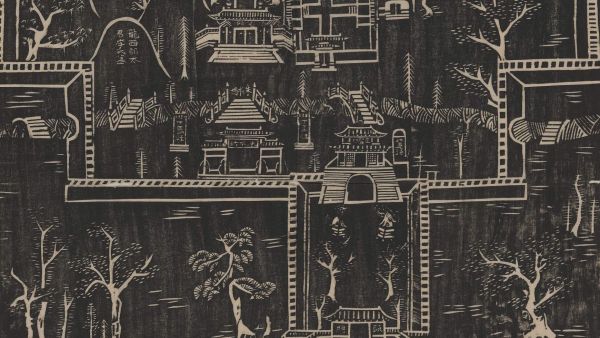
In his final years, Confucius returned to his hometown; this was perhaps the period during which he composed texts such as the Analects, which traces the events of his life. He had gained many disciples by this time, among whom Yan Hiu (c.521-481 BCE), depicted to your left, was ranked as first. Confucius is buried in his family’s cemetery, located approximately two kilometres north of the temple, along with some of his disciples and thousands of his descendants.
Read more information about Confucian stone rubbings in Traces of Confucianism through stone rubbings.
-
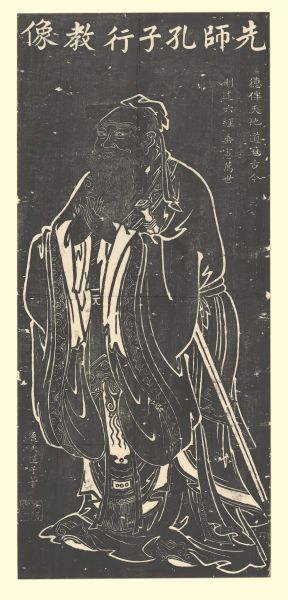
Daozi Wu (Attributed artist)
Chinese 689-759
Praising the greatness of Ancient Master Confucius' teaching
c.1912-1949
Stone rubbing
There is no contemporary portrait of Confucius recorded, however, this image which depicts the philosopher as a wise old man with hands clasped, has become a recognisable prototype. The rubbing was made from a stele or marker, at the Temple of Confucius, Qufu, Shandong Province. The Temple features hundreds of stelea which share the teachings of Confucius and impressions made by ink rubbing have the ability to spread Confucianism more broadly.
Harry Simon Collection, donated by the Asia Institute in 2009
Rare East Asian Collection, Archives and Special Collections
UniM Bail SpC/EA Harry Simon, 6178 W631
-
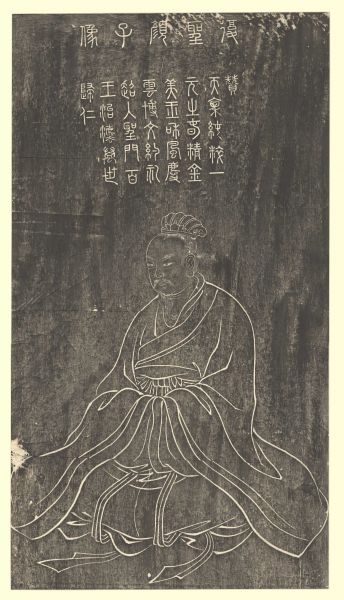
Unknown Artist
Chinese
Portrait of Yan Hui
c.1912-1949
Stone rubbing
This portrait depicts Yan Hui (c. 521–481 BCE) a disciple of Confucius who ranked as number one of the 72 disciples. While he is seated in this rendering, another image shows Yan Hui as a small figure walking behind the Master, perhaps as an active representation of the transference of teachings. Yan Hui was from the same province as Confucius who mourned his early death.
Harry Simon Collection, donated by the Asia Institute in 2009
Rare East Asian Collection, Archives and Special Collections
UniM Bail SpC/EA Harry Simon, 6178 F210
-
Unknown Artist
Chinese
The Confucius Family Cemetery
c.1912-1949
Stone rubbing
This rubbing shows the Confucius family cemetery, located approximately two kilometres north of the Temple of Confucius at Qufu. In his final years Confucius returned to his hometown, by this stage he had gained many disciples and perhaps it was also the time when he worked on his famous texts, such as the Analects which traces his life. Confucius is buried in this cemetery, along with some of his disciples and thousands of his descendants.
Harry Simon Collection, donated by the Asia Institute in 2009
Rare East Asian Collection, Archives and Special Collections
UniM Bail SpC/EA Harry Simon, 6178 C112
-
Unknown Artist
Chinese
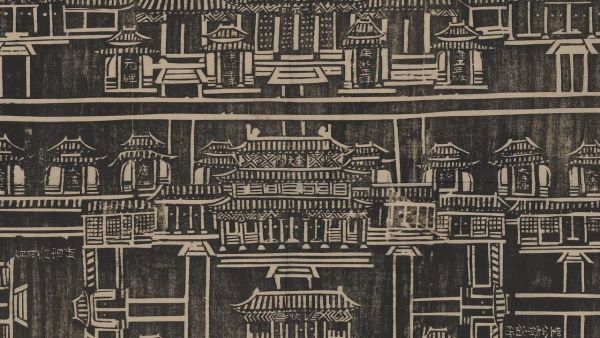
The Temple of Great Master Confucious
c.1912-1949
Stone rubbing
Shortly after his death, a temple was built to venerate Confucius at the site of his family home in Qufu. Progressively over the centuries, the Temple changed and evolved as more buildings were replaced and added. The rubbing shows how the temple complex is organised from a central axis and includes 460 rooms and nine courtyards. As the eye moves up the sheet, it encounters the largest building Dacheng Hall or the Hall of Great Perfection at the heart of the site.
Harry Simon Collection, donated by the Asia Institute in 2009
Rare East Asian Collection, Archives and Special Collections
UniM Bail SpC/EA Harry Simon, 6178 C112M