Classics 经部
The Classics category of the Si Ku Quan Shu mainly consists of Confucian books and Xiaoxue, an overarching label for works of grammatology, phonology, and exegesis. The latter were included because it was thought that understanding the literal meaning of Chinese characters was essential for later scholars to appreciate the ideas of Confucius, especially as the language evolved over time.
The Confucian canon has been subject to significant change. During the Western Han Dynasty (202 BCE-8 CE), it was claimed that Confucius had complied the Six Classics, comprising the books of Odes, Documents, Rites, Music, Changes, and Spring and Autumn Annals. The Book of Music was not extant by the time the canon was formed however, and the remaining texts became known as the Five Classics. These were later divided further into the Nine Classics, and became prescribed textbooks for Imperial examinations during the Tang Dynasty (618-907); in the Song Dynasty (960-1279), this became the Thirteen Classics and Four Books. At this time, the Book of Filial Piety was added to the Confucian canon: the emperor was hailed as the Father of the People, and the state was modelled on the familial unit. As the state ideology, Confucianism’s moral values were promoted in order to maintain social order, hierarchy, and sovereignty.
Key Objects
-
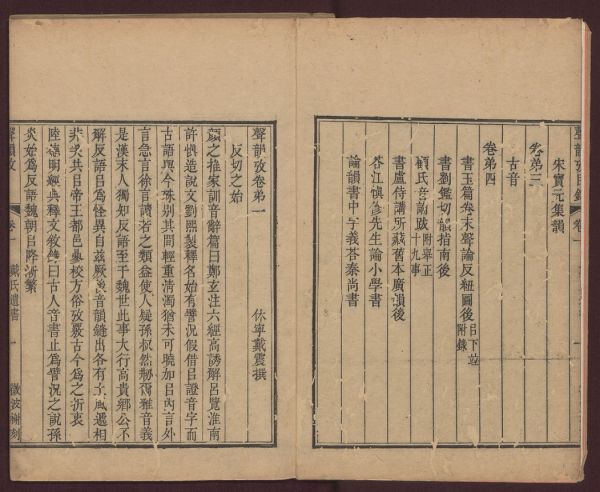
Gu Yanwu
Jiangsu, China, 1613-1682
Five Treatises on Phonology, 1643
Woodblock imprint
China: unknown publisher
Han Chinese scholar Gu Yanwu was revered for his loyalty to the fallen Ming Dynasty, and for his contribution to the empirical research method, which was one of the two major trends of scholarship in the eighteenth and early nineteenth centuries. Five Treatises on Phonology is a representative work of this method; it aimed at recovering lost poetic rhythms from extant Confucian classics. The work also had political implications too; Gu believed that educated government officials could work more harmoniously if they adopted a shared understanding of Confucianism. He sought to implement this by applying a uniform system of phonological pronunciations to the Confucian canon.
Rare East Asian Collection, Archives and Special Collections
UniM Bail SpC/EA 5120 K391
-
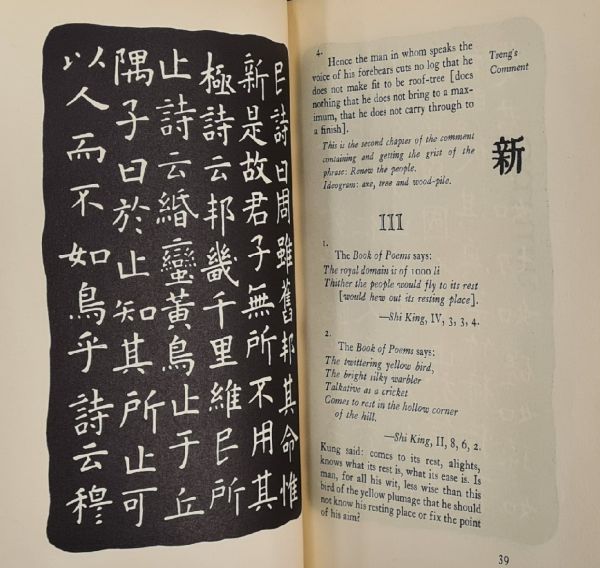
Pound, Ezra (translator)
United States of America, 1885-1908; England and Europe, 1908-1972
The Great Digest: and, The Unwobbling Pivot, 1952
London: Owen, 1952
Ezra Pound was given the notes of deceased academic Ernest Fenollosa in 1913 by his widow, Mary McNeil Fenollosa. These encouraged his interest in Chinese literature, particularly the writings of Confucius. Although Pound didn’t read Chinese well, he nevertheless undertook to translate works into English, often re-interpreting Confucian texts in a manner he felt would be more politically potent to modern Western audiences.
Rare Books Collection, Archives and Special Collections
UniM Bail SpC/ER 53A
-
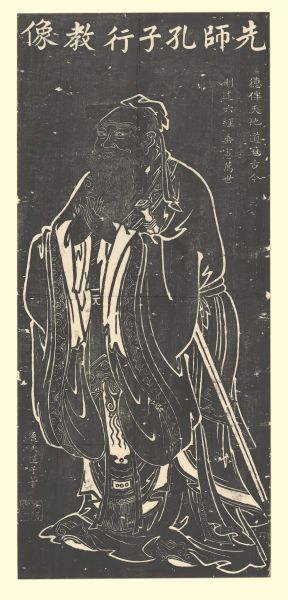
Daozi Wu (Attributed artist)
Chinese 689-759
Praising the greatness of Ancient Master Confucius' teaching
c.1912-1949
Stone rubbing
There is no contemporary portrait of Confucius recorded, however, this image which depicts the philosopher as a wise old man with hands clasped, has become a recognisable prototype. The rubbing was made from a stele or marker, at the Temple of Confucius, Qufu, Shandong Province. The Temple features hundreds of stelea which share the teachings of Confucius and impressions made by ink rubbing have the ability to spread Confucianism more broadly.
Harry Simon Collection, donated by the Asia Institute in 2009
Rare East Asian Collection, Archives and Special Collections
UniM Bail SpC/EA Harry Simon, 6178 W631
-
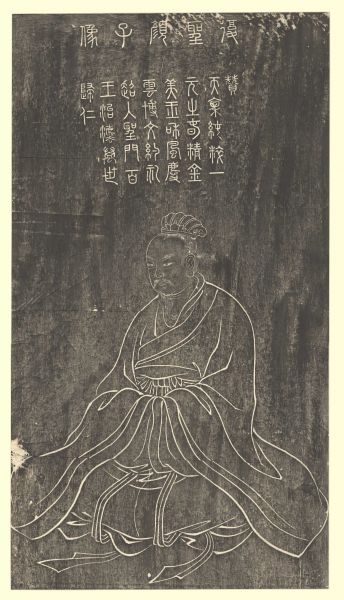
Unknown Artist
Chinese
Portrait of Yan Hui
c.1912-1949
Stone rubbing
This portrait depicts Yan Hui (c. 521–481 BCE) a disciple of Confucius who ranked as number one of the 72 disciples. While he is seated in this rendering, another image shows Yan Hui as a small figure walking behind the Master, perhaps as an active representation of the transference of teachings. Yan Hui was from the same province as Confucius who mourned his early death.
Harry Simon Collection, donated by the Asia Institute in 2009
Rare East Asian Collection, Archives and Special Collections
UniM Bail SpC/EA Harry Simon, 6178 F210
-
Unknown Artist
Chinese
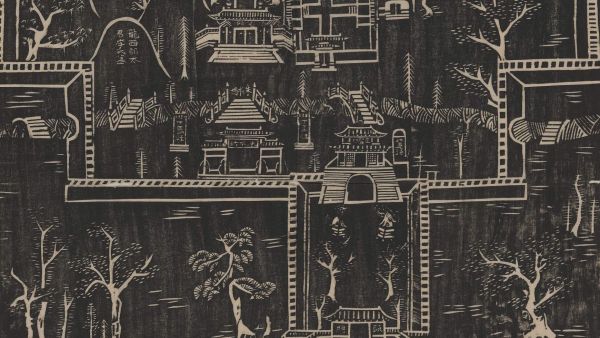
The Confucius Family Cemetery
c.1912-1949
Stone rubbing
This rubbing shows the Confucius family cemetery, located approximately two kilometres north of the Temple of Confucius at Qufu. In his final years Confucius returned to his hometown, by this stage he had gained many disciples and perhaps it was also the time when he worked on his famous texts, such as the Analects which traces his life. Confucius is buried in this cemetery, along with some of his disciples and thousands of his descendants.
Harry Simon Collection, donated by the Asia Institute in 2009
Rare East Asian Collection, Archives and Special Collections
UniM Bail SpC/EA Harry Simon, 6178 C112
-
Unknown Artist
Chinese
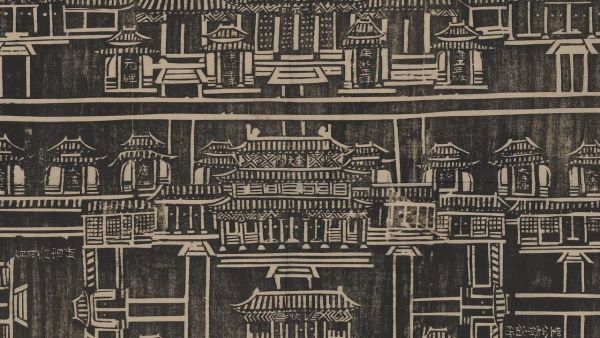
The Temple of Great Master Confucious
c.1912-1949
Stone rubbing
Shortly after his death, a temple was built to venerate Confucius at the site of his family home in Qufu. Progressively over the centuries, the Temple changed and evolved as more buildings were replaced and added. The rubbing shows how the temple complex is organised from a central axis and includes 460 rooms and nine courtyards. As the eye moves up the sheet, it encounters the largest building Dacheng Hall or the Hall of Great Perfection at the heart of the site.
Harry Simon Collection, donated by the Asia Institute in 2009
Rare East Asian Collection, Archives and Special Collections
UniM Bail SpC/EA Harry Simon, 6178 C112M