This page provides general information for University of Melbourne researchers on the open access policies of major external funders of Australian research.
ARC Open Access Policies
In March 2026, a new Open Access Policy was announced by the Australian Research Council (Version 2026.1). This new policy will apply to all ARC grant schemes that open for application on or after 1 July 2026, and also stipulates the following regarding different versions over time:
For Grant Agreements where the Grant Guidelines do not specify a version, version 2021.1 of the Policy applies.
For Grant Agreements where the Grant Guidelines specify a version of the Policy, the specified version applies.
The information below outlines both Version 2026.1 and Version 2021.1 of the policy. Please ensure you consult the relevant policy for your funding agreement.
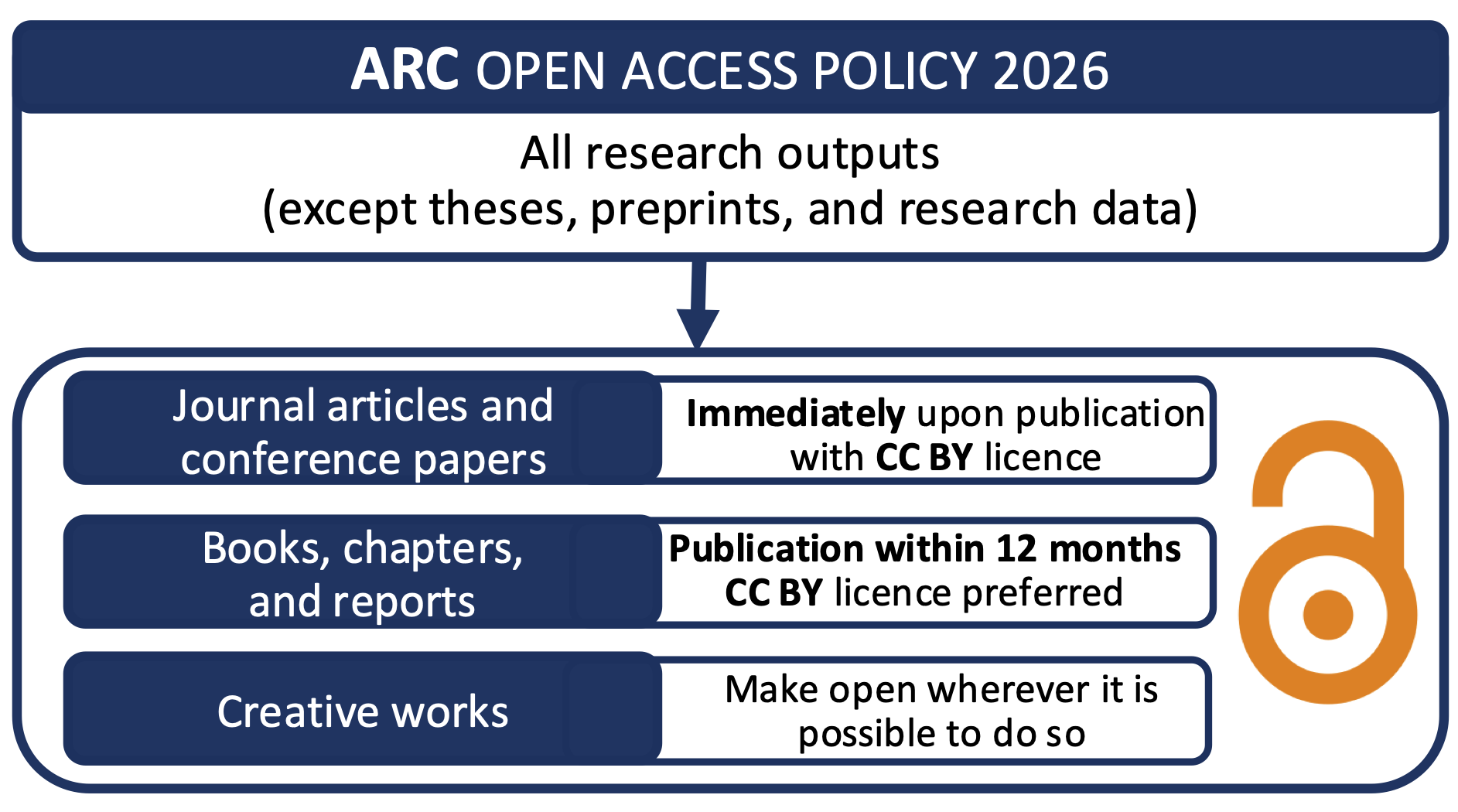
2026 ARC Policy Summary
Scope: This policy applies to all research outputs arising from ARC-funded research, including creative works that have undergone external review of an equivalent academic standard. The policy does not apply to preprints and comparable resources, or to research data.
- Journal articles and peer-reviewed conference papers must be made open access immediately on publication with a Creative Commons Attribution (CC BY) licence applied.
- Monographs, edited volumes, chapters and research reports must be made openly accessible within 12 months publication. A CC BY licence is recommended for these.
- Creative works are to be made openly accessible wherever it is possible to do so. A CC BY licence is recommended for these.
All research outputs must have a DOI. Metadata for all research outputs must be openly accessible in an institutional repository within three months from publication.
Version: The open access version must be either the final published version (Version of Record) or the Author Accepted Manuscript (AAM).
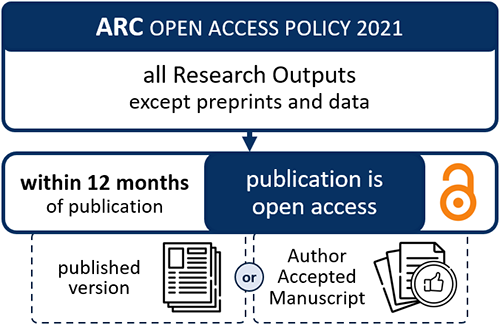
2021 ARC Policy Summary
Scope: All research outputs arising from ARC-funded research. The policy does not apply to preprints and comparable resources, or to research data.
Requirement: The research output must be open access within 12 months publication. Metadata for all research outputs must be openly accessible in an insitutional repository within three months from publication.
Licence: No specific licence is mandated, although a Creative Commons Attribution (CC BY) licence is encouraged.
Version: The open access version must be either the final published version (Version of Record) or the Author Accepted Manuscript (AAM).
Pathways to Compliance (ARC Open Access Policies)
There are various pathways to compliance with the 2021 and 2026 ARC Open Access Policies:
Route 1: Open access publishing (Version of Record open access)
There are two preferred pathways for achieving this, wherein the final published version is open access. These pathways apply to both versions of the ARC policy:
- Publish in an open access journal or with an open access publisher. This may require the payment of an Article Processing Charge (APC), Book Processing Charge (BPC), or Chapter Processing Charge (CPC). Many open access journals and book publishers do not levy fees for open access publishing. See our guidance on open access journals and publishers.
- Publish in a journal with which we have an open access publishing agreement. For example, publish in a journal covered by one of our Read and Publish agreements. Explore our open access publishing agreements.
Route 2: Repository open access (Author Accepted Manuscript open access)
There are different requirements here depending on the policy version. Please refer to the relevant detail below.
| 2021 Policy Requirements | 2026 Policy Requirements |
|---|---|
| An embargo period of 12 months or less is permitted. If a publisher requires an embargo longer than 12 months, consider negotiating a shorter embargo. Publishers’ default embargo periods can usually be found on their websites or in the Open Policy Finder. | Depositing the Author Accepted Manuscript (AAM) immediately in an open online repository with a CC BY licence (for journal articles or peer reviewed conference papers), or within twelve months for books and chapters. ARC recommends the inclusion of a rights retention statement in the submitted manuscript (see below). This will enable the immediate sharing of the peer-reviewed and revised AAM without embargo, under a CC BY licence. |
| If a research output cannot, or will not, be made openly accessible for any reason, an explanation must be provided in the Final Report. | In cases where a research output has not been, or will not be, made openly accessible within the required timeframe, the Final Report must also provide:
|
Guidance on depositing research in our institutional repository can be found on the Minerva Access website.
Although not a preferred pathway, paying a fee to publish open access in a hybrid venue is compliant with this policy. However, pursuit of this pathway and the payment of APCs/BPCs/CPCs is not required by the ARC and is discouraged by the University. Researchers are instead encouraged to explore other open access publishing or repository options.
Completing the ARC Final Report
To complete the ARC Final Report, researchers are required to identify the open access status of each output produced during the project.
Click here for guidance on how to complete this section in the ARC Final Report
NHMRC and MRFF Open Science Policy
The 2026 National Health and Medical Research Council (NHMRC) and Medical Research Future Fund (MRFF) open science policy requires full and immediate open access for research papers funded in full or in part by the NHMRC and/or MRFF. From 2 February 2026, the policy applies to all grants and scholarships awarded under NHMRC Funding Agreements or the MRFF grant agreements (Business Grants Hub-administered or NHMRC-administered).
NHMRC and MRFF Open Science Policy documents on the NHMRC website
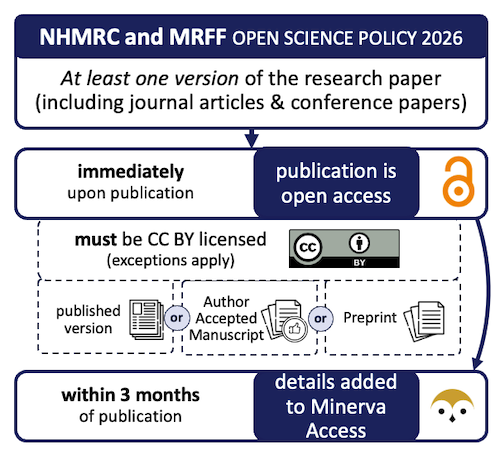
2026 NHMRC and MRFF Policy Summary
Scope: Research papers (including peer-reviewed journal articles and peer-reviewed conference papers) supported in whole or in part by the NHMRC or MRFF (Business Grants Hub-administered or NHMRC administered).
Requirement: The research paper must be open access immediately upon publication. No embargo is permitted. Metadata for all research outputs must be openly accessible in an insitutional repository within three months from publication.
Licence: A Creative Commons Attribution (CC BY) licence is required (exceptions apply).
Version: The open access version must be either the final published version (Version of Record), the Author Accepted Manuscript (AAM), or a preprint version made available in a publicly accessible archive or preprint server.
Pathways to Compliance (2026 NHMRC and MRFF Open Science Policy)
The following open access pathways are compliant with the 2026 NHMRC and MRFF Open Science Policy:
Route 1: Open access publishing (Version of Record open access)
There are two preferred pathways for achieving this, wherein the final published version is open access:
- Publish in an open access journal or venue. This may require the payment of an Article Processing Charge (APC). Note that many open access journals do not levy APCs. See our guidance on open access journals and publishers.
- Publish in a journal with which we have an open access publishing agreement. For example, publish in a journal covered by one of our Read and Publish agreements. Explore our open access publishing agreements. When submitting to a hybrid journal covered by an agreement, we recommend including a rights retention statement (see below). This will ensure immediate repository open access is possible if an agreement's publishing cap is reached or if the agreement is not renewed.
Route 2: Repository open access (Author Accepted Manuscript open access)
Depositing the Author Accepted Manuscript (AAM) immediately in an open online repository with a CC BY licence. Authors must include the NHMRC’s rights retention statement in their submitted manuscript (see below). This will enable the immediate sharing of the peer-reviewed and revised AAM without embargo, under a CC BY licence. Guidance on depositing research in our institutional repository can be found on the Minerva Access website.
Route 3: Preprints made open access in a publicly accessible archive or preprint server.
NHMRC and MRCC encourage the posting of preprints of all manuscripts with a CC BY licence in a publicly accessible archive or preprint server (including but not limited to arXiv, Peer J Preprints, or F1000 Research). This ensures the content is accessible and provides versioning options when linking later to the Version of Record (if applicable). Our preprints page provides further information.
The NHMRC discourages the payment of APCs to publish open access in hybrid journals not part of an institutional open access publishing agreement. Although it technically fulfils the policy's open access requirements, it goes against the spirit of the policy (see the FAQ below).
Author Rights Retention
Rights retention allows authors to share their peer-reviewed research openly without embargo.
By including rights retention statements in submitted manuscripts, authors can openly license their peer-reviewed and revised Author Accepted Manuscripts (AAMs). This allows AAMs to be shared in an open access repository without embargo. This strategy is typically used for journal articles and conference papers.
Both the ARC and NHMRC recommend the use of rights retention statements when submitting to a subscription or paywalled venue when pursuing the Repository open access pathways (see above).
The statements below allow authors to assert sharing rights over their peer-reviewed and revised Author Accepted Manuscripts (AAMs). These AAMs can then be shared in a repository, such as Minerva Access, immediately upon publication.
ARC guidance on rights retention
To make an Author Accepted Manuscript (AAM) available in a repository using a CC-BY licence, an author needs to retain sufficient rights to apply that licence. The ARC supports the use of the following rights retention statement when submitting to a subscription or paywalled publisher:
This research was funded in whole or part by The Australian Research Council [grant identification number and DOI]. For the purposes of compliance with the funder’s open access policy, the author has applied a CC BY licence to any Author Accepted Manuscript version arising from this submission.
NHMRC and MRFF guidance on rights retention
When pursuing the Repository open access pathway (Author Accepted Manuscript open access - see above), NHMRC and/or MRFF-funded authors must include the following rights retention statement when submitting to a subscription or paywalled venue:
This research was funded in whole or part by the [select the most appropriate option from below]:
- The National Health and Medical Research Council [grant number(s)].
- The Medical Future Fund [grant number(s)].
- The Medical Research Future Fund [grant number(s)] and National Health and Medical Research Council [grant number(s)].
For the purposes of open access, the author has applied a CC BY public copyright licence to any Author Accepted Manuscript version arising from this submission.
It is common practice for the rights retention statement to be included in the submitted manuscript's "Acknowledgements" section. Authors may also wish to include it in the submission's accompanying cover letter or note.
More details on rights retention can be found in the NHMRC and MRFF Open Science Policy. The cOAlition S Rights Retention Strategy website also has guidance on rights retention and having conversations with publishers. Also see:
Plan S and cOAlition S
The Plan S open access initiative was launched in 2018 by cOAlition S, a group of research funding organisations.
Participating funders require research outputs to be immediately open access upon publication. The funders have all adopted open access policies that align with the ten Plan S principles.
Plan S has expanded beyond its origins in Europe to include research funders around the world, including:
- National Health and Medical Research Council (NHMRC)
- World Health Organization (WHO)
- European Commission
- UK Research and Innovation (UKRI)
- Gates Foundation
- Wellcome Trust
A full list of members can be found on the cOAlition S website.
Pathways to Compliance (Plan S)
Under open access policies aligned with Plan S, research outputs must be made open access under an open licence immediately upon publication. A Creative Commons Attribution (CC BY) licence is preferred.
The Plan S website encourages researchers to fulfil these obligations by either:
- publishing in an open access journal;
- publishing on an open access platform (such as Wellcome Open Research or Gates Open Research); or,
- immediately sharing the AAM in an open access repository (under a CC BY licence and without embargo).
Notably, funders do not support hybrid journal publishing models. They discourage or prohibit publishing open access in subscription journals for a fee.
cOAlition S advocates for a Rights Retention Strategy. Here, authors use rights retention statements to retain rights to share their peer-reviewed and revised AAMs under CC BY licences. This allows them to be made open access in a repository without embargo. The NHMRC adopted this strategy in their 2022 Open Access Policy, as described above.
US public access policies
In 2022, the White House Office of Science and Technology Policy (OSTP) issued a memorandum (the Nelson Memo) requiring federal agencies to develop immediate public access policies. These new policies would replace those implemented after the 2013 memorandum, which allowed for a 12-month embargo. Note that these policies do not necessarily require outputs to use open licences, such as Creative Commons licences.
A new 2024 NIH (National Institutes of Health) Public Access Policy, for example, came into effect on 1 July 2025. This policy requires peer-reviewed journal articles arising from NIH funding to be publicly available in the PubMed Central repository immediately upon publication. This could be either the published version (Version of Record) or Author Accepted Manuscript (AAM) of the article.
Further guidance on implementing the 2024 NIH policy can be found at Authors Alliance: "An Updated NIH and Publisher Guidance" (18 July 2025).
FAQ
Definitions for key terms, including open access, Creative Commons, Author Accepted Manuscript (AAM), Version of Record (VoR), and rights retention, can be found on our Definitions page.
-
Grant-funded researchers and the University of Melbourne must work together to ensure compliance with funder open access policies.
Researchers on ARC or NHMRC grants can ensure compliance by:
- reading this page and relevant policies;
- only pursuing compliant open access pathways;
- consulting the Open Access Publishing page before publishing;
- linking their ORCID to their Elements profile;
- acknowledging their grant funder when publishing or sharing their research.
The University ensures compliance by:
- providing resources and services to support open access;
- providing open access publishing pathways and an institutional open access repository.
Those on ARC grants should consult Section 6.6 Roles and responsibilities in the ARC Open Access Policy 2021.1 document, or for grants awarded after July 1 2026, Section 4.1 Responsibilities of the ARC Open Access Policy 2026.1 document.
-
Most funder open access policies encourage researchers to make all outputs open access, if possible. This is true of both the ARC and NHMRC open access policies.
-
The ARC and NHMRC/MRFF open access policies encourage researchers to make their research data as open as possible.
For example, the 2026 NHMRC and MRFF Open Science Policy states:
Researchers are expected to take reasonable steps to share research data and associated metadata, using an 'as open as possible, as closed as necessary' approach. Researchers must adhere to the CARE and FAIR principles.
Making research data available in a timely and responsible way maximises the benefit that can be derived from research by ensuring other researchers can verify the data, build on it and use it to advance knowledge and improve the health and wellbeing of society.
ARC and NHMRC both encourage researchers follow F.A.I.R. Principles. F.A.I.R. stands for Findable, Accessible, Interoperable, and Reusable.
The NHMRC also encourages adherence to C.A.R.E. Principles for Indigenous Data Governance. This acronym stands for Collective benefit, Authority to control, Responsibility and Ethics.
Note that some other funders, such as the Gates Foundation, may require research data sharing.
To find out more about making your data open, visit our Open Data page or explore the Digital Stewardship website.
-
There is no expectation that researchers share their early work as preprints, although the 2026 NHMRC and MRFF Open Science Policy does endorse posting preprints (using a CC BY licence) as a potential pathway to open access compliance. Preprints are currently out of scope of the ARC open access policy.
The policies do state in-principle support for preprint sharing. The 2026 NHMRC and MRFF Open Science Policy, for example, states:
NHMRC and MRFF encourage the posting of preprints for all manuscripts, regardless of whether they are choosing to achieve compliance with this policy.
Note that some other funders, such as the Gates Foundation, may require the sharing of preprints.
-
Researchers under the 2026 NHMRC and MRFF Open Science Policy can avoid publisher embargo periods by posting a preprint or submitting their manuscript with a rights retention statement. Such an approach may be necessary for other funder policies aligned with Plan S.
Researchers under the 2021 and 2026 ARC Open Access Policies are expected to take reasonable steps to make outputs open access. For work not published open access, this will require depositing the peer-reviewed Author Accepted Manuscript (AAM) in an institutional repository. If open access publishing is not possible without APC payment, and the publisher does not allow repository open access, then this must be noted in the Final Report.
For guidance in choosing where to publish to meet funder requirements, please contact your discipline's Liaison Librarians.
-
As a member of cOAlition S, the NHMRC does not support hybrid publishing models. The relevant section of the 2026 NHMRC and MRFF Open Science Policy reads:
'Hybrid' journals require the payment of an article processing charge (APC) for an individual journal article to be made open access in an otherwise subscription journal. Unless these journals are included as part of a formal agreement between an institution or group of institutions and a publisher (for example, a 'read and publish' or a transformative agreement), hybrid journals do not meet the intent of this Policy.
This aligns with one of the ten Plan S principles from cOAlition S:
8. The Funders do not support the 'hybrid' model of publishing. However, as a transitional pathway towards full Open Access within a clearly defined timeframe, and only as part of transformative arrangements, Funders may contribute to financially supporting such arrangements.
This principle reflects the need to transition away from hybrid publishing models to fully open access futures. Hybrid models mean that institutions pay twice for content: once to subscribe to the journal, and again to publish open access in the journal. Hybrid APCs are also higher, on average, than those of open access journals. For more on this, see the cOAlition S blog post "Why hybrid journals do not lead to full and immediate Open Access" (29/4/2021).
-
If your grant is not provided by the ARC, the NHMRC, or a cOAlition S member, there may still be a funder open access policy in play.
Any relevant open access, sharing, or publishing policies should be available through your grant provider. If you have difficulties locating an open access policy on the funder's website, please reach out to your grant provider. Further grant support can be found on the Funding pages of the Research Gateway.
The Open Policy Finder website can also be searched for funder open access policies. Always check the currency of records against funders' websites.
-
-
No. ResearchGate and Academia.edu are academic social networking platforms, not repositories. Such platforms are not compliant with most funder open access policies, including the ARC and NHMRC policies.
Grant-funded researchers with paywalled outputs must pursue a compliant repository open access pathway. This usually involves depositing the Author Accepted Manuscript (AAM) in an institutional repository, like Minerva Access, or another reputable repository. In the case of the NHMRC, it may also require use of a rights retention statement.
Note that uploading publications to academic networking sites will often breach publisher policies. Authors should always check their publishers' sharing policies before posting work on such sites. These policies can usually be found on publishers' websites or in a signed publishing agreement. Most can also be found using services like Open Policy Finder or How Can I Share It.
For more information on Research Gate, Academia.edu, visit our Researcher profiles and identifiers guide.
-
Both the ARC and NHMRC require that funded and in-scope research outputs have a public record in an institutional repository within 3 months of publication. This record must provide the publication’s metadata (authors, title, venue, a persistent identifier, and so on), as well as the Grant ID and authors’ ORCIDs.
For more detail, ARC funded researchers should consult Section 4.3 Requirements for Metadata of the 2026 Open Access Policy (for grants funded on or after 1 July 2026), or Section 6.3 Requirements for Metadata of the 2021 Open Access Policy for older grants.
NHMRC and/or MRFF funded researchers should consult Section 5.3 Metadata and Persistent Identifiers of the 2026 NHMRC and MRFF Open Science Policy for more detail.
The process of creating metadata records in our institutional repository, Minerva Access, is now fully automated if you:
- Link your ORCID in your Elements profile. You can find detailed instructions here: Registering for an ORCID and connecting it to Elements.
- Acknowledge your grant funder in your publication.
If you notice any grant-related publications have not appeared in Minerva Access, please contact our Research Outputs team at research-outputs@unimelb.edu.au
-
A DOI, or Digital Object Identifier, is a unique and persistent link to a digital resource. DOIs are important for accurate referencing and linking to scholarly publications. It is usually a string of numbers and/or letters, sometimes looking like this: doi:10.25259/IJSA_20_2023.
DOIs have become increasingly important in scholarly publishing and are a way to directly link to published outputs. Many publishers will assign a DOI to your work, or once can be assigned via an open repository.
In their 2026 Open Access Policy, the Australian Research Council (ARC) has mandated the use of DOIs for research outputs arising from ARC funded research (see their ARC Open Access policy for details). The DOIs must be included in an institutional repository metadata record, and be provided in the Final Report.
The 2026 NHMRC and MRFF Open Science Policy recommends and encourages the use of persistent identifiers (PIDs) such as DOIs for all research outputs, and for inclusion in the Final Report.
If the publisher of your output does not assign a DOI, you can mint one through Melbourne Figshare.
Click here for details on how to obtain a DOI for a research output (UoM log in)
-
The 2026 NHMRC and MRFF Open Science Policy stipulates that all research papers are made available under a CC BY attribution licence. Exceptions do apply. More information is available in their policy under Section 2.1 and Section 5.7 of the policy.
The Australian Research Council currently has two active policies:
- The 2026 ARC Open Access Policy stipulates that all journal articles and peer reviewed conference papers are made available under a CC BY attribution licence. A CC BY licence is recommended for all other outputs.
- The 2021 ARC Open Access Policy encourages the use of a CC BY licence for all research outputs.
Exceptions do apply for these policies. You must have a valid reason for requesting a more restrictive licence, including research involving indigenous knowledges or other sensitive data. Check the relevant policy for details.
Click here for more information on selecting a licence for your work
Further support
For enquiries relating to open access publishing and repositories, including how to comply with funder requirements, please contact your Faculty or Subject Liaison Librarian.
Further support for grants and funding can be found on the Funding pages of the Research Gateway. See also the advice on ARC Schemes and NHMRC Schemes on the Research Funding website.
Page last updated 24 July 2026.

Unless otherwise noted, the content of this page is licensed under a Creative Commons Attribution-ShareAlike 4.0 International licence.