It was fashionable to take the Grand Tour. When the term first appeared in print in English Catholic priest and tour guide Richard Lassels’ (c.1603-68) travel book, Voyage of Italy, or a Compleat Journey through Italy (1670), it described a journey of cultural development undertaken by young men belonging to the British aristocracy . Regarded as part of the ongoing education of the ruling class, The Grand Tour incorporated art, archaeology and architecture, as well as promoted the study of politics, economics and social culture. Primarily, this included making judgments about the grandeur of the Roman Empire and the economic state of modern Italy and comparing both to the wealth and imperial power of Britian. After spending, on average, more than a year travelling abroad, Grand Tourists returned home with collections of objects, ideas and opinions that had an enormous impact on a wide range of Europe’s most influential cultural institutions−including in science, art and architecture, politics and education.
The golden age of the Grand Tour ended in the late 1700s, when it was interrupted by wars between Britain, France, Italy and Spain. The resumption of safe travel to continental Europe in the early nineteenth century coincided with the establishment of commercial travel companies offering organised tours affordable to the middle classes. As opportunities to travel grew, the popular narrative around taking a Grand Tour shifted from education, research and discovery to social aspiration, improvement and sightseeing.
-
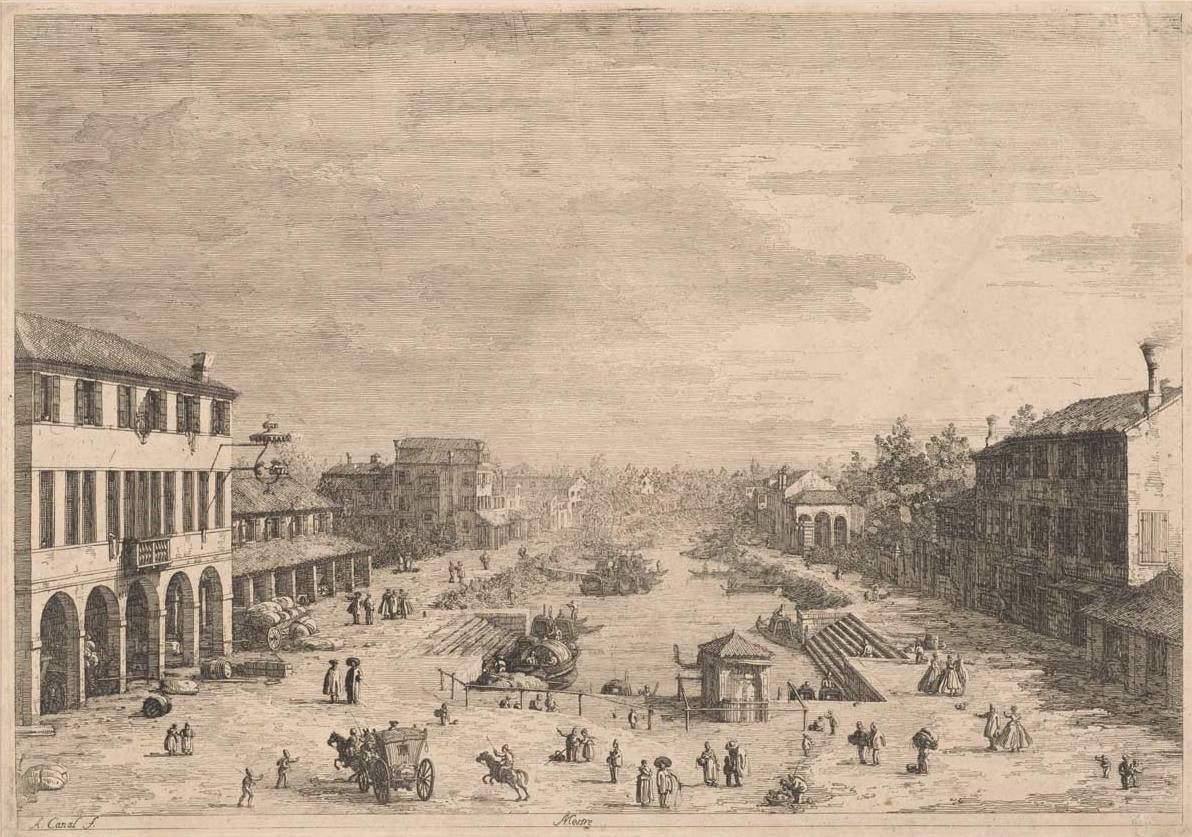
Giovanni Antonio Canal (known as Canaletto) (artist)
Italy (Venice), 1697-1768; active EnglandMestre, c.1740-46
Etching
from Vedute alle prese da i luoghi altre ideate [Views, some taken from the places, others imaginary]Gift of Dr J. Orde Poynton, 1959
Prints and Drawings Collection, Archives and Special Collections
1959.2128Canaletto’s painted views of Venice were among the most highly sought-after works of art by British collectors on the Grand Tour. When tourism to Venice was interrupted due to the War of Austrian Succession in 1740-48, Canaletto experimented with making 33 etchings to supplement his income. This print, featuring the harbor town of Mestre on the Venetian mainland, is one of 31 topographic and imaginary views made around Venice in the early 1740s that were published together some time after 1744.
The title plate to the Views was inscribed with a dedication to Joseph Smith, British Consul to the Venetian Republic. Smith was appointed to the position of Consul in 1744 and possibly commissioned and financed Canaletto to make the set, which was probably issued before the artist left Italy for England in 1746. The preliminary drawing to Mestre, (Canale delle Barche at Mestre on the Venetian mainland, c.1740-1742), held in the Royal Collection Trust, London, was purchased by King George III (r.1760-1820) directly from Smith in 1762.
-
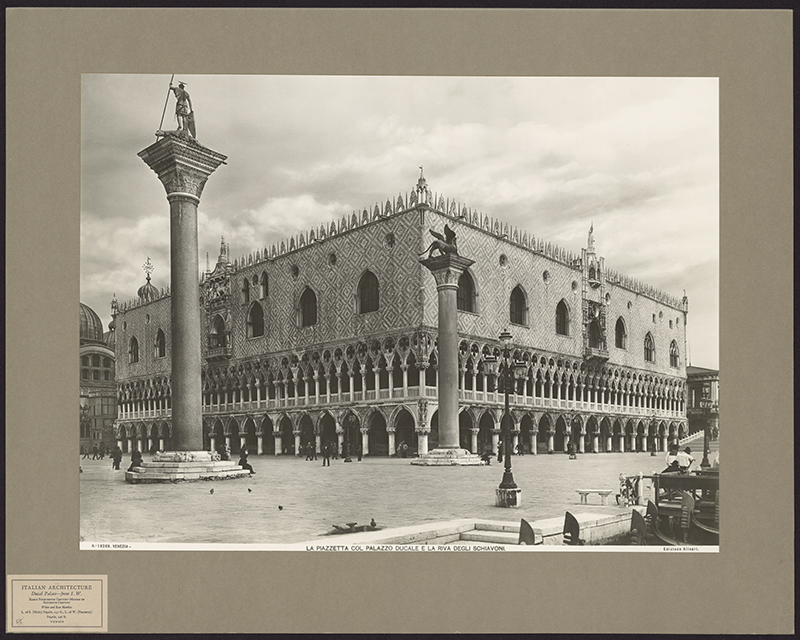
Fratelli Alinari (photographic studio)
Italy (Florence), est. 1852
Carnegie Corporation of New York (author)
United States of America, est.1911
Rudolf Lesch fine arts, Incorporated (publisher)
United States of America, active 1940s-70sDoge’s Palace (Venice, 1300s-1500s), c.1915-20, printed c.1927
Silver gelatin photograph, print from glass negative
from Carnegie Art Reference Set for CollegesGift of the Carnegie Corporation of New York, 1938
Visual Cultures Resource Centre, Faculty of Arts
20.009.277 -
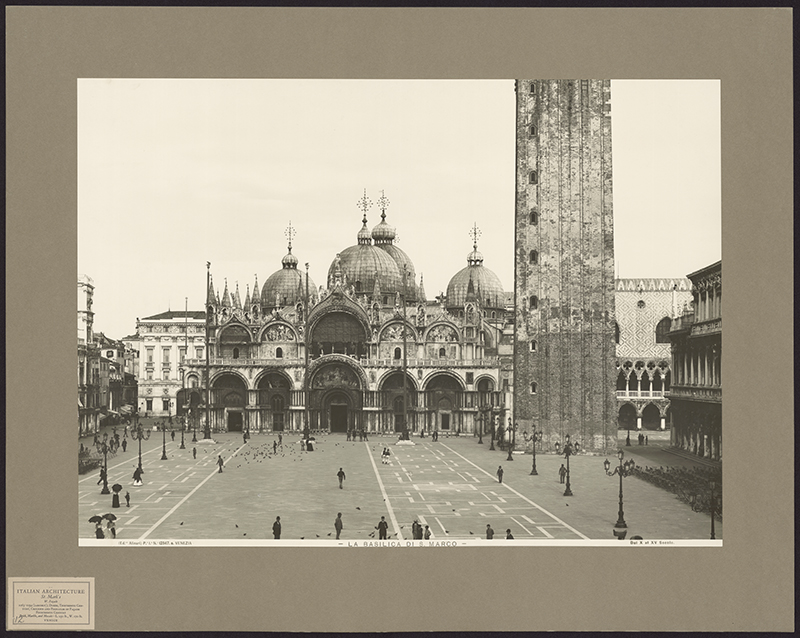
Fratelli Alinari (photographic studio)
Italy (Florence), est. 1852
Carnegie Corporation of New York (author)
United States of America, est.1911
Rudolf Lesch fine arts, Incorporated (publisher)
United States of America, active 1940s-70sSt. Mark's (Venice, 1063-1094), c.1900-20, printed c.1927
Silver gelatin photograph, print from glass negative
from Carnegie Art Reference Set for CollegesGift of the Carnegie Corporation of New York, 1938
Visual Cultures Resource Centre, Faculty of Arts
25.001.003 -
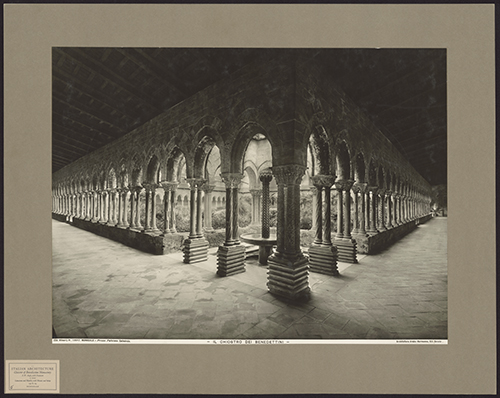
Fratelli Alinari (photographic studio)
Italy (Florence), est. 1852
Carnegie Corporation of New York (author)
United States of America, est.1911
Rudolf Lesch fine arts, Incorporated (publisher)
United States of America, active 1940s-70sCloister of Benedictine Monastery (Monreale, c. 1200), c.1900-20, printed c.1927
Silver gelatin photograph, print from glass negative
from Carnegie Art Reference Set for CollegesGift of the Carnegie Corporation of New York, 1938
Visual Cultures Resource Centre, Faculty of Arts
20.009.269 -
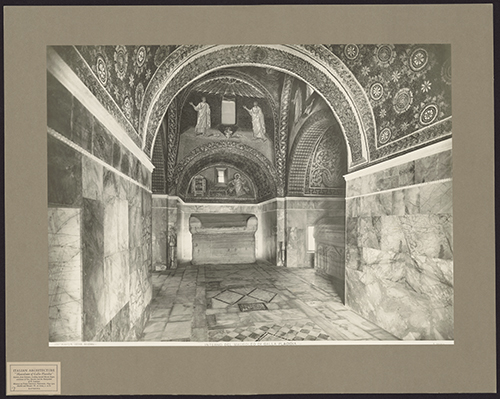
Fratelli Alinari (photographic studio)
Italy (Florence), est. 1852
Carnegie Corporation of New York (author)
United States of America, est.1911
Rudolf Lesch fine arts, Incorporated (publisher)
United States of America, active 1940s-70sMausoleum of Galla Placidia (Ravenna, 1400s; Restored, 1899-1902), c.1902-20s, printed c.1927
Silver gelatin photograph, print from glass negative
from Carnegie Art Reference Set for CollegesGift of the Carnegie Corporation of New York, 1938
Visual Cultures Resource Centre, Faculty of Arts
20.009.272 -

A.S. (author)
Unknown, active Italy c.1890sItaly, 1890s
Italy [s.n.]Rare Books Collection, Archives and Special Collections
UniM Bail SpC/BX ef 779.3645 ITAL -

Unknown (artist)
Bradbury & Evans (printer)
England, est. 1828-1900
Punch, or The London Charivari (publisher)
England, est. 1841-2002On the grand tour, 1872, published 19 October 1872
Wood engraving and letterpressGift of Terence Lane OAM, 2024
Prints and Drawings Collection, Archives and Special Collections
2024.0074 -
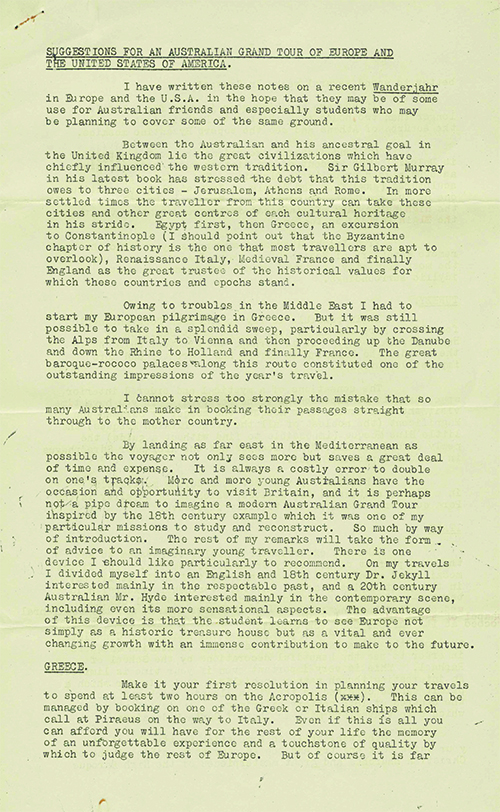
Joseph Burke (author)
England, 1913-1992; Australia from 1946Suggestions for an Australian Tour of Europe and the United States of America, 1955
University of Melbourne Archives, Archives and Special Collections
UMA-ITE-2012027600001In 1947, English born historian Joseph Burke was appointed Herald Professor of Fine Arts at the University of Melbourne. The first such appointment in Melbourne, Burke was engaged with establishing art history as one of the University’s central disciplines, designing the course outline and popularising the subject. In 1952, Burke spent twelve months on sabbatical travelling through Greece, Turkey, Italy, Holland, Belgium, France, Germany, Austria, Switzerland, England and America. On his return Burke gave a public lecture titled 'Suggestions for an Australian Grand Tour of Europe and the United States’. Although America was now considered essential to a twentieth century Grand Tour, in his address Burke continued to assert that for the modern Australian traveller the cultural itinerary should be to ‘first go to Egypt, then Greece, an excursion to Constantinople, Renaissance Italy, Medieval France and finally England—the great trustee of the historical values’.