Art
-
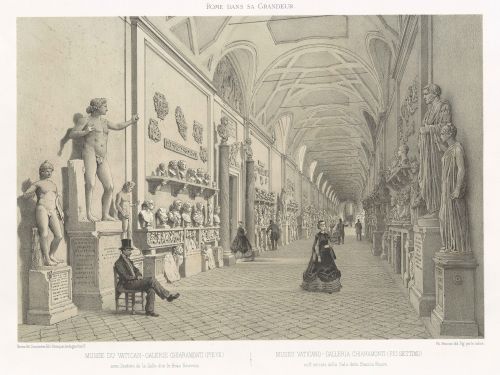
Eugène Cicéri (artist)
France, 1813-90
Henri Desire Charpentier (publisher)
France, 1806-after 1876Musée du Vatican – Galerie Chiaramonti. [Vatican Museum – Chiaramonti Gallery.], 1870
Tinted lithograph
from Rome dans sa grandeur. Vues, monument ancient et modernes [Rome in its grandeur. Views, monuments ancient and modern]Gift of Terence Lane OAM, 2024
Prints and Drawings Collection, Archives and Special Collections
2024.0069Lithography, which had been invented in 1798 by German playwright Joann Alois Senefelder (1771-1834) and was original used for publishing sheet music, was by the 1820s and 1830s the primary commercial print medium for the mass reproduction of images. In early-nineteenth century France, lithography intersected with the invention of photography, and was used to produce low-cost, popular print publications. Countless series of topographical and scenic views replicating the realistic images that photography was now capable of recording were marketed to middle-class consumers.
Print folios such as these reflected widespread interest in looking at collections of art and antiquities, and the formation of their display in public museums and galleries. They served to entrench the association between art, culture, education, travel and social improvement in the popular imagination. This contributed to an exponential growth in the number of people visiting art galleries and aspiring to take a Grand Tour.
-
Fratelli Alinari (photographic studio)
Italy (Florence), est. 1852
Carnegie Corporation of New York (author)
United States of America, est.1911
Rudolf Lesch fine arts, Incorporated (publisher)
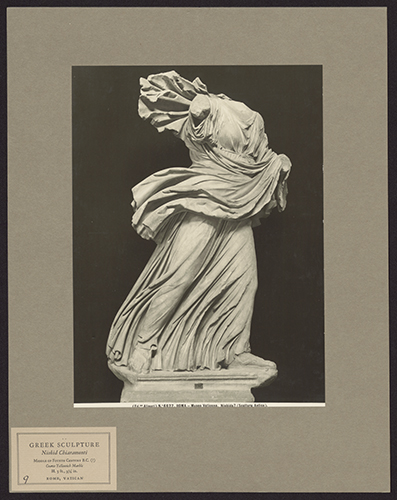
United States of America, active 1940s-70sNiobid Chiaramonti (4th century BC; Vatican, Rome), c.1890, printed c.1927
Silver gelatin photograph, print from glass negative
from Carnegie Art Reference Set for CollegesGift of the Carnegie Corporation of New York, 1938
Visual Cultures Resource Centre, Faculty of Arts
25.001.002 -
François Perrier (artist)
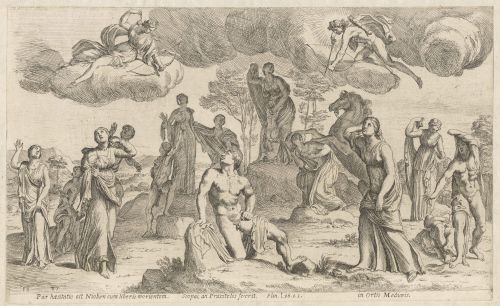
France, 1594 1649Par haesitatio est Nioben cum liberis morientem. [There is a certain hesitation in Niobe dying with her children.], 1638
Etching
from Segmenta nobilium signorum et statuarum [Segments of noble signs and statues]Gift of Terence Lane OAM, 2024
Prints and Drawings Collection, Archives and Special Collections
2024.0083This print was based on a group of 13 marble statues found buried in a vineyard near the Porta San Giovanni in Rome in 1583, which were modeled after the Greek goddess Niobe and her children. The group illustrates the myth surrounding Niobe’s sorrows and her subsequent transformation into stone, following the death of her seven daughters and seven sons at the hands of Artemis and Apollo.
In 1584 the Niobid group was acquired by Cardinal Ferdinando de' Medici (1549-1609) and placed in the gardens of Villa Medici on the Pincian Hill overlooking Rome. It is in this garden setting, where they remained for almost two centuries, that French artist François Perrier drew them. In 1770 the group was moved to Florence, and in 1794 installed in the Niobid Room in the Uffizi−a Neoclassical room in which the statues were arranged to be viewed, like pictures, in sequence along the walls of the gallery.
-
Eugène Cicéri (artist)
France, 1813-90
Henri Desire Charpentier (publisher)
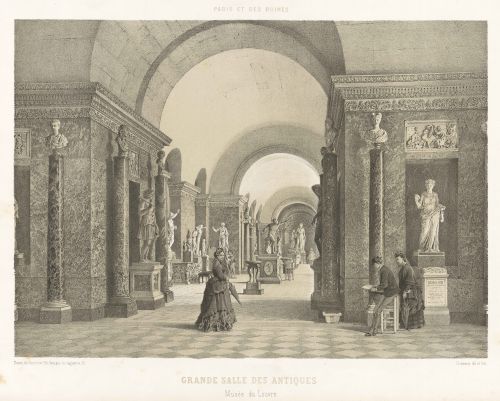
France, 1806-after 1876Grande Salle des Antiques – Musee du Louvre. [Great Hall of Antiques – Louvre Museum.], 1861
Tinted lithograph
from Paris dans sa splendeur. Monuments, vues, scènes historique, descriptions et histoire [Paris in its splendour. Monuments, views, historical scenes, descriptions and histories]Gift of Terence Lane OAM, 2024
Prints and Drawings Collection, Archives and Special Collections
2024.0073 -
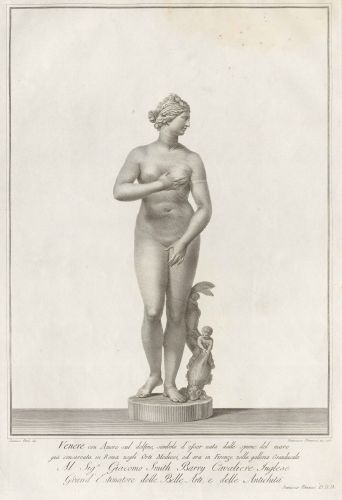
Francesco Piranesi (engraver)
Italy (Rome), 1758-1810
after Corazzari Ludovico (draughtsman)
Unknown, active Italy (Rome), 1780sVenere con Amore sul delfino, simbolo d' esser nata dalle spume del mare gia conservata in Rome negli Orti Medicei, ed ora in Firenze nella galleria Granducale. [Venus with Cupid on a dolphin, symbol of being born from the sea foam, formerly preserved in Rome in the Medici Gardens, and now in Florence in the Grand Ducal Gallery.], 1781
Engraving
from Choix des meilleures statues antique [Selection of the best antique statues]Gift of Terence Lane OAM, 2024
Prints and Drawings Collection, Archives and Special Collections
2024.0080 -
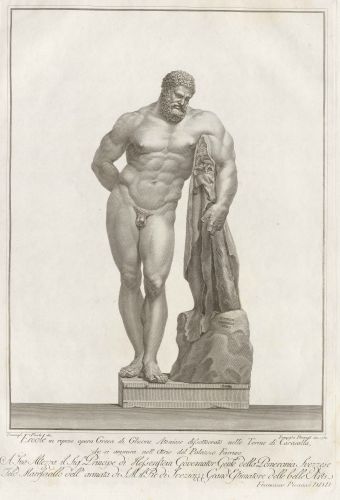
Francesco Piranesi (engraver)
Italy (Rome), 1758-1810
after Corazzari Ludovico (draughtsman)
Unknown, active Italy (Rome), 1780sErcole in riposo opera Greca di Glicone Atenoese dissotterrato nelle Terme di Caracalla, che si ammira nell' Atrio del Palazzo Farnese. [Hercules at rest, a Greek work by Glycon the Athenian, unearthed in the Baths of Caracalla and which can be admired in the Atrium of the Farnese Palace.], 1781
Engraving
from Choix des meilleures statues antique [Selection of the best antique statues]Gift of Terence Lane OAM, 2024
Prints and Drawings Collection, Archives and Special Collections
2024.0079 -
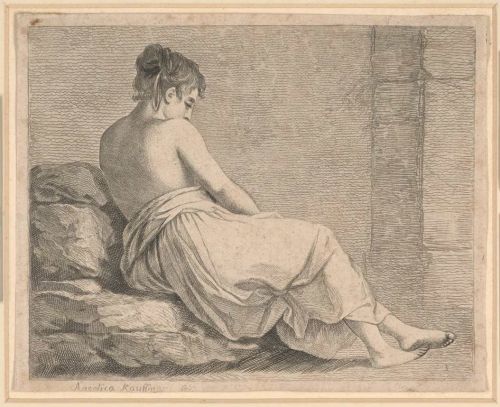
Angelica Kauffman (artist)
Switzerland, 1740-1807; active Italy (Florence and Rome) and England(Reclining figure), 1770
EtchingGift of Dr J. Orde Poynton, 1959
Prints and Drawings Collection, Archives and Special Collections
1959.3137Swiss-born artist Angelica Kaufman made this small etching four years after she moved from Rome to London - the year after she became a founding member of the Royal Academy in 1769. With no explicit allegorical content and recalling the pose and dress of a classical statue, Kauffman evokes both a Neoclassical archetype and an intimate portrait of a model with the downcast expression of melancholy.
The poetic nature of Kauffman’s Neoclassicism aligned with the writings of her friend Johann Joachim Winckelmann (1717-68) and his famous description of the haunted art historian, mourning for what has passed. In doing so, Kauffman imbues her imagery with a subtlety that evaded many of her male counterparts. According to historian Angela Rosenthal ‘the “difference” that Kauffman brought to representation was not innate but discursively defined, informed by eighteenth-century notions of femininity and artistic creativity that are both contradictory and unstable.’
-
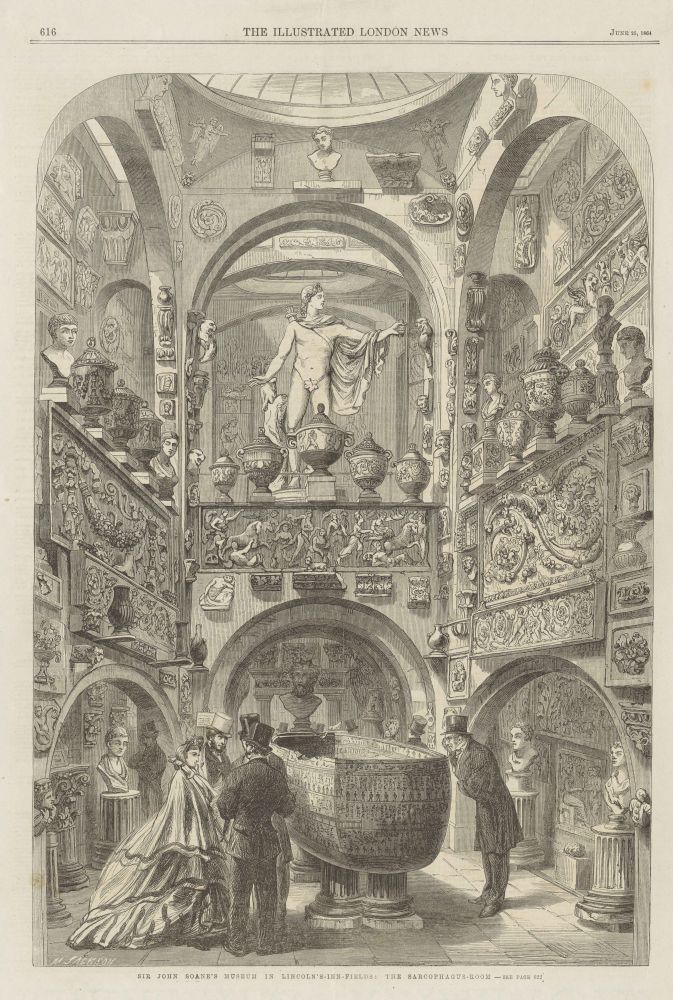
Jackson Mason (wood engraver)
England, 1819 1903
The Illustrated London News (publisher)
England, est. 1842-2003Sir John Soane’s Museum in Lincoln’s Inn fields: The Sarcophagus Room 1864, published 25 June 1864
Wood engraving and letterpressGift of Terence Lane OAM, 2024
Prints and Drawings Collection, Archives and Special Collections
2024.0132 -
Edward Radclyffe (engraver)
England, 1810-63
after Llewelynn Frederick William Jewitt (artist)
England, 1816-86
Joseph Mead (publisher)
Unknown, active England c.1840s
Aubert & Cie (publisher)
est. Paris, France, active 1830s-80s
Theodor Oswald Weigel (publisher)
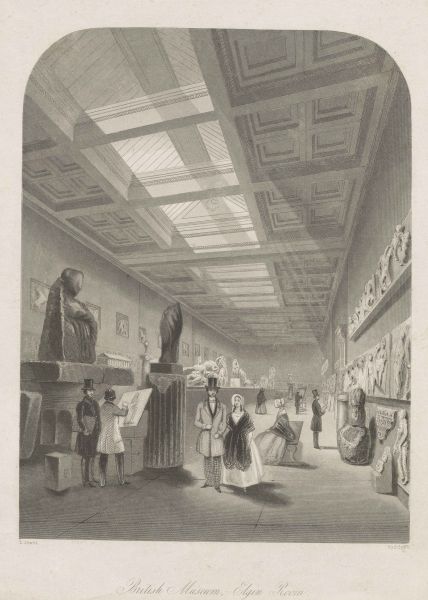
Germany (Leipzig), 1812-81British Museum, Elgin Room, 1841-44
Engraving
from London interiorsGift of Terence Lane OAM, 2024
Prints and Drawings Collection, Archives and Special Collections
2024.0135The Elgin Room in the British Museum was built to display the Parthenon Sculptures. Designed in the Greek Revival style in the 1820s by English architect Robert Smirke (1780-1867), the room formed part of the Museum’s major reconstruction and modernization project. This resulted in the creation of exhibition spaces that allowed the British public to move with greater ease through a succession of gallery spaces in which individual masterpieces could be clearly viewed, studied and admired with minimal decorative distractions. As art historian Christopher Marshall writes, Smirke’s design signaled the beginnings of ‘an emerging museological ideal in favour of recasting the museum as a series of clear and didactic museum gallery-boxes’. By contrast, when Neoclassical architect and collector Sir John Soane (1753-1837) opened his carefully thematically curated and modestly scaled house museum to the public in 1833, visitors were, in Marshall’s words; ‘in danger of being engulfed at any moment by the sheer profusion of Soane’s mixing together of objects.’
-
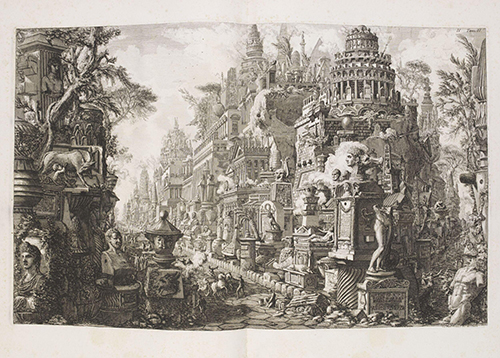
Giovanni Battista Piranesi (artist)
Italy (Venice), 1720-78; active RomeLe antichita romane: opera del cavaliere Giambattista Piranesi, 1784
Paris: Calcographie des Piranesi frères, 1804-07Rare Books Collection, Archives and Special Collections
UniM Bail SpC/RB 38 Left v.1
Image courtesy: V&A Museum -
Frans Van der Steen (etcher)
Belgium (Flanders), c.1625 72; active Austria (Vienna)
after David Teniers the Younger (intermediary draughtsman)
Belgium (Flanders), 1610-90
after Nicolaus van Hoy (artist)
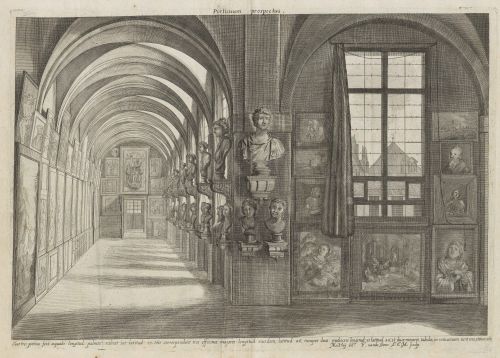
Belgium (Flanders), 1631-79; active Italy (Rome) and Austria (Vienna)Porticum prospectus [View of the portico]. (View of the picture and sculpture gallery of Duke Leopold Willem of Austria in Stallburg, Vienna), c.1645-60
Etching
from Theatrum Pictorium [Theatre of painting]Gift of Terence Lane OAM, 2024
Prints and Drawings Collection, Archives and Special Collections
2024.0089 -
Nicolas Chevalier (engraver and etcher)
France, 1661 1720; active Netherlands
after René Charpentier (intermediary draughtsman)
France, 1680-1723
after François Girardon (artist)
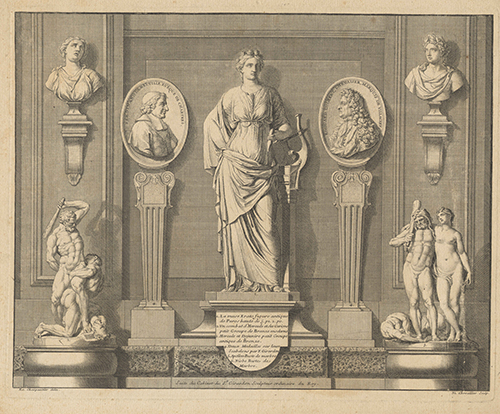
France, 1628-1715(View of gallery of antique sculptures in the Louvre), 1709
Engraving and etching
from La Galerie de Girardon [The Gallery of Girardon]Gift of Terence Lane OAM, 2024
Prints and Drawings Collection, Archives and Special Collections
2024.0090