Archaeology
-
Unknown (sculptor)
Unknown, active Italy (Rome), c.100 CEBas relief sarcophagus fragment of boy with dolphin, c.100 CE
Marble sculptureGift of David and Marion Adams, 2009
University of Melbourne Art Collection
2009.0251.000.000 -
![(Metope from the Parthenon) [1]](https://library.unimelb.edu.au/__data/assets/image/0011/5343527/varieties/Medium.jpg)
William Bromley (engraver)
England, 1769-1842
Henry Moses (engraver)
England, 1782 1870
Robert Newton (engraver)
England, 1787-c.1830
James Henry Watt (engraver)
England, 1799-1867
after Henry Courbold (draughtsman)
England, 1787-1844
The British Museum (publisher)
est. London, England, 1753(Metope from the Parthenon), 1826-35
Etching and engraving
from A Description of the Collection of Ancient Marbles in the British Museum with Engravings, Vol. IIVGift of Terence Lane OAM, 2024
Prints and Drawings Collection, Archives and Special Collections
2024.0125‘Smashed, fragmented, displaced, rearranged’: this is how historian Jenifer Neils describes the fate of the enormous Doric frieze that once decorated the metopes on the façade of the Parthenon in Athens. Made from 92 carved marble reliefs, the frieze, which ran the length of all four sides of the temple, illustrated scene-by-scene details of four stories from Greek mythology. Progressively destroyed from the sixth century until the final metope sculptures were taken down in 1993, what fragments survive today reside in collections across the world.
This group of prints shows 5 of the 15 metope marbles depicting the Centauromachy–the battle between the Lapiths and the Centaurs–which were taken from the south side of the Parthenon between 1801 and 1812 at the instruction of the British Ambassador to the Ottoman Empire, Thomas Bruce, 7th Earl of Elgin (1766-1841). Transferred to the British Museum by an Act of Parliament in 1817, the fragments of frieze, along with other sculptures taken from the Acropolis in Lord Elgin’s possession, were renamed erroneously under the agreement as the ‘Elgin Marbles’. The cultural ownership of the marbles and the question of repatriation remains one of the most politically contested of contemporary history.
-
![(Metope from the Parthenon) [2]](https://library.unimelb.edu.au/__data/assets/image/0005/5343530/varieties/Medium.jpg)
William Bromley (engraver)
England, 1769-1842
Henry Moses (engraver)
England, 1782 1870
Robert Newton (engraver)
England, 1787-c.1830
James Henry Watt (engraver)
England, 1799-1867
after Henry Courbold (draughtsman)
England, 1787-1844
The British Museum (publisher)
est. London, England, 1753(Metope from the Parthenon), 1826-35
Etching and engraving
from A Description of the Collection of Ancient Marbles in the British Museum with Engravings, Vol. IIVGift of Terence Lane OAM, 2024
Prints and Drawings Collection, Archives and Special Collections
2024.0126 -
![(Metope from the Parthenon) [3]](https://library.unimelb.edu.au/__data/assets/image/0006/5343531/varieties/Medium.jpg)
William Bromley (engraver)
England, 1769-1842
Henry Moses (engraver)
England, 1782 1870
Robert Newton (engraver)
England, 1787-c.1830
James Henry Watt (engraver)
England, 1799-1867
after Henry Courbold (draughtsman)
England, 1787-1844
The British Museum (publisher)
est. London, England, 1753(Metope from the Parthenon), 1826-35
Etching and engraving
from A Description of the Collection of Ancient Marbles in the British Museum with Engravings, Vol. IIVGift of Terence Lane OAM, 2024
Prints and Drawings Collection, Archives and Special Collections
2024.0127 -
![(Metope from the Parthenon) [4]](https://library.unimelb.edu.au/__data/assets/image/0009/5343534/varieties/Medium.jpg)
William Bromley (engraver)
England, 1769-1842
Henry Moses (engraver)
England, 1782 1870
Robert Newton (engraver)
England, 1787-c.1830
James Henry Watt (engraver)
England, 1799-1867
after Henry Courbold (draughtsman)
England, 1787-1844
The British Museum (publisher)
est. London, England, 1753(Metope from the Parthenon), 1826-35
Etching and engraving
from A Description of the Collection of Ancient Marbles in the British Museum with Engravings, Vol. IIVGift of Terence Lane OAM, 2024
Prints and Drawings Collection, Archives and Special Collections
2024.0128 -
![(Metope from the Parthenon) [5]](https://library.unimelb.edu.au/__data/assets/image/0010/5343535/varieties/Medium.jpg)
William Bromley (engraver)
England, 1769-1842
Henry Moses (engraver)
England, 1782 1870
Robert Newton (engraver)
England, 1787-c.1830
James Henry Watt (engraver)
England, 1799-1867
after Henry Courbold (draughtsman)
England, 1787-1844
The British Museum (publisher)
est. London, England, 1753(Metope from the Parthenon), 1826-35
Etching and engraving
from A Description of the Collection of Ancient Marbles in the British Museum with Engravings, Vol. IIVGift of Terence Lane OAM, 2024
Prints and Drawings Collection, Archives and Special Collections
2024.0129 -
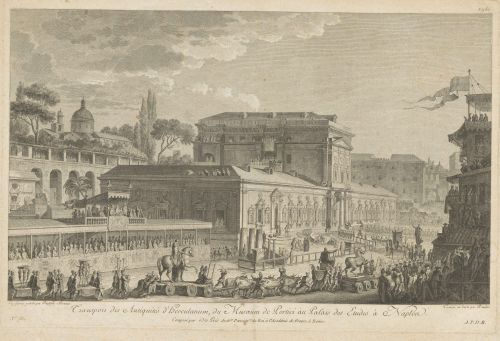
Jean Duplessi Bertaux (engraver)
France, 1747 or 1750-1818 or 1820
Robert Daudet II (engraver)
France, 1737-1824
after Louis Jean Desprez (artist)
France, 1743-1804
Abbé Jean Claude Richard de Saint Non (publisher)
France, 1730-92Transport des antiques d’Herculanum, du Museum de Portici, au Palais des a Naples. [Transport of the antiques of Herculaneum, from the Museum of Portici, to the Palace of Naples.], 1781-86
Engraving
from Voyage Pittoresque Ou, Description Des Royaumes De Naples Et De Sicile [Picturesque Travels or, Description of the Kingdoms of Naples and Sicily]Gift of Terence Lane OAM, 2024
Prints and Drawings Collection, Archives and Special Collections
2024.0111 -
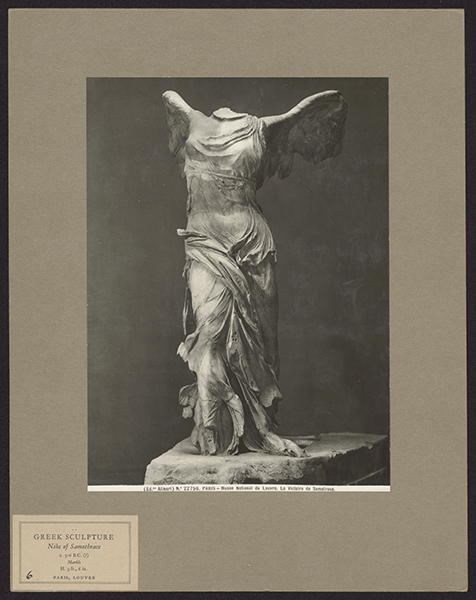
Fratelli Alinari (photographic studio)
Italy (Florence), est. 1852
Carnegie Corporation of New York (author)
United States of America, est.1911
Rudolf Lesch fine arts, Incorporated (publisher)
United States of America, active 1940s-70sNike of Samothrace (Greek, c. 306 BC; Louvre, Paris), c.1908, printed c. 1927
Silver gelatin photograph, print from glass negative
from Carnegie Art Reference Set for CollegesGift of the Carnegie Corporation of New York, 1938
Visual Cultures Resource Centre, Faculty of Arts
20.009.021 -
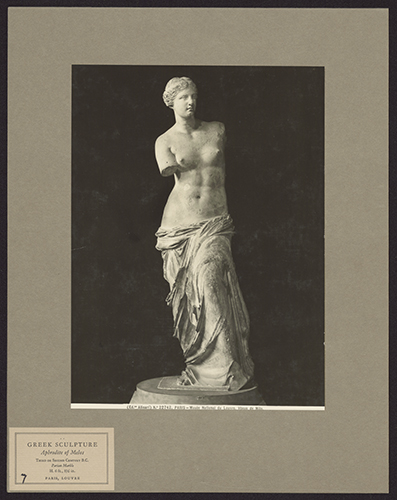
Fratelli Alinari (photographic studio)
Italy (Florence), est.1852
Carnegie Corporation of New York (author)
United States of America, est.1911
Rudolf Lesch fine arts, Incorporated (publisher)
United States of America, active 1940s-70sAphrodite of Melos (Greek, 3rd-2nd century BCE; Louvre, Paris), c.1920-30
Silver gelatin photograph
from Carnegie Art Reference Set for CollegesGift of the Carnegie Corporation of New York, 1938
Visual Cultures Resource Centre, Faculty of Arts
20.009.022 -
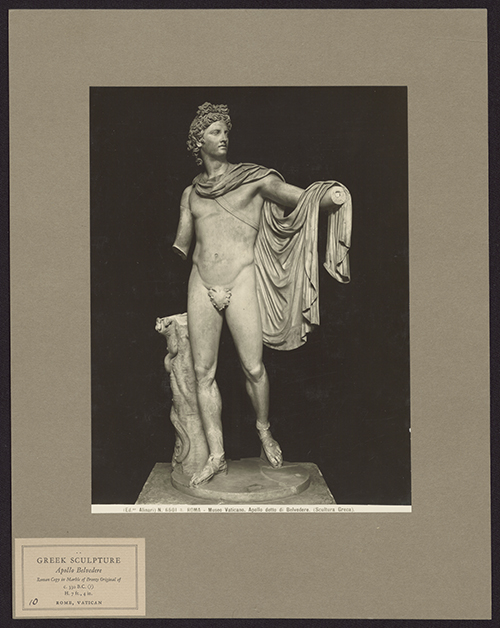
Fratelli Alinari (photographic studio)
Italy (Florence), est. 1852
Carnegie Corporation of New York (author)
United States of America, est.1911
Rudolf Lesch fine arts, Incorporated (publisher)
United States of America, active 1940s-70sApollo Belvedere (Roman copy c. 330 BC; Vatican, Rome), c.1873-80, printed c.1927
Silver gelatin photograph, print from glass negative
from Carnegie Art Reference Set for CollegesGift of the Carnegie Corporation of New York, 1938
Visual Cultures Resource Centre, Faculty of Arts
20.009.023