The Tribuna and the Grand Tour
Dr Callum Reid

Introducing the Tribuna
Visitors to the Uffizi Gallery in Florence don’t have to walk very far before they encounter the Tribuna, the octagonal room off the first corridor, fenced off and viewed from one of its three doorways. Decorated with many of its original furnishings, cabinets and paintings, it’s a modern-day historical diorama, treated as an art object in its own right, with labels outlining its historical significance.
Along with the eastern corridor, it was the first place that the Medici Grand Dukes began to display art in the Uffizi, a nucleus for the new gallery as collections radiated out, filling the surrounding rooms from the late sixteenth century onwards. As the gallery grew, the Tribuna remained its central jewel, a destination for Grand Tourists, and a place where the Grand Dukes would display their very best things.1
The room took on many different incarnations, beginning as a princely wunderkammer for the new grand Duke Francesco I de’ Medici, who moved a portion of his collections of art and naturalia over from the small studiolo in the palace next door. The studiolo had object cabinets built into its walls, each decorated with painting and sculpture representing one of the four elements.2
This decorative program was brought over to the Tribuna, with hidden cabinets built into the walls, large ebony and pietre dure cabinets for coins and intaglios and a shelf to display stautettes and antiquities. The theme of the four elements was also subtly retained and can be seen in today’s decoration:
- Earth represented by the pietre dure floor
- Fire represented by the velvet walls
- Water represented by the mother-of-pearl shells inlaid inside the dome
- Wind represented by a weathervane built into the top of the Tribuna, that allowed you to read the wind’s direction from inside.
Thus, the Tribuna became a new stately studiolo, designed to direct Grand Ducal collecting towards noble visitors, radiating Francesco I’s collection and wealth outwardly, a symbolic gesture fitting his new position as Grand Duke of Tuscany. This move from a private to a public tribuna, and shift in terminology, is described by Paula Findlen:
‘While Renaissance collectors frequently labelled the museum a studio, studiolo, stanzino (little room), or occasionally guardaroba (wardrobe), Baroque collectors preferred terms like Tribuna…the former reflected a sense of containment and privacy; the latter openness and sociability.’3
The taste of the Grant Tourists
Courtly guests and Grand Tourists descended on Florence from the mid-seventeenth century, with the ‘Great Duke’s Gallery’ a major stop on their journey. Those that recorded their travels described the Tribuna’s most expensive furnishings and paintings, along with a number of the objects that still evoked a ‘cabinet of curiosities’, rather than a picture room. Richard Lassels recounts in 1663-64:
‘In this tribuno, I saw also the famous Nayle half gold half iron, made by the famous Alchimist Thurnheuser. They showed me also a great lump of Gold, not yet stamped into Coyn; two shells of Mother of Pearl, with their two Pearls still sticking to them, and just as they grow: The Pearls are rich Pearls and round. The two pieces of emmeraud rock, the one-piece form yet into perfect Emmeraud, but only begun, the other quite finished and green.’4
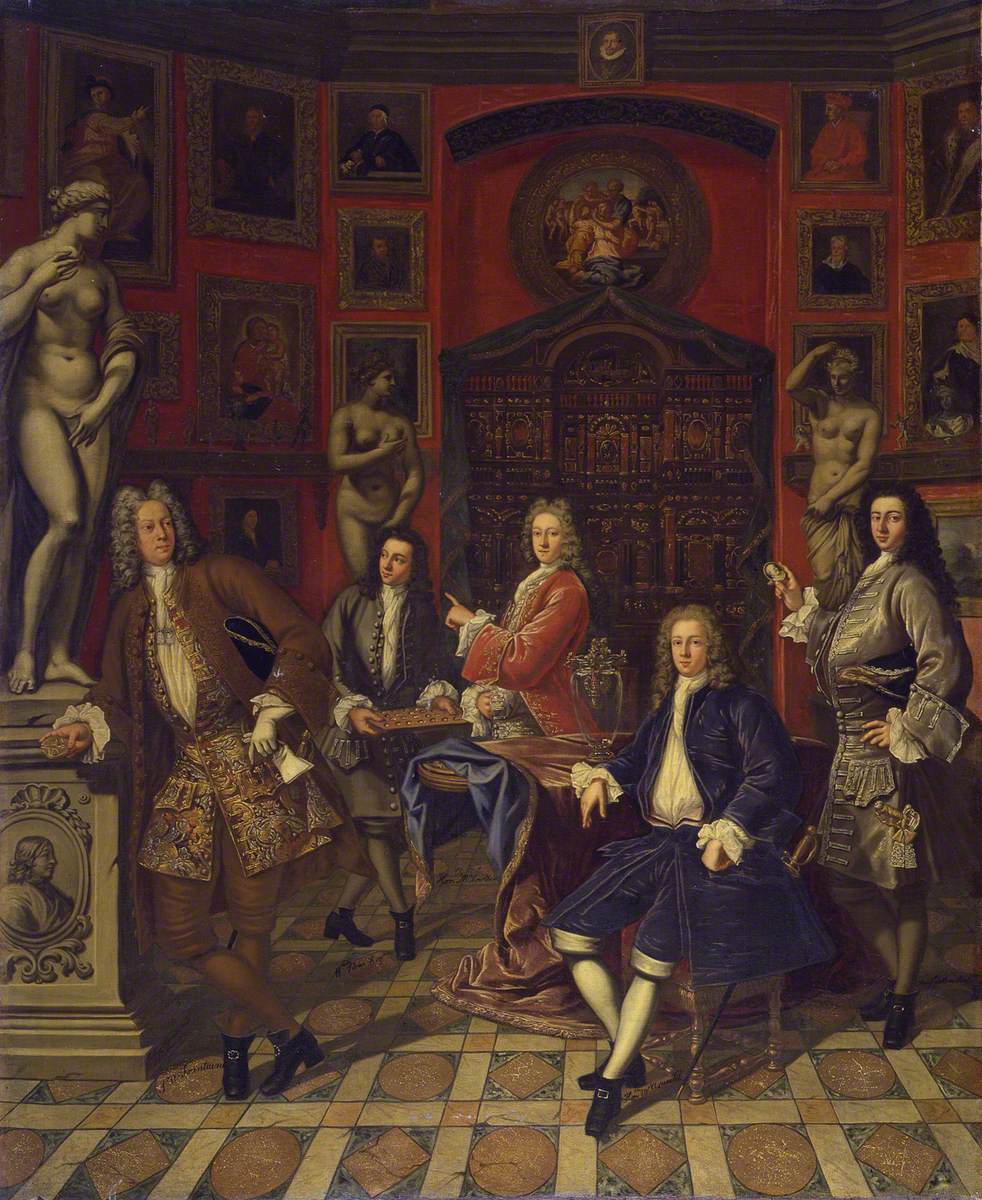
Along with naturalia, Grand Tourists’ main taste was for antique coins, cameos and sculpture. This is communicated in one of the earliest images of the Tribuna - Giulio Pignatta’s Sir Andrew Fountaine and Friends in the Tribune, painted in 1715.5 Framed around a coin cabinet and Michelangelo’s Doni Tondo, the works of art fall into shadow cast by the spot-lit protagonists. Three classical Venus figures: Celestial Venus, Medici Venus and Venus Victrix, act as a framework for the composition, in which the subjects are posed with items from different cabinets; crystal vases, ancient coins and intaglios.
The evolution of the Tribuna through the seventeenth and eighteenth centuries shows us the evolution of European taste and a steady increase in paintings. As newly acquired works rotated through the space, Grand Tourists began picking up on them, remarking on the finest works in accounts of their voyages. These included acquisitions like Michelangelo’s Doni Tondo (installed in 1609), Hans Holbein’s Richard Southwell (1621), or the large influx of works by Titian, sent from Francesco Maria II della Rovere, the Duke of Urbino, in honour of the marriage of Vittoria della Rovere into the Medici family (1631). Before sending them, the Duke of Urbino wrote to the Medici Grand Duke, stating that he still had ‘some paintings by Raphael and Titian, which, being works of very excellent hands, would go well amongst the others that adorn the galleries of Your Highness.’6
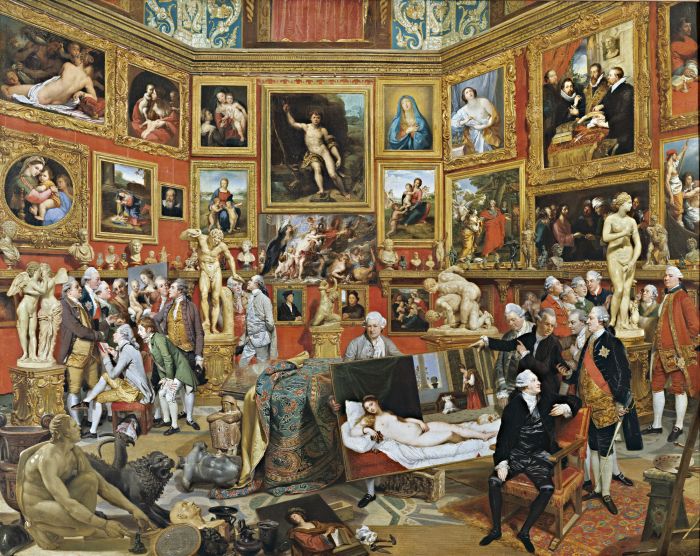
Perhaps the most famous painting sent over from the della Rovere collection was Titian’s Venus of Urbino, which wasn’t installed until over a century later in 1736, but that became perhaps the most popular painting in the Tribuna.7 The evolution of the display program is visualised in Johan Zoffany’s Tribuna of the Uffizi . Painted as a commission for the Queen of England to show her the treasures of the Florentine gallery, Zoffany squeezes every picture possible onto the walls, bringing in works from the Palazzo Pitti across the river, even illustrating newly acquired works like Guercino’s Sybil on the floor surrounded by nails, straight out of the crate. This maximalist canvas is also filled with known Grand Tourists (including Zoffany himself), engaging directly with the works, most notably the Venus of Urbino, which is being handled by figures in the foreground.8
The Medici Venus, Grand Tourists and Napoleon
On the right of Zoffany’s canvas, a gaggle of Grand Tourists huddle excitedly around the Medici Venus (or Venus de’ Medici), which at this point was the most popular work of sculpture in the world, and the chief reason for visiting the Tribuna (perhaps along with the Venus of Urbino). Comparable to a visit to the Louvre today to see the Mona Lisa, the Uffizi’s Medici Venus drew enormous crowds, who wrote rapturously in their travel accounts:
‘It must be acknowledg’d that this (sculpture) is the most charming Body, and the finest Piece of Workmanship in the World.’
Maxemilien Misson, 16959
‘On entering the Tribuna, the eye is immediately struck with six marble statues standing in the centre, among which is that famous statue, called the Venus de Medici. This has hitherto, in the unanimous opinion of all judges, been esteemed to surpass not only all the statues in Florence, but any piece of sculpture throughout the world.’
Johann Keysler, 173010
‘Language cannot describe it in its true perfection, nor can any copies reach the beauties of the original Venus ... There I saw artis summum Opus. Human power can go no further.’
Earl of Cork, 175411
‘Figure to yourself something a thousand times more beautiful than the most beautiful objects you have ever seen. A thousand times more touching than anything that has ever touched you, a thousand times more enchanting than that by which you have ever been enchanted: Such is the Venus de Medicis. For in this Venus, every part is Venus.’
Charles Dupaty, 1785 (on his fourth visit to the Medici Venus)12
The popularity of this statue saw a proliferation of copies spread across Europe. Bronze-cast versions stood in Blenheim Palace and the Liechtenstein collections, commissioned from bronze caster Massimiliano Soldani-Benzi. There were terracotta copies created for Versailles and copies of varying dimensions purchased by viewers wishing to take the Venus home.
For some visitors, only the original would suffice. In 1796, Uffizi Gallery director Tomasso Puccini wrote a letter to his brother, having just taken a young Napoleon and all his generals on a tour that stopped past the Tribuna: ‘He was very taken by the Venus, he spoke to me a lot about her. He told me to make sure Tuscany don’t declare war, because he would take her to Paris...’
Puccini mollified the young commander, ‘I told him to rest assured, after his purchases in Rome, he could create the top Cabinet in Europe, without needing our Venus.’ Perhaps with this in mind, following the first French occupation in 1799, cases were prepared for the immediate transfer of the gallery’s most significant works to the port of Livorno, and plans made to secure ‘a large vessel’ to move them to safety. These plans were put into action when the French invaded neighbouring Lucca in June 1800.
Eventually, Napoleon’s spies located the whereabouts of the Uffizi treasure, which was hidden in Palermo in crates behind a church. His sources were ordered to find these crates and relieve them of just the Medici Venus – everything else could be left behind. Once uncovered, the Venus was taken on the first boat from Palermo to Marseille and joined the Emperor’s Italian bounty, installed in a purpose-built room in the Musée Napoléon. The statue stayed in Paris until the fall of Napoleon around 1815, after which it was immediately returned to the Tribuna.
Bercher’s Etching-Aquatints of the Tribuna
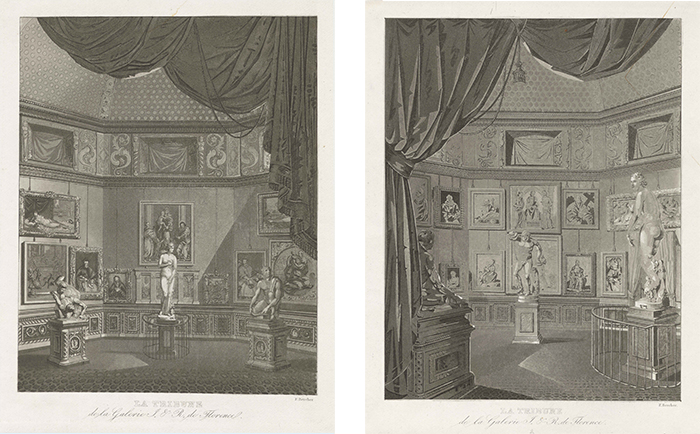
In the mid-nineteenth century, during what would be the final years of Florence’s Grand Duchy, the artist known only as F Bercher created two different views of the Uffizi Tribuna, (figures 5 and 6). Two angles on a now tranquil and ordered room, there are still signs of the c. 250 years of evolution it had been through. The Medici Venus, only recently returned from Paris, now sits behind a small fence. A greater influx of visitors meant that doors have been opened on the north and south ends of the room for easier passage. The small shelf that was still present for Zoffany had been removed and the maximalist room filled with objects and people now focuses solely on paintings and sculpture. What hasn’t changed is the room’s mission: the place for the very best objects in the collection, with nods to its history. Works like the Venus of Urbino and Doni Tondo remain on display, the major classical sculpture remains in view and the theatre of the room is maintained through the artistic repoussoir of the drawn curtains.
Endnotes
[1] Detlef Heikamp, “Zur Geschichte Der Uffizien-Tribuna Und Der Kunstschränke in Florenz Und Deutschland,” Zeitschrift fur Kunstgeschichte 26, no. 3/4 (1963): 193–268, https://doi.org/10.2307/1481600; Detlef Heikamp, “La Tribuna degli Uffizi come era nel Cinquecento,” Antichità viva 3, no. 3 (1964): 11–30.
[2] Valentina Conticelli, “Guardaroba di cose rare et preziose”: Lo studiolo di Francesco de’ Medici-arte storia, e significati (Agora Publishing, 2007); Lindsay Alberts, “The studiolo of Francesco I de’ Medici: A Recently-Found Inventory,” ARTHS 2, no. 1 (2015): 3–26; Larry J. Feinberg, “The Studiolo of Francesco I Reconsidered,” in The Medici, Michelangelo and the Art of Late Renaissance Florence, ed. Cristina Acidini Luchinat et al. (Yale University Press, 2002), 47–66.
[3] Paula Findlen, Possessing Nature: Museums, Collecting and Scientific Culture in Early Modern Italy (University of California Press, 1996), 109.
[4] Richard Lassels, The Voyage of Italy, or, a Compleat Journey through Italy, in Two Parts (John Starkey, 1670), 171–72.
[5] See Andrew Moore, Norfolk and the Grand Tour (Norfolk Museum Service, 1985), 27-31,95,96. for Andrew Fountaine’s Grand Tour
[6] Francesco Maria II della Rovere to Ferdinando II de’ Medici, 29 July 1630, cited in Paola Barocchi and Giovanna Gaeta Bertelà, Collezionismo mediceo e storia artistica, II. Il Cardinal Carlo, Maria Maddalena, Don Lorenzo, Ferdinando II, Vittoria della Rovere, 1621-1666 (SPES, 2005), 61., “mi restano alcuni quadretti di Rafaelle e di Tiziano, che per esser opera di mani tanto eccellenti, starebbono bene fra gli altri, che ornano le galerie di Vostra Altezza.”
[7] The ASGF hold records of the requests to copy individual works in the gallery. Titian’s Venus is requested every year with regularity. See ASGF, Filze I-IX for the years 1738-1775 (1739-1768 undocumented). Giuseppe Bianchi writes in his Catalogo Dimostrativo that “Titian’s Venus is in a poor state now, on account of the copies that have been made, up to 250 now, 68 of which were performed in the 16 years I have been in the Gallery.”
[8] For more on Zoffany’s canvas, see Oliver Millar, Zoffany and His Tribuna (Paul Mellon Foundation for British Art, 1966).
[9]Maximilien Misson, A New Voyage to Italy: With Curious Observations on Several Other Countries, as: Germany, Switzerland, Savoy, Geneva, Flanders, and Holland; Together with Useful Instructions for Those Who Shall Travel Thither (Bently, 1695).
[10] Johann Georg Keysler, Travels Through Germany, Bohemia, Hungary, Switzerland, Italy and Lorrain, Vol 1 (The Author, 1756).
[11] The Gentleman's and London Magazine: Or Monthly Chronologer, 1741-1794. (J. Exshaw., 1741), 679.
[12] Dupaty, Charles, Travels Through Italy: In a Series of Letters; Written in the Year 1785, by President Dupaty. Translated from the French by an English Gentleman. (G. G. J. and J. Robinson, 1788), 91.