Susan Sontag, The Volcano Lover: A Romance
Professor Deirdre Coleman, Robert Wallace Chair of English
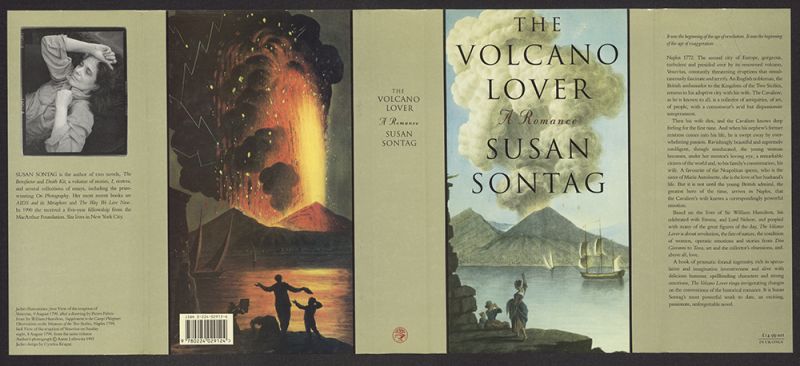
Susan Sontag’s historical novel has all the makings of a page-turner. The setting is late eighteenth-century Naples, a key city of the Grand Tour, ruled by a decadent court but dominated (and threatened) by the city’s far-famed volcano, Vesuvius. Destroyer of the ancient Roman towns of Pompeii and Herculaneum, Vesuvius remained alarmingly active throughout its recorded history, erupting spectacularly in 1794 during France’s bloody, revolutionary ‘Terror’. Sontag subtitled her novel, A Romance, but there are many romances in this novel. Just as the main character, Sir William Hamilton, British envoy to Naples, is to become sexually enthralled by the clever and voluptuous young Emma Hart, he is also obsessed with Vesuvius. The volcano is an ‘emblem of passion’ for him, an unpredictable and dangerous mistress whose moods he captured for the Royal Society in a series of learned essays. He also sent lava and other geological specimens to the British Museum. With its dangerous lava flows, Vesuvius symbolizes the French revolution. It also rivals the sinister Neapolitan court as ‘a principle of disaster, monarchical, lording it over the scene’.
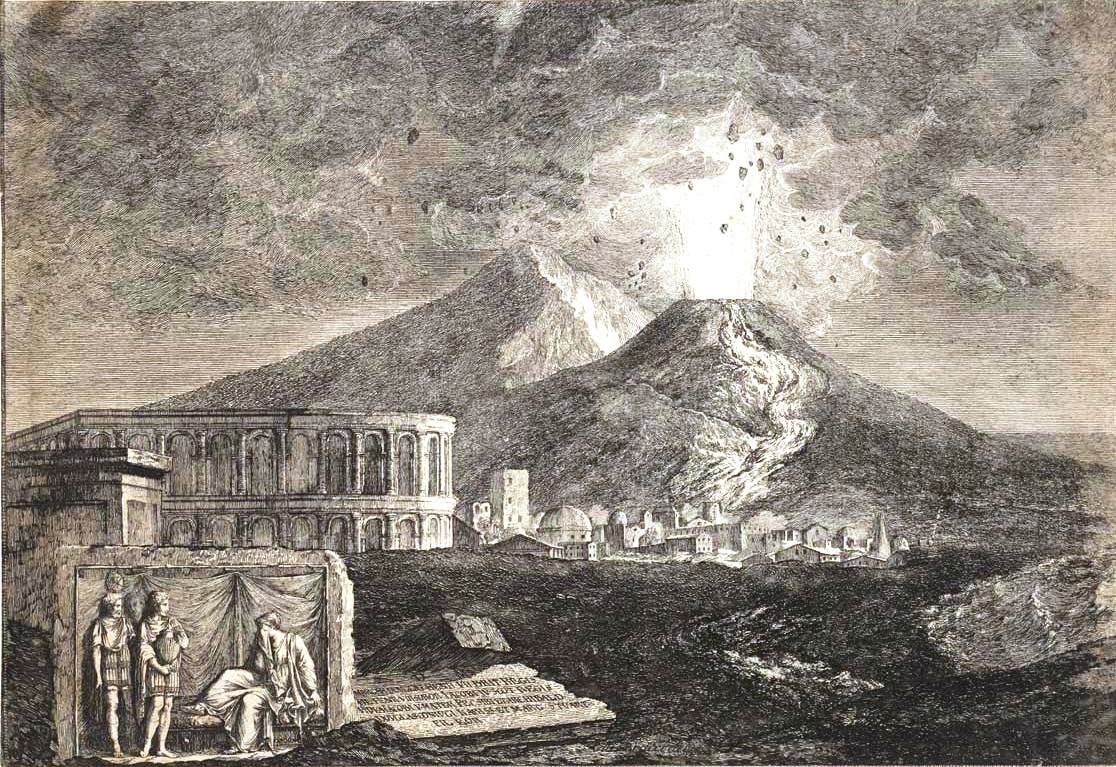
Sontag opens her novel with the Cavaliere (as she dubs Sir William) back on a visit to London with his first wife, a wealthy heiress. An avid antiquarian and collector of antiquities, Hamilton has succeeded in selling to the British Museum his extensive collection of Greek and Roman vases, statuary, coins, and amulets, receiving a handsome sum for what is now popularly called ‘Stuff the British Stole’. As his stately, ornate carriages process through London on their return to Naples, laden with ‘forty-seven large trunks’, Hamilton and his wife are surrounded by the ‘ceaselessly replenished throngs of beggars, maids, peddlers, apprentices, shoppers, pickpockets, touts, porters, errand boys’. This theme of the grotesque inequality between the obscenely rich and the many wretched is mirrored in Naples, a city which in 1764, the first year of Hamilton’s residency, saw a recurrence of famine and plague, killing an estimated 40,000. When the plague abated and the royals returned from the safety of their summer residences, they erected the traditional cuccagna, described in the novel as ‘an artificial mountain festooned with meat, game, cakes, and fruit, whose dismantling by the ravenous mob, unleashed by a salvo of cannon, was applauded by the overfed from balconies’.
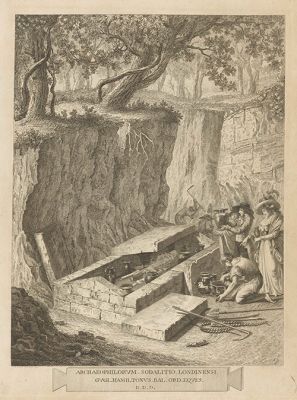
Hamilton’s collecting is a key theme in the novel, rivalling his devotion to Vesuvius. After his first wife dies, his collection of aesthetic objects comes to embrace Emma Hart. A great beauty, with long, luxuriant chestnut hair, Emma’s social ascent is steep, from blacksmith’s daughter to Lady Hamilton. At 16, having been passed from one aristocrat to another, Emma became the mistress of Hamilton’s nephew and hopeful heir, Charles Greville. Profiting from her beauty, Greville commissioned the British artist George Romney to paint Emma in a series of pictures. This commercial speculation marked the beginning of men profiteering from her captivating face and figure. Adept at self-fashioning Emma was the model for more than sixty portraits by Romney, the most famous of which are the mysterious Spinstress and his delightful depiction of her as Nature. After a few years, tired of waiting for the childless Hamilton to die, Greville packs Emma off to his uncle in Naples. Believing at first that Greville planned to join her in Italy, Emma soon understands that she has been trafficked between the two men. She gets her revenge when, five years later, she marries Hamilton, 36 years her senior. During these prenuptial years in Naples, Hamilton employed a raft of tutors for her in singing, piano, drawing and languages, all designed to transform her into a ‘fair lady’. In the engraving A tomb at Nola, the elegant married couple are depicted in the act of grave-robbing, admiring the original vases they have just plundered. Judging by the roots of a tree dangling high up in the air, an entire cliff face has been demolished to disinter the once hidden and heavily fortified stone coffin.
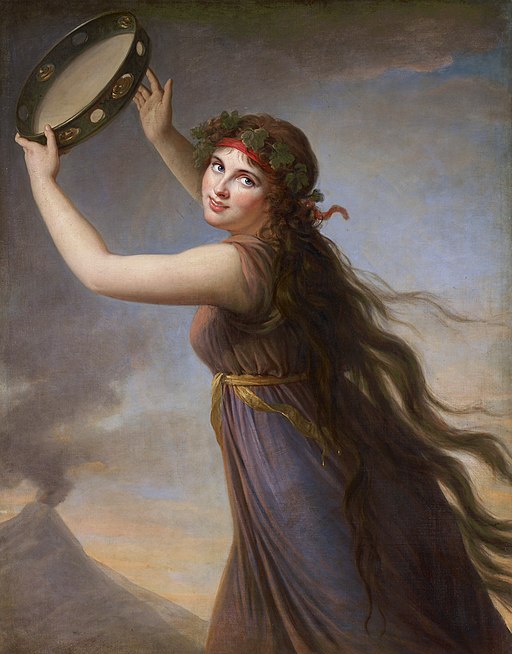
Emma Hamilton is best known today for her ‘attitudes’ or tableaux vivants, performed for guests at the British ambassadorial residence in Naples. Here she skillfully struck poses from classical history and mythology, draped in a classical toga against candle-lit backdrops, with Hamilton ‘stage manager and privileged spectator’. Well-trained by Romney, Emma posed as numerous female figures: the abandoned Ariadne, the grief-struck Medea, the sorceress Circe, the prophet Cassandra, suicidal Dido, raped Lucrece, and Diana, huntress and symbol of chastity. Many Grand Tourists present at these exhibitions spread her fame abroad. One such was Goethe who wrote, astonished, of Emma’s dexterous use of shawls and veils in her rapid and seamless modelling, ‘standing, kneeling, sitting, reclining’. Her range of emotional expression was also extraordinary: ‘serious, sad, playful, ecstatic, contrite, alluring, threatening, anxious’.1 Even Catharine the Great in Moscow, hearing of Emma’s theatrical transformations, demanded an image of her be sent. Back in London Horace Walpole, connoisseur and wit, quipped: ‘people are mad about her wonderful expression’ but he doubted its authenticity, ‘so few antique statues having any expression at all’.2 Given the international prestige of classical learning, Emma’s theatrics probably helped to legitimise her place amongst the aristocracy. In the end, Sontag reveals the significance of their private theatre. Hamilton was ‘the great collector’, a Pygmalion who publicly displayed Emma as his ‘proud possession’, a high-value artefact like the ancient vases she often held as she performed. For Emma, who had once hoped to act on the London stage, it was ‘most natural to exhibit beauty’ for what is beauty (she asked herself) ‘without a chorus, without the whispers, the sighs, the murmurs?’. Her longing for an audience was fulfilled with her gallery of living statues. The painting which best captures Emma’s beauty at the height of her fame in Naples is that of Marie Antoinette’s court painter, Élisabeth Vigée le Brun. In flight from the revolution, she painted her as a Bacchante, follower of the God of Wine (1792).
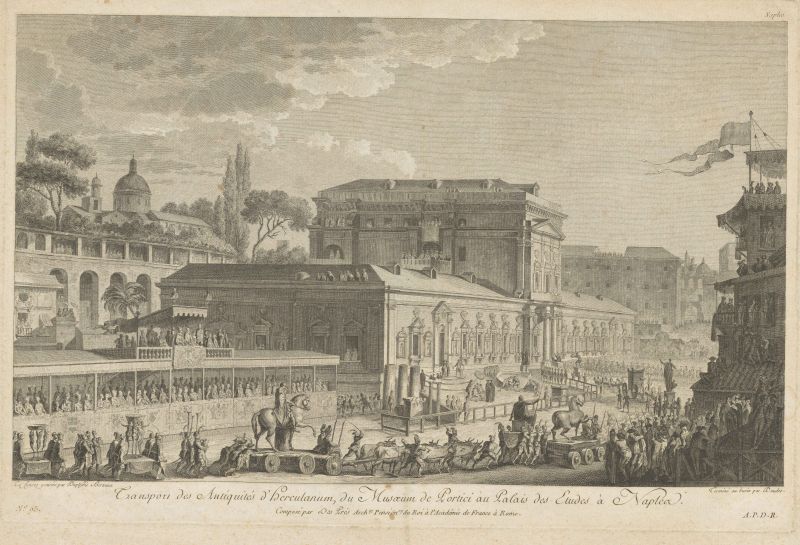
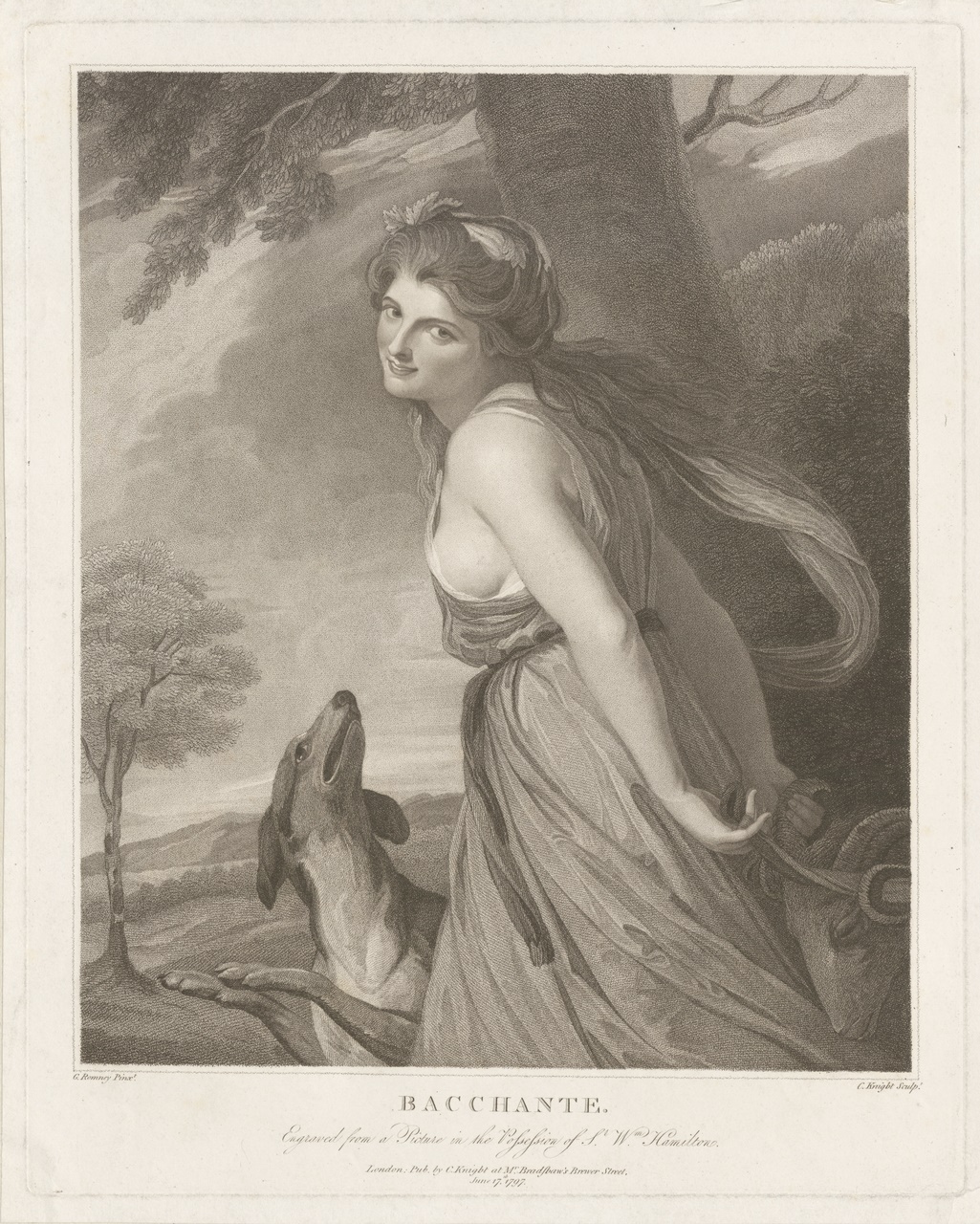
Hamilton’s possession of Emma mirrors the Neapolitan court’s exclusive ownership of Pompeii and Herculaneum. No notetaking or sketching was allowed, and the only reference books on these sites were scholarly, in foreign languages. It is striking, too, that while many prints illustrate workmen with shovels and wheelbarrows, the busy scene is always lorded over by one or two gentlemen, as in The excavation of the Temple of Isis in Pompeii, 1775. Living under censorship, the average Neapolitan might only get a glimpse of ancient statuary and other artefacts as they were trundled around the city, captured in the print Transport of the antiques of Herculaneum, from the Museum of Portici, to the Palace of Naples, 1781-86. But while the collector Hamilton ‘has no existence unless he goes public’ and ‘puts his passions on display’, publicity is very different for Emma. As a woman, celebrity tips over all too quickly into notoriety and vulgar commodification. This is clear in the many satirical prints of the older, fatter Emma, the cruellest of which was James Gillray’s Dido in Despair, 1801. This print references her later scandalous ménage à trois with Lord Nelson, the ‘Hero of the Nile’. Here, as Nelson sails off to fight yet another battle, we see an obese, grief-struck Emma, her wizened, aged husband asleep behind her. Notably, while Sontag is sympathetic to Emma as the trafficked victim of Greville and Hamilton, she is less sympathetic when Emma takes charge of her own love triangle. Alcoholism and an opulent lifestyle take a toll on her beauty, while Nelson is grotesquely battle-scared, missing an eye and an arm. By the time they become lovers, they are already caricatures, animated by Sontag’s animus against them for their alliance with the brutal Neapolitan royal court and its execution of local republicans, many of whom were members of the city’s intellectual élite.3 In revenge Sontag describes the overweight Emma dancing the tarantella and making a fool of herself. Sontag also vulgarly furnishes their house with ‘trophies, pictures, and china celebrating the hero’s victories’. This novelistic depiction of Emma’s declining reputation is mirrored in the shift from Vigée le Brun’s joyful and innocent painting of her as a Bacchante, to the many gleeful later satires, such as Knight’s popular print of Emma, Bacchante (Lady Hamilton), 1797, with its enticing, come-hither glance and one breast revealed. More visually subtle is the tribute paid to Emma and her enduring reputation in a recent exhibition, Inspired by Women (25 Sept 2024 - 23 Mar 2025), staged at The Johnston Collection, a house museum of fine and decorative arts in East Melbourne. In a muslin draped room wittily entitled ‘Gentlemen I have Known’, collection items include two busts and two oval miniatures, placed in front of a painting of the Battle of Trafalgar. Above the door, there hangs a print of Cupid Unveiling Venus, 1800.4
Endnotes
[1] Johann Wolfgang von Goethe, Italian Journey, trans. W. H. Auden and Elizabeth Mayer (Penguin, 1970), 208.
[2] W.S. Lewis and D. Wallace, The Yale Edition of Horace Walpole’s Correspondence (Yale University Press, 1937–83), Volume XI, p. 338.
[3] See the review by British historian Linda Colley in The New York Review of Books (December, 1992), notable for its own anti-Sontag, anti-American animus.
[4] Installation image, ‘Inspired by Women’ exhibition, 25 September 2024—23 March 2025, The Johnston Collection, East Melbourne. Image by Adam Luttick, Luts Photography.