
Introduction
Niobe has long been a byword for hubris and loss. Her boastfulness and taunting of the gods resulted in the massacre of her children (the Niobids). The tragic narrative echoes through the centuries in the form of literary descriptions and emotive imagery. Mentioned by the ancient writers Homer, Sophocles and Ovid, she is the title character in Aeschylus’s partially surviving play, Niobe. The Niobids were a popular subject of artistic focus in the ancient world and multiple Roman copies of Greek sculptures have been uncovered.1

The most well-known and complete group is the sculptural grouping shown in Francois Perrier’s etching (c.1638) and currently displayed in the Uffizi, Florence. The assemblage is made up of fourteen sculptures depicting the Niobids during the onslaught of Apollo and Artemis. They are recognised as second century CE Roman copies of earlier third century BCE Greek sculptures and were uncovered in Rome in 1583.2 There they were displayed in the gardens of the Villa Medici on the Pincian Hill and were a must-see attraction for Grand Tourists visiting Rome. Due to their popularity on the Grand Tour’s itinerary, papal permission was required to remove them from Rome and be transported to Florence in 1770.3 The Niobe grouping, thus, had two settings and contexts during the Grand Tour. The reception and interpretation of this sculptural narrative would have differed in the Roman and Florentine settings. This short essay will explore the changing contexts of the Niobids, focusing on the effect of the displays and spatial narratives on the interpretation of the sculptures and the myth of Niobe.
Niobe’s Everlasting Grief
There are multiple versions of the Niobe myth, but most ancient sources agree she was the daughter of the titan Tantalus and sister of Pelops, founder of the doomed house of Atreus. Married to Amphion, king of Thebes, she bore 14 children: 7 sons and 7 daughters.4 In a moment of fatal pride, Niobe boasted of her superior motherhood compared to Leto, who had borne only two children, the twin gods Apollo and Artemis. Details of the insult are lost, but the aftermath is vivid: Apollo slew her sons, Artemis her daughters. For 9 days the Niobids lay unburied as Niobe, consumed by grief, refused food. Only after Zeus took pity and buried them did she relent. She was finally turned to stone on the peak of Mount Sipylus. Despite her petrified form, her tears continued to swell and fall as an everlasting fountain of grief.5
The Niobids’ Display History
The Perrier print includes a caption identifying the placement of the Roman copies in the Villa Medici gardens, Rome. It continues by referencing the Roman author Pliny’s Naturalis Historia in book 36, chapter 1, where he discusses the authorship of the original Niobid sculptures as possibly by Scopas or Praxiteles.6 In his text, Pliny claims the sculptures were placed in the Temple of Apollo Sosianus in Rome. However, recent scholars have suggested the location was a semicircular fountain in a cavea nymphaeum, or theatre with fountains in the Lamian Gardens on the Esquiline Hill, Rome.7 The theatre was arced with Niobe and her daughter at the centre and eight Niobids on a raised section of the structure.8 Elena Diacciati suggests the remaining figures were placed evenly one of each side and two in the centre at ground level.
There have also been multiple theories about the display of the original Greek sculptures.9 One theory suggests that the sculptures were placed in an external pediment of a temple.10 If the sculptures were displayed in a pediment, this would suggest that Niobe was also placed in the centre with her children displayed in a horizontal line. This varies from the Roman nymphaeum semicircular display, as there would have been greater space between the sculptures compared to a pediment arrangement. In addition, the pediment placement on an Apollonian temple would have emphasised the actions of twin gods, with the triangular shape echoing the mythic hilltop of Sipylus. In comparison, placing the sculptures in an arc with continuous running water would have emphasised the grief of Niobe and her eternal tears. Thus, each hypothesised placement offers a different interpretation or emphasis of the myth.
A Medicean Folly in Rome
Installed in the Medici Garden after its rediscovery in a vineyard in 1583, the grouping was a main highlight for travellers during the Grand Tour.11 The placement of antique sculptures, particularly damaged or partial sculptures, in gardens and grottoes was popular in the sixteenth century, and are early forms of garden follies or amusements.12 Francois Perrier’s etching of the grouping captures the placement of the monumental sculptural grouping in their garden setting at the Villa Medici in Rome. The figures are seen scattered atop a small hill; their chaotic positioning echoing the confusion during the fateful attack of the Delian twins.13 Homer described Niobe’s final place in the Illiad as resting ‘upon the rocks and lonely hills’ of Mount Sipylus.14 Perrier’s image mirrors this description as the sculptures are strewn in groupings or alone in amongst or set on stony outcrops. The principal figure of Niobe at the back of the scene is elevated on a rocky platform and forms the apex or peak of the triangular composition. Her children are scattered in front of their mother scrambling to save themselves. The non-linear placement of these sculptures creates an interwoven composition of writhing and despairing figures, captured in the moment of their demise. The setting and composition undoubtedly referenced the original myth, encouraging the viewer to imagine the horrific onslaught in front of them.
Beyond the emotive and intertwined interaction of the figures, the composition is triangular and encourages a specific reading of the scene. The pyramidal structure and emphasis on an apex and focal point of Niobe highlights the main figure as the instigator of her own doom and recalls the actions of Apollo and Artemis through the hilltop setting. Perrier’s print emphasises this by including fictional additions of the gods poised on clouds above, firing arrows at their victims. All the Niobids and Niobe have faces deeply engrained with anguish and horror. They are all facing to the heavens or shielding themselves from the attack above. This encourages the viewer’s gaze upwards to the frightful gods in their act of retribution. As such, this triangular composition, in the garden setting and in the etching, does not highlight the everlasting grief of Niobe and her tears, but rather the consequence and chaos of her actions.
The Theatre of Niobe in the Uffizi
In 1770, the sculptures were acquired by Grand Duke Pietro Leopoldo of Tuscany. He had seen the sculptures in the Villa Medici gardens and sought to acquire them, with proposals to house them in the Boboli Gardens on a rocky platform or pavilion or in the Galleria degli Uffizi, Florence. The Uffizi, only open for a year prior, was selected as the home of sculptures as part of a ‘revamping’ and ‘new conceptual arrangement of the collection’.15 In 1771 the Scrittoio delle Regie Fabriche proposed that ‘Niobe and her unfortunate children’ should be placed in the stanzone or large hall where the Uffizi had recently begun renovations.16 By 1779, there was great debate about the surrounding decoration of the room. The new director of the Uffizi, Giuseppi Pelli Bencivenni, argued that the room decorations and paintings should be chosen according to the Niobids’ placements.17 Luigi Lanzi, advisor to the director, was adamant that the galleries’ display should be by medium, arguing that the salone should only display the Niobids.18 For differing reasons, Pelli Bencivenni and Lanzi’s arguments demonstrate a distinct understanding and recognition of a spatial narrative and relationship between the three-dimensional and two-dimensional artworks. It wasn’t until 1781-82, under the vision of Pietro Leopoldo, that the Niobids were placed in dialogue with large-scale seventeenth century paintings.19 Four paintings by Rubens, Grisoni and Suttermans were selected to adorn the walls of the new salone for the Niobids.
The Niobids were placed on pedestals on each of the four sides of the room. This linear positioning around the outskirts of the room intended to reference their placement in the nymphaeum in the Lamian Gardens.20 Although not placed in an arc, the Niobids followed a single line as in the nymphaeum. Luigi Lanzi discusses the placement in his 1792 guide of the Uffizi galleries, stating that, due to the shape of the room, the sculptures needed to be placed around the walls rather than in a central grouping, as they had been in Rome.21 Lanzi adds that Francesco Carradori completed four lunettes of Artemis and Apollo in the act of shooting.22 The two paintings by Rubens, showing battle scenes and titled The entry of Henry IV into Paris and Henry IV at the Battle of Ivry (both completed in 1627), were placed at either end of the room. On the corridor side opposite the windows, the Rape of Proserpine (1732) by Giuseppe Grisoni and The Florentine Senate pays homage to Ferdinand II de' Medici as elected Grand Duke (1625) by Justus Sutermans.23
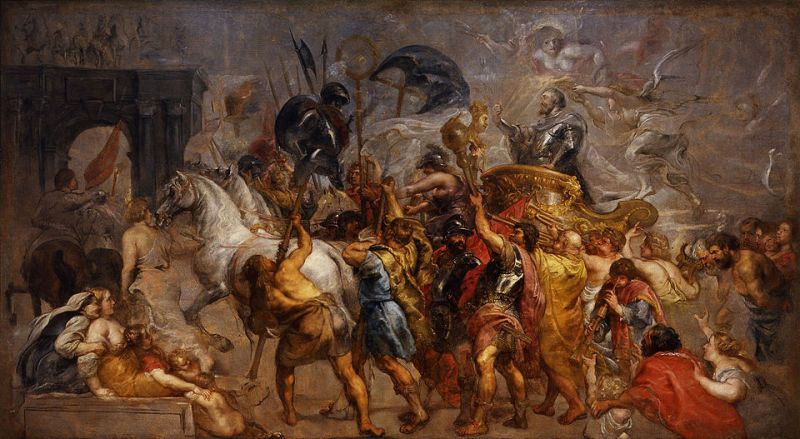
The display of the Niobids transitioned from a triangular display and composition in the Medici Gardens to a lineup of individual plinths or pedestals. This individuates the sculptures and enables close examination and appreciation. In this way, they are less likely to be read as a single narrative and less focus is on the main figure of Niobe. Like in Perrier’s print, the lunettes of Artemis and Apollo firing arrows reference the attack; however, due to the scale of the paintings, the sculptures more actively interact with the large paintings behind. This creates new spatial narratives and visual associations. For example, Niobe stands in front of Rubens’ battle scene trying to shield herself and her daughter from the violence behind her—both from Apollo and Artemis in the lunette and the infantry and cavalry clashing in the painting. To her left and right, other daughters are angled to either protect themselves or flee from the onslaught. The sculptures in front of Suttermans’ canvas all have their faces directed to the enthroned Ferdinand II de’ Medici and the lunette above the entrance to the room.
Further, the scene is no longer linked to the hilltop of Sipylus or to the eternal tears of Niobe’s petrified form. Niobe is also not the central figure of the assemblage. Only her larger scale distinguishes her. However, the affective nature of the sculptural grouping is perpetuated in this display, but it is individuated rather than collective. As Lanzi reasoned, the room did not allow for a combined arrangement. The figures are approached individually in a lateral movement pattern, allowing both an appreciation of the artist’s skill and the despair of each figure. Thus, the room of Niobe is presented as moments of individual emotion and violence, compared to the collective confusion and chaos of the Roman setting.
Changing Tastes and a Timeless Story
The enduring appeal of the Niobid sculptures lies not only in their emotive subject matter but in the changing contexts and corresponding interpretations throughout their display history. During the Grand Tour, their display in the gardens of the Villa Medici and later in the Uffizi offered two differing interpretive frameworks and emphases. In Rome, the garden setting evoked the hilltop scene of the original myth, and the confused composition emphasised the chaos and consequence of Niobe’s actions. By contrast, in Florence, the theatre of sculpture and painting created new spatial narratives and interactions that altered and heightened their interpretation. These display contexts reveal how the reception of the Niobe grouping was subject to evolving tastes - from the antique sculpture gardens of the later Renaissance to the birth of the public museum and art historical viewing in the Uffizi in the eighteenth century. In 1989, the Uffizi began plans to reinstate the Niobe room according to Lanzi’s description.24 This was realised in 2004, ensuring that the myth and grief of Niobe continues to enrapture audiences to this day.
Endnotes
[1] These are mainly Roman copies of earlier Greek sculptures. For example, there is a partially destroyed Niobe grouping from Hadrian’s Villa at Tivoli. One of which, the Chiaramonti Niobid, is now in the Vatican Museums’ collection. See B. Frischer and M. Brennan, “The Niobid project: Digital modeling and restoration of a complex sculptural group at Hadrian's Villa”, Digital Heritage International Congress (DigitalHeritage) (2013): 383-86; Antonio Natali and Antonella Romualdi, A Theatre for Niobe: The Rebirth of a Regal Room in the Uffizi (Giunti,2017), 197-98.
[2] Natali and Romualdi, 195.
[3] Natali and Romualdi, 207.
[4] The number of the children changes in each source. For this essay, I have listed 7 sons and daughters, as the sculptural groupings consists of 14 children and Niobe.
[5] Described by Sophocles in his play Antigone, Niobe is turned to stone on the mountain top. see Thomas Davidson, “The Niobe Group”, The Journal of Speculative Philosophy 9, no. 2 (1875), 146–47.
[6] Pliny. Natural History, vol. 10, Books 36–37, trans. D. E. Eichholz, Loeb Classical Library 419.(Harvard University Press, 1962).
[7] Natali and Romualdi, 195.
[8] Natali and Romualdi, 199.
[9] John Shertzer Hittell, Photographs of Sculpture Presented by John S. Hittell, vol. 6. The University of California, 1886, 7.
[10] Davidson suggests that the original sculptures may have differed in size or scale as the Roman copies. Davidson, 158-159. Hittell suggests that the sculptures were originally in the temple of Apollo in Cilicia, Asia Minor. Hittell, 7.
[11] Natali and Romualdi, 207.
[12] Francis Haskell and Nicholas Penny, Taste and the Antique: The Lure of Classical Sculpture, 1500-1900 (Yale University Press, 1982), 7-8, 12.
For sculpture created in the style of grottoes and antique sculpture, see Una Roman D’Elia, “Giambologna’s Giant and the Cinquecento Villa Garden as a Landscape of Suffering”, Studies in the History of Gardens & Designed Landscapes 1, no. 31 (January 1, 2011): 1–25.
[13] Apollo and Artemis were born on the island of Delos, hence the epithet ‘Delian’.
[14] Davidson, 143-44.
[15] Natali and Romualdi, 207, 145.
[16] Natali and Romualdi, 26-27.
[17] Natali and Romualdi, 26-27.
[18] Natali and Romualdi, 145.
[19] Natali and Romualdi, 8.
[20] Natali and Romualdi, 195-98.
[21] Luigi Antonio Lanzi, La Real Galleria di Firenze accresciuta, e riordinata per comando di SAR l'Arciduca Granduca di Toscana (Mücke, 1782), 74.
[22] Lanzi, 77.
[23] Lanzi, 77.
[24] Natali and Romualdi, 8.