The Burning Mountain: Depicting the Sublime
Dr Richard Gillespie
When William Hamilton arrived in Naples in November 1765 to take on his role as the British ambassador to the Kingdom of Naples and Sicily, he surely could never have anticipated that he would spend more than three decades in Naples – nor that he would become a celebrated collector of Greek vases and an instigator of the scientific study of volcanoes. The fourth son of Lord Archibald Hamilton, he would not inherit the title and wealth, so he tried several careers – first a commission in the army, then elected to Parliament, and finally appointed as ambassador to Naples. Fortuitously, Hamilton’s father-in-law had died two years previously, leaving Hamilton’s wife a substantial income from property in Wales; this would support the Hamilton’s expensive lifestyle in Naples.1
Mount Vesuvius is a dominating presence in Naples, even when inactive. But the volcano was about to commence an active phase in Hamilton’s early years as a resident. At first it was simply belching smoke, and Hamilton would climb the mountain to peer down into the crater and collect lava samples. On an excursion in November 1766 he observed that a hillock of sulphur, issuing a blue flame, had appeared near the summit: ‘As I was examining this phaenomenon, I heard a violent report, and saw a column of black smoke followed by a reddish flame, shoot up with violence from the mouth of the volcano, and presently fell a shower of stones, one of which falling near me, made me retire with some precipitation, and also rendered me more cautious of approaching too near, in subsequent journeys to Vesuvius.’2 Curiosity often overwhelmed caution. Four months later Hamilton heard a major explosion and instantly rushed from Naples: ‘I passed the whole night upon the mountain… I approached the mouth of volcano, as near as I could with prudence; the lava had the appearance of a river of red hot and liquid metal, such as we see in the glass houses, on which were large floating cinders half lighted, and rolling over one another with great precipitation down the side of the mountain, forming a most beautiful and uncommon cascade.’3
Hamilton was perfectly positioned to observe the changes in Vesuvius. His wealth enabled him to maintain four houses in and around Naples: the embassy of Palazzo Sessa, which was both his residence, his private museum and the scene of large banquets; a house at Caserta where in winter Hamilton would shoot game with King Ferdinand; a summer house on the beach at Posillipo, which enjoyed a clear view of Vesuvius across the bay; and a villa at Portici, situated at the foot of Vesuvius, from where Hamilton could undertake close observation of the mountain’s changing behaviour.4
A keen naturalist and antiquarian, Hamilton began sending detailed reports back to the Royal Society of London, where they were read at the society’s meetings and published promptly in its Philosophical Transactions. His reports were accompanied with samples of the different types of lava, sulphur and cinders, both to illustrate his accounts and for chemical analysis. Within a few years Hamilton was casting his net more widely; his 1770 paper on Mount Etna in Sicily was awarded the Copley Medal by the Royal Society. The evidence of volcanic activity was evident throughout southern Italy; he now ‘looked upon mount Vesuvius only as a spot on which nature was at present active, and thought myself fortunate of seeing the manner in which one of her great operations (an operation, I believe, much less out of her common course than is generally imagined) was effected.’5 In 1772 Hamilton would collect all his reports together into a single work, Observations on Mount Vesuvius, Mount Etna, and other volcanos.6
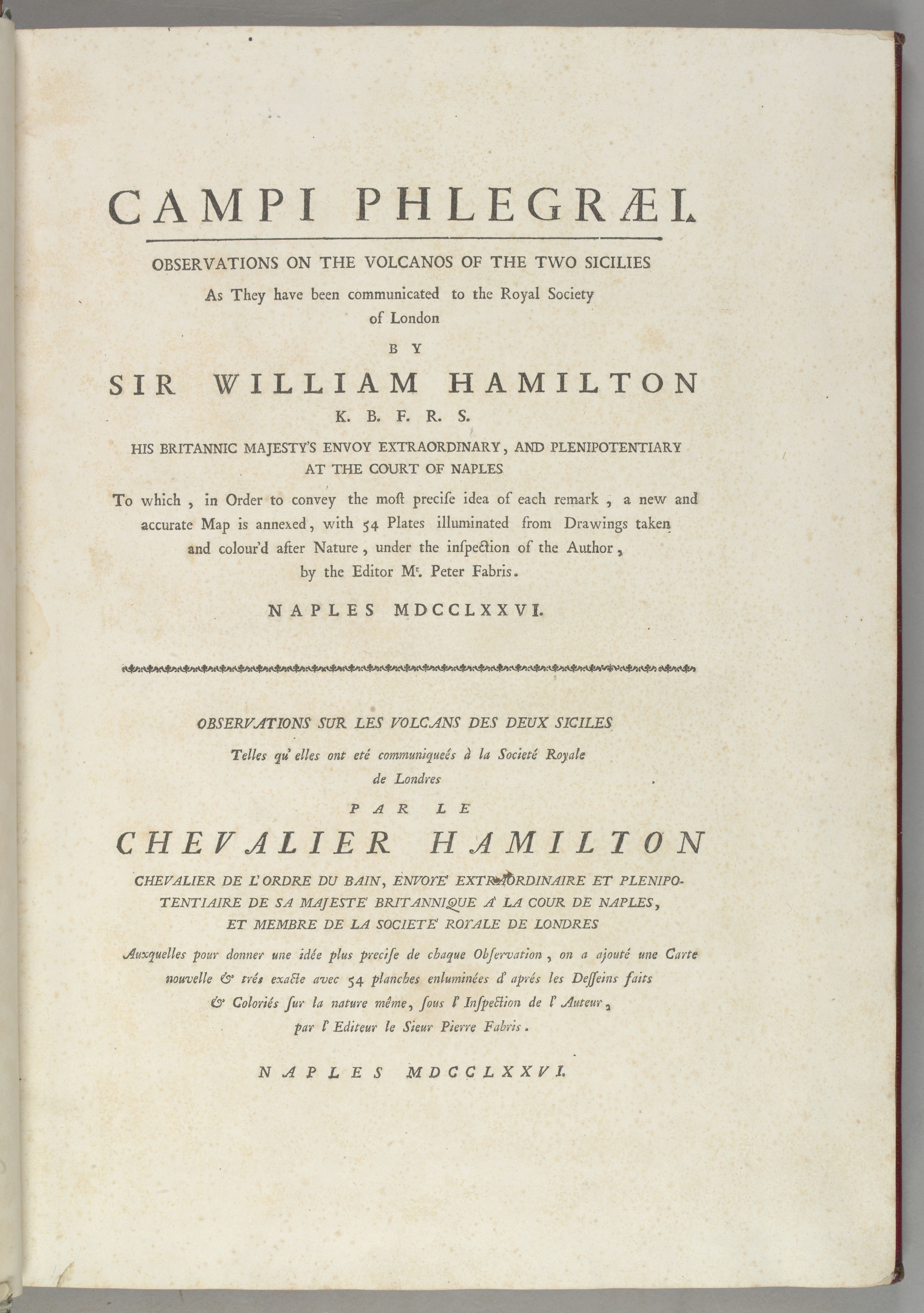
Words and lava samples were well and good; but how to convey the visual power and sublimity of Vesuvius in eruption? Hamilton commissioned British-Italian artist Pietro Fabris to paint the dramatic eruption and lava cascades of 1767. Fabris painted the scene onto transparent fabric, which Hamilton sent to the British Museum with instructions on how to light the image from the rear to create a dramatic night-time effect. Sir John Pringle, council member of the Royal Society reported to Hamilton the impact of the painting on viewers: ‘The representation of that grand & terrible scene, by means of the transparent colours, was so lively & so striking, that there seemed to be nothing wanting in us distant spectators but the fright that every body must have been fired with who were near.’7 Encouraged by similar responses, Hamilton commissioned Fabris to undertake an extraordinary set of 54 gouache paintings of Vesuvius in eruption, the lava fields in the region, and detailed depictions of lava samples, combining the plates with his previous reports and publishing it in 1776 as Campi phlegraei: Observations on the volcanoes of the Two Sicilies.8
Since the mid-18th century Naples had been an increasingly popular destination on the itinerary of Grand Tourists. It was the third-largest city in Europe, with the attractions of the court of King Ferdinand and Queen Maria Carolina, the palaces and opera, the colourful Neapolitan street life, and the antiquities recovered from nearby Herculaneum and Pompeii, housed in the Real Museo Borbonico, one of the earliest and finest public museums in Europe. The more adventurous tourists could risk malaria, bad roads and bandits to venture 100 kilometers south to Paestum, site of three imposing Greek temples.
But Vesuvius formed the centerpiece of a seductive blend of tourism, commerce, danger and the sublime. Approaching Naples by coach in the middle of the night, English writer and diarist Hester Lynch Piozzi described the scene in her two-volume account of her travels in the mid-1780s; ’Never was such weather seen by me since I first came into the world; thunder, lightning, storm at sea, rain and wind, contending for mastery, and combining to extinguish the torches bought to light us the last stage: Vesuvius, vomiting fire, and pouring torrents of red hot lava down its sides, was the only object visible; and that we saw plainly in the afternoon thirty miles off, where I asked a Franciscan friar, If it was the famous volcano? “Yes,” replied he, “that’s our mountain, which throws up money for us, by calling foreigners to see the extraordinary effects of so surprising a phaenomenon.’9 Like the other tourists, Piozzi and her party climbed and were assisted up Vesuvius to be astonished by the dramatic landscape and the diversity of the lava fields.
The appetite for Vesuvius in Britain, especially in London, was fired by the eruptions and by Hamilton’s accounts. English actor and producer David Garrick introduced scenes of Vesuvius erupting in his production of The Witches at Drury Lane Theatre in 1771, while artist Joseph Wright of Derby exhibited dramatic paintings of Vesuvius erupting−although these were imaginative works based on Hamilton’s accounts as Vesuvius did not erupt during Wright’s visit to Italy. The elaborate pleasure gardens in London, which would often conclude their night-time events with a fireworks show, re-themed these as volcanic eruptions. Hamilton fed the enthusiasm, commissioning Neapolitan modeller Giovanni Altieri to make a large three-dimensional model of the volcano that would be sent to George III.10
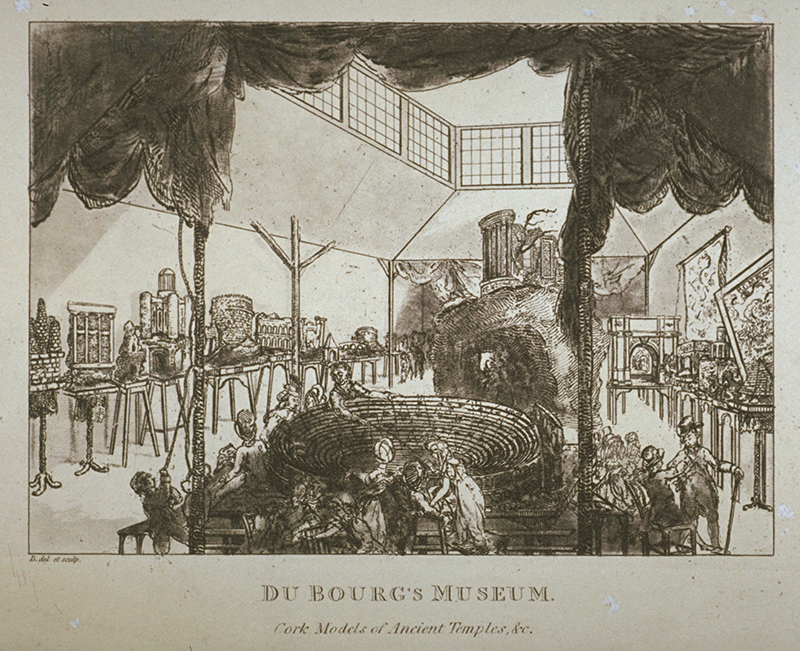
One depiction of Vesuvius remained an attraction in London for decades. English artist and modeller Richard Du Bourg began holding exhibitions in London of cork models of classical sites in Italy from 1775. Appropriately, the technique of using cork to construct architectural models had been developed in Naples for the construction of nativity scenes or presepi. After two seasons Du Bourg introduced ‘several new Models, never before exhibited, particularly a Model of Mount Vesuvius in the time of an eruption, with the flowing of the lava’. Drawing on a mixture of theatrical techniques and mechanisms, Du Bourg’s model amazed visitors, a newspaper account reporting that the model ‘gives a perfect idea of it in that tremendous state, the colours and flowing of the lava justly represented, and beyond any thing I have seen or could imagine’.11 His exhibition burned down in 1785 (some newspapers claimed that the Vesuvius model had started the conflagration; Du Bourg vehemently denied this). He would restart his exhibition at the end of the century, and it continued until 1819 complete with a Vesuvius erupting and with smells produced by burning pitch. Du Bourg’s ‘Classical Exhibition’ provided a virtual Grand Tour for those who could not afford to travel, as an alternative due to the cessation of tourism during the Napoleonic wars, or to remind past tourists of the sites they had visited.12
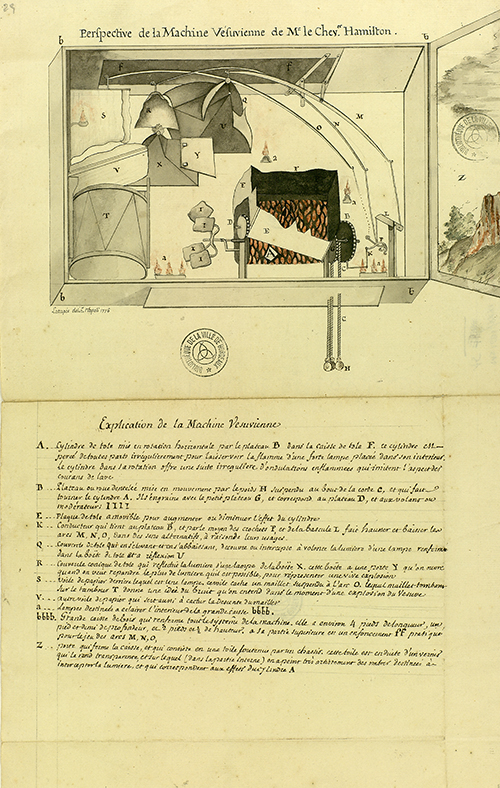
William Hamilton also experimented with creating a more animated version of the backlit transparency of Vesuvius that he had sent to the British Museum. That original 1768 transparency had seemingly used lights in different positions to bring Fabris’s painting to life. But Hamilton was well aware of the stage mechanisms used in theatres, sending David Garrick a painting of Vesuvius and an account of a mechanical contrivance to bring the painting to life. That letter has not survived, but French naturalist Françoise de Paule Latapie made a detailed sketch of Hamilton’s Vesuvian apparatus while visiting Italy in 1776, and that sketch has fortuitously survived in the Bibliothèque municipale de Bordeaux.13
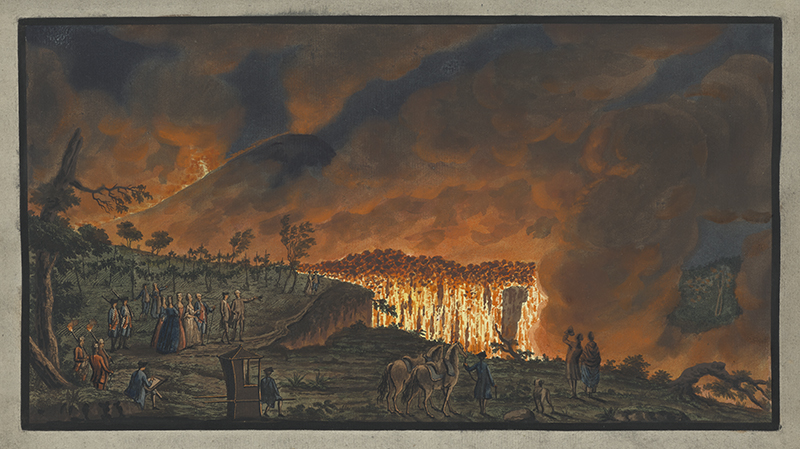
The apparatus was designed to animate plate 38 in Hamilton’s Campi Phlegraei, ‘Night view of a current of lava, that ran from Mount Vesuvius towards Resina, the 11th of May 1771.’ The view showed a cascade of lava falling into a valley, with Hamilton depicted in the foreground showing the dramatic sight to the King and Queen of Naples. Pietro Fabris includes himself lower left, sketching the scene in preparation for his detailed painting. It is unclear if this mechanism was ever constructed; there is no unambiguous description of it by a contemporary, although Latapie’s detailed description seems to indicate that Hamilton did have it in one of his Neapolitan residences. The back-lit transparency sent by Hamilton to the British Museum has also not survived.
The Grand Tour exhibition in the Baillieu Library provided an ideal opportunity to create a modern version of Hamilton’s Vesuvian apparatus. Hamilton’s apparatus used a clockwork drive to rotate a perforated drum that would filter candlelight onto the lava cascade; an additional mechanism lifted vanes to reveal lava flow higher up the volcano, while the mechanism could also strike a drum to mimic explosions. An interdisciplinary team from the Faculty of Engineering and Information Technology and Student and Scholarly Services has collaborated to use modern mechatronics to reproduce the likely effect.
Now, 250 years later, like Vesuvius long dormant, Hamilton’s Vesuvian apparatus is erupting in the Baillieu Library.
Endnotes
[1] For an overview of Hamilton’s collecting and scientific activities in Italy, see Ian Jenkins & Kim Sloan, Vases and volcanoes, Sir William Hamilton and his collection (British Museum Press, 1996), a catalogue accompanying the British Museum exhibition.
[2] Philosophical Transactions of the Royal Society, 57 (Royal Society,1767), 193
[3] Philosophical Transactions of the Royal Society, 57 (Royal Society, 1767), 194
[4] Carlo Knight, “Sir William Hamilton’s Neapolitan houses”, The First Naples Conference (2006). URL: https://herculaneum.classics.ox.ac.uk/index.php/papers-from-the-first-naples-conference/
[5] William Hamilton, Philosophical Transactions of the Royal Society, 61 (Royal Society, 1771), 40
[6] William Hamilton, Observations on Mount Vesuvius, Mount Etna and other volcanoes ( T. Cadell, 1772)
[7] John Pringle to William Hamilton, 2 May 1768, Correspondence and Papers of Sir William Hamilton, British Library Add MS 42059
[8] William Hamilton, Campi phlegraei: observations on the volcanoes of the Two Sicilies, (Publisher not identified, 1776)
[9] Hester Lynch Piozzi, Observations and reflections made in the course of a journey through France, Italy and Germany, Vol.II A. Strahan and T. Cadell, 1789), 1-2. On tourism to Vesuvius in the late 18th and 19th centuries, John Brewer, Volcanic: Vesuvius in the Age of Revolutions (Yale University Press, 2023)
[10] Theatrical Review, Vol. I, (1772), 327-8; Nicholas Daly, “The volcanic disaster narrative: from pleasure garden to canvas, page and stage”, Victorian Studies, 53 (2011), 255-285; Pietro D’Onofri, Elogio estemporaneo per la gloriosa memoria di Carlo III (Pietro Pergher, 1789)
[11] Gazetteer and New Daily Advertiser, 2 June 1778
[12] Richard Gillespie, ‘Richard Du Bourg’s “Classical Exhibition”, 1775-1819’, Journal of the History of Collections, 29 no. 2 (2017), 251-269
[13] Françoise de Paule Latapie, Hamilton’s Vesuvian Apparatus, Bibliothèque municipale de Bordeaux, Fonds Lamontaigne, Ms 1696, xxxi, 15; Bent Sørenson, ‘Sir William Hamilton’s Vesuvian Apparatus’, Apollo, 159 (2004), 50-57