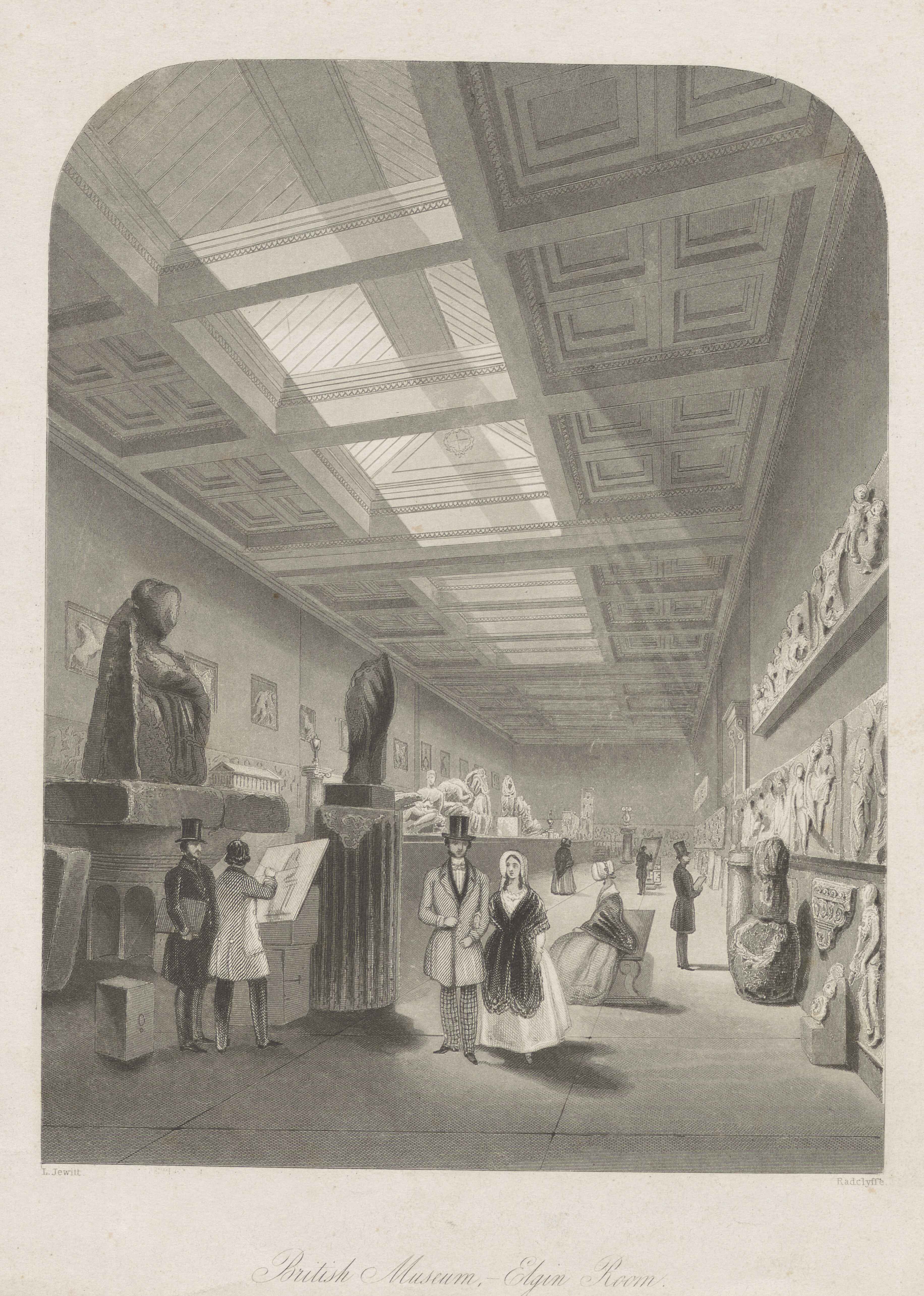
Visitors to mid-nineteenth-century London were able to enjoy a vast influx of priceless antiquities that had poured into the nation’s capital during the Grand Tour and the decades thereafter. Two prints, by Edward Radclyffe and Jackson Mason, show the impact of this paradigm shift in the rise of a global museology. They depict two of the most influential of these new sites for public display that were situated just a kilometre from each other in the city’s centre. In one we see the newly constructed Elgin Room in the British Museum, designed in the 1820s by Robert Smirke (1780-1867) to house the renowned Parthenon Sculptures as part of his wider modernisation of the old British Museum site.1 In the other we see a crowded array of plaster casts, sculptures and artefacts that had been brought together by the visionary architect and collector, Sir John Soane (1753-1837), to form the basis of the recently inaugurated private museum founded in his name.2
Two factors made possible the removal of the Parthenon Sculptures from the Temple of Athena on the Athenian Acropolis and their subsequent relocation to far-off London. One was the political intervention of Thomas Bruce, 7th Earl of Elgin (1766-1841), acting in his capacity as British Ambassador to the Ottoman Empire. The other was the Turkish antipathy towards Greek cultural heritage during their dominion over the region on behalf of the Sultan in Constantinople.3 Elgin had initially intended to display the Sculptures on his own property. But their removal and relocation had left him bankrupt. As a result he was forced to sell them to the British Government who commissioned a special Parliamentary Select Committee to look into the matter before eventually acquiring them for the British Museum in 1816 (a further complicating factor, incidentally, for the Greek Government today since it requires them to negotiate for the Sculptures’ return with both the Museum and the British Government simultaneously).
The Parthenon Sculptures were initially housed in a shed tacked onto the side of the Museum while more suitable accommodation could be found for them. Here they remained more or less exposed to the elements - alternatively baking or freezing depending on conditions - while attracting the first of many negative assessments regarding their display. A sense of the inherent inappropriateness of detaching them from their original context is already evident, for example, in Byron’s Childe Harold, with its referenceto‘shrinking gods to northern climes abhorred’ (1822-25, canto 2, stanza XV). The sentiment is expressed yet more forcefully in Thomas Hardy’s Christmas in the Elgin Room of 1905.Here the frozen statues complain to the visitor about having to endure an eternal exile in ‘the gloom/Of this gaunt room/Which sunlight shuns and sweet Aurore but enters cold’ (1905, lines 17-20).
The options for viewing antiquities in the UK had, in fact, been limited up until that time. This was because most of the collections then in existence tended to be locked away in English country houses belonging to the small but dedicated band of members of the landed gentry with the money and the inclination to pursue such lofty ideals. Notable examples included Thomas Coke, later 1st Earl of Leicester (1697-1759), for whom William Kent had designed the fabulously elaborate Marble Hall and Statue Gallery at Holkham Hall in Norfolk.4 Now seventy years later Smirke’s design for the Elgin Room sought to do away with the perceived pomposity and architectural inaccuracies of Kent’s Palladian approach in favour of a more austere and ‘correct’ Greek Revival style. This resulted in the creation of a stripped back and lucidly rational exhibition space that allowed the Parthenon Sculptures to stand out more clearly from their surrounds without the distraction of excessive ornamentation or architectural detailing. Smirke’s Elgin Room thus expressed an emerging museological ideal in favour of recasting the museum as a series of clear and didactic museum gallery-boxes – a modernising approach that would eventually lead to the ubiquitous white cube gallery of the twentieth century.
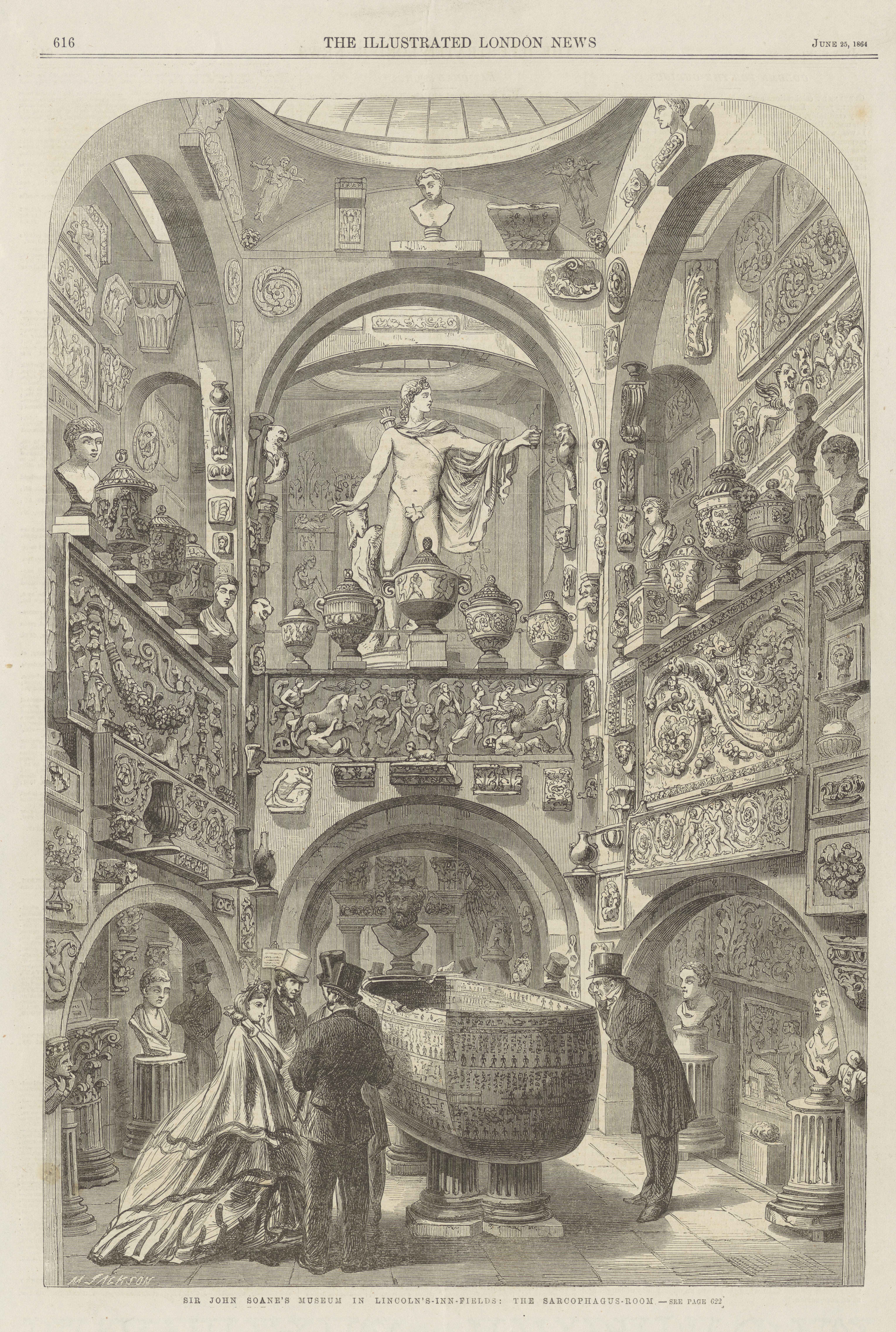
Sir John Soane, by contrast, pursued a much more luxuriant agenda for his museum which was founded on the idea of the artful juxtaposition. Here the beauty of the individual artefact is allowed to become almost engulfed by the sheer profusion of an artful mixing together of objects with their opposites - originals with facsimile casts, complete artefacts with disjointed fragments, and modern with ancient. The result is an interweaving of objects into an immersive and exploratory display environment that constitutes a unique and unforgettable work of art in its own right. The visual impact of this approach, moreover, was further magnified by virtue of its being crammed into a series of small rooms stacked on top of each other and squeezed into a single three-story London townhouse. The Sir John Soane’s Museum was first opened to the public by bequest from the architect in 1833 and remains accessible today as one of the city’s lesser-known treasures. Impossible to do justice to via conventional photography, it has to be seen to be believed.
The Soane Museum might offer a radical alternative to the progressive didacticism of the British Museum. Yet it would be all too easy to view it as a Neoclassical version of the wilful eccentricities exhibited in the Baroque Wunderkammer collections of the seventeenth century, for example, with their cramped displays of stuffed mermaids, narwhal horns and classical statuary. Soane was, in fact, highly precise and purposeful in his arrangement of the collections, tinkering with them endlessly in order to express a complex series of ideas about the evolution of ornamentation over time together with yet deeper notions of history, entropy and the centrality of death. He was also an early forerunner of the thematic display, carefully curating a series of themed rooms each expressing a different narrative that contributed to the cumulative effect of the Museum as a whole.
Mason's print emphasises this by highlighting the central role played by the basement gallery – or so-called Sarcophagus Room. This was designed to function as a kind of crypt reminiscent of the original Roman burial chambers or catacombs from out of which many of the archaeological discoveries of the Grand Tour had been excavated. It thus functions as a kind of deconstructed museum – or museum in reverse – as presided over by a bust of Pluto, the god of the Underworld, and surrounded by a host of funerary objects inching their way upwards from the sepulchral gloom towards the brightness and airiness of the Colonnade and Dome above. This enlightened space was presided over, in turn, by a cast of the famous Apollo Belvedere statue in the Vatican, Apollo being God of music and the arts, and long associated with the concept of the museum via the muses who accompany him and who lend their name to the Latin term for the museum – Musaeum, or Locus Musus, space of the muses.5
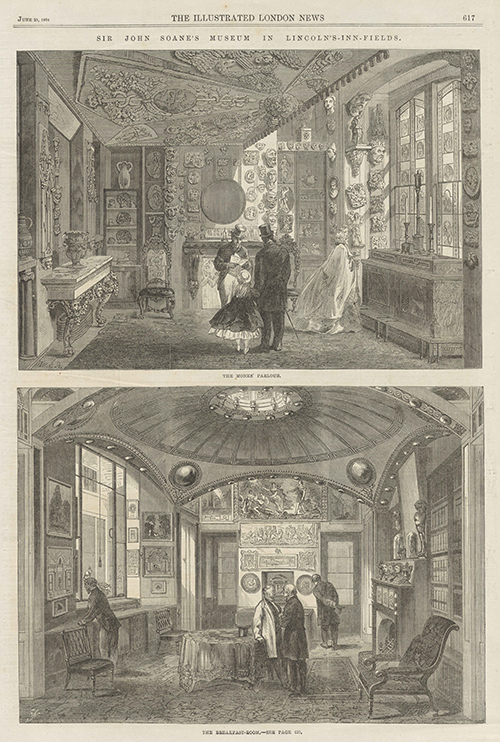
Mason’s ”Monk’s Parlour” adds to the prevailing tomb-like atmosphere of the basement. Designed in the Gothic manner, this small room was said to be inhabited by the imaginary ghost of a medieval monk named ‘padre Giovanni’. Father John was given a make-believe tomb (actually reserved for the remains of the Soanes’ pet dog Fanny) and conjured up via the addition of an articulated human skeleton that had been purchased just prior to Soane’s own death in 1837. Soane would have surely appreciated this alignment of the death-filled imagery of his collection with the personal circumstances of his own eventual demise. His obsession with death found its most spectacular expression in the alabaster Sarcophagus of King Seti I (1303-1290 BCE) towards which the visitors in the print direct their attention. This was one of the most significant archaeological discoveries of its day and it helped establish the Soane Museum as a major stop along the city’s tourist itinerary. Taken from the Valley of the Kings in 1817 it had been initially offered to the British Museum who had nonetheless baulked at its high asking price of £2000. Snapping it up instead, Soane had then demonstrated a flair for showmanship by celebrating its arrival at his museum by hosting no fewer than three lavish evening parties for nearly 1000 guests for which he ordered more than 300 oil lamps to illuminate the Museum at night. In their very different ways then, the Elgin Room of the British Museum and the Sarcophagus Room of the Sir John Soane’s Museum both highlight the central importance of architecture and exhibition design in shaping two such radically differing settings for the display of antiquities in the rapidly evolving landscape of nineteenth-century-European museology.
Endnotes
[1] For the early display of the Parthenon Sculptures, see Ian Jenkins, Archaeologists and Aesthetes: In the Sculpture Galleries of the British Museum (British Museum Press, 1992),75-101. For their more recent history, see Christopher R. Marshall, “Athens, London or Bilbao? Contested Narratives of Display in the Parthenon Galleries of the British Museum”, Suzanne MacLeod, Laura Hourston Hanks and Jonathan Hale (eds.), Museum Making: Narratives, Architectures, Exhibitions (Routledge, 2012), 34-47.
[2] For the Sir John Soane’s Museum, see most recently, Bruce Boucher, John Soane’s Cabinet of Curiosities: Reflections on an Architect and His Collection (Yale University Press, 2024).
[3] The bibliography on the legal and ethical issues relating to the Parthenon Sculptures is immense, but for a useful recent text, see Catharine Titi, The Parthenon Marbles and International Law (Springer, 2023).
[4] For the early development of English sculpture galleries, see Ruth Guilding, “Marble Mania – The Taste for Antique Sculpture”, in Marble Mania: Sculpture Galleries in England, 1640-1840, exhibition catalogue, edited by Ruth Guilding, (Sir John Soane’s Museum, 2001), 4-15.
[5] The classic study of this concept remains Paula Findlen, “The Museum: Its Classical Etymology and Renaissance Genealogy”, Journal of the History of Collections, 1/1(1989), 59-78.