…foreign travel completes the education of the English gentleman… At home we are content to move in the daily round of pleasure and business… But in a foreign country, curiosity is our business and our pleasure; and the traveller, conscious of his ignorance and covetous of his time, is diligent in the search and the view of every object that can deserve his attention.1
Writing while summering at his family estate in Buriton in 1762, the English historian Edward Gibbon (1737-94) mused on the role of travel in his education. These travels would take him to Switzerland, France, and ultimately Italy. In Rome, he would be inspired to write the work for which he is best remembered today:
It was at Rome, on the 15th of October 1764, as I sat musing amidst the ruins of the Capitol, while the bare-footed friars were singing vespers in the Temple of Jupiter, that the idea of writing the decline and fall of the city first started to my mind.2
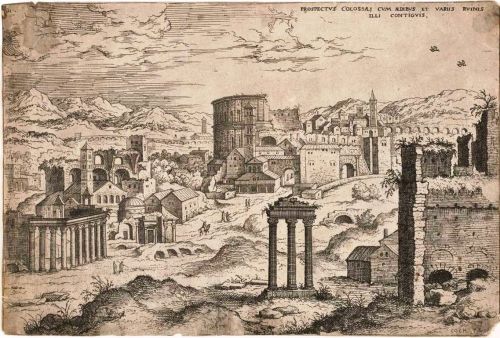
This seed of an idea would ultimately develop into The History of the Decline and Fall of the Roman Empire, published in six volumes from 1776 to 1789. While Gibbon was undoubtedly one of the most prolific writers to come out of the Grand Tour, he was not the only person to make such a journey. The Grand Tour, with its regime of sites and images, would have a profound cultural impact, and on architecture in particular.
From the seventeenth through the nineteenth centuries, an itinerary of European travel would become a common practice of the British elite. As argued by James Buzard, ‘the Grand Tour was, from start to finish, an ideological exercise.’3 Part finishing school, part social ritual, such travels came to be seen as an indispensable part of the education of young men (and, less often, women) of the ruling class. People had travelled before, and written about their travels too. From Marco Polo and Ibn Battuta, to the pilgrims of the Middle Ages, accounts of travel were an established genre. Yet the Grand Tour was also something new. Bathed in the afterglow of the Renaissance’s fervor for Graeco-Roman antiquity, and shaped by the nascent impulse to categorize and collect that developed during the Enlightenment, the Grand Tour would establish a cultural agenda and matching itinerary that was followed by travellers for centuries. The sites that travellers visited would reinforce collective interest in classical architecture, shaping the design of buildings across Europe and, by extension through colonisation, much of the world well into the twentieth century.
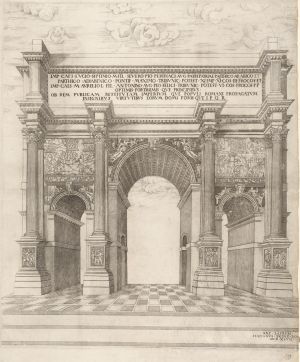
These architectural preoccupations can be seen in the things travellers took home as mementoes – some of which is now on display as part of this exhibition. Rome and its ruins loom large here, as they had done since the Italian Renaissance. The engravings of Flemish artist Hieronymus Cock (1510-70), made some two centuries before The Decline and Fall was written, depict scenes not unlike the one which would inspire Gibbon. They reflect an interest that would only grow over time. More technical in his approach is the work of the Burgundian engraver Antoine Lafréry (1512-77), whose 1547 engraving of the The Arch of Septimus in Rome, seen in reconstructed form, scrubs the ravages of time from the edifice. Architects who could not afford to undertake the Grand Tour could still learn from prints like these, and dissemination of such images would serve as an educational aid and model for architects across Europe and beyond.
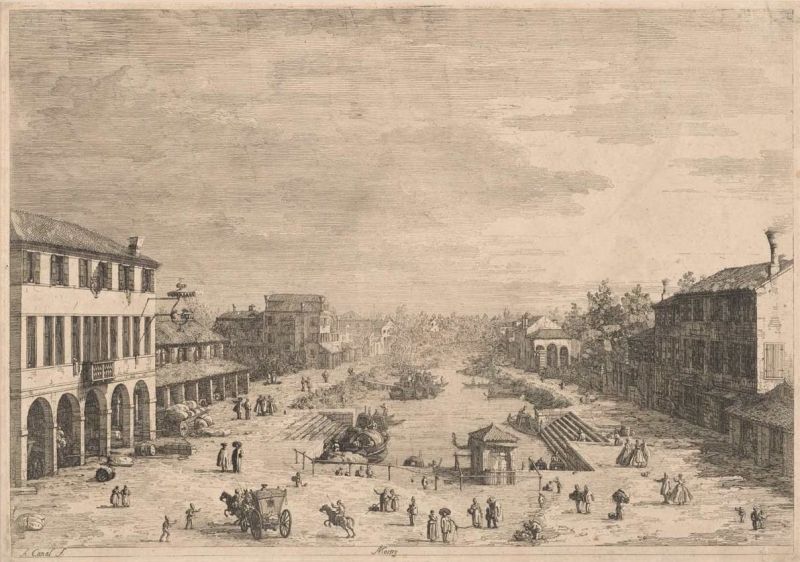
One of the most significant architects to undertake the Grand Tour was the Englishman John Soane (1753-1837). Soane’s travels would take him to Paris, Naples, Rome, and Palermo, with numerous excursions beyond. In letters home, Soane would advise his friends: ‘I need not tell you my attention is entirely taken up in the seeing and examining the numerous and inestimable remains of Antiquity’.4 Soane was also an avid collector, and his house museum on Lincoln’s Inn Fields in London is filled with casts made from ruins and paintings of places he visited.5 Among the artists he collected was Giovanni Antonio Canal (1697-1768), also known as Canaletto, whose vedute of his hometown Venice continue to be prized by museum collections. A Canaletto etching of Mestre c.1740-46, is on display as part of this exhibition.
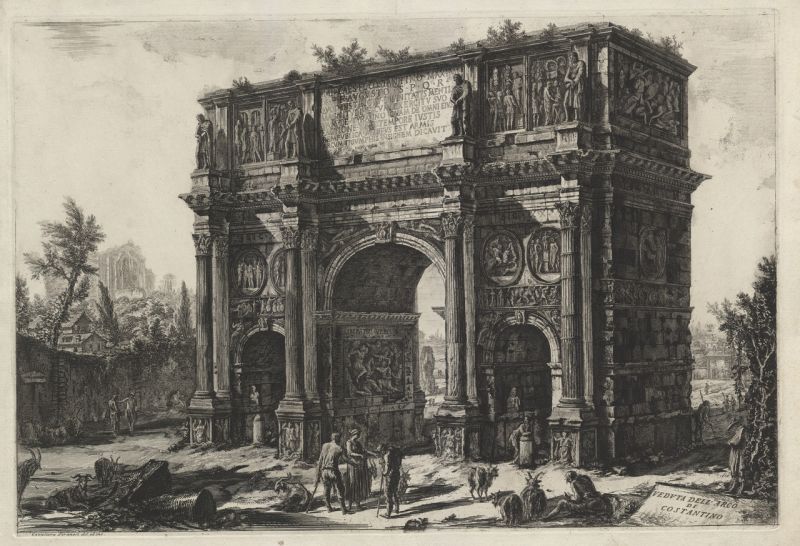
Though working in a different medium, what Soane did with this inspiration from his travels was no less prodigious than the work Gibbon produced. Where many Regency architects looked to the classical orders for geometric rules and proportions, in Soane’s work classical elements were stylised or distorted and classical rules subverted to create a singular approach to the classical language. While these idiosyncrasies opened Soane up to criticism from his contemporaries, his imaginative approach to architecture continues to attract the admiration of architects to this day.6Among Soane’s most famous works was the Bank of England, described by the architectural historian John Summerson as ‘an interior of a kind previously unknown in England and not found elsewhere except in a type of Byzantine church with which few English architects were familiar and which none would have regarded as an acceptable model for imitation.’7 As with Piranesi’s inventive reworking of ancient monuments, Soane’s Bank of England translated ideas he encountered on his travels to create a new modern office space. In line with the Romantic aesthetics of the time, Soane’s new building would be depicted as a ruin by the artist Joseph Michael Gandy (1771-1843), anticipating the demolition of its banking chambers in 1925.
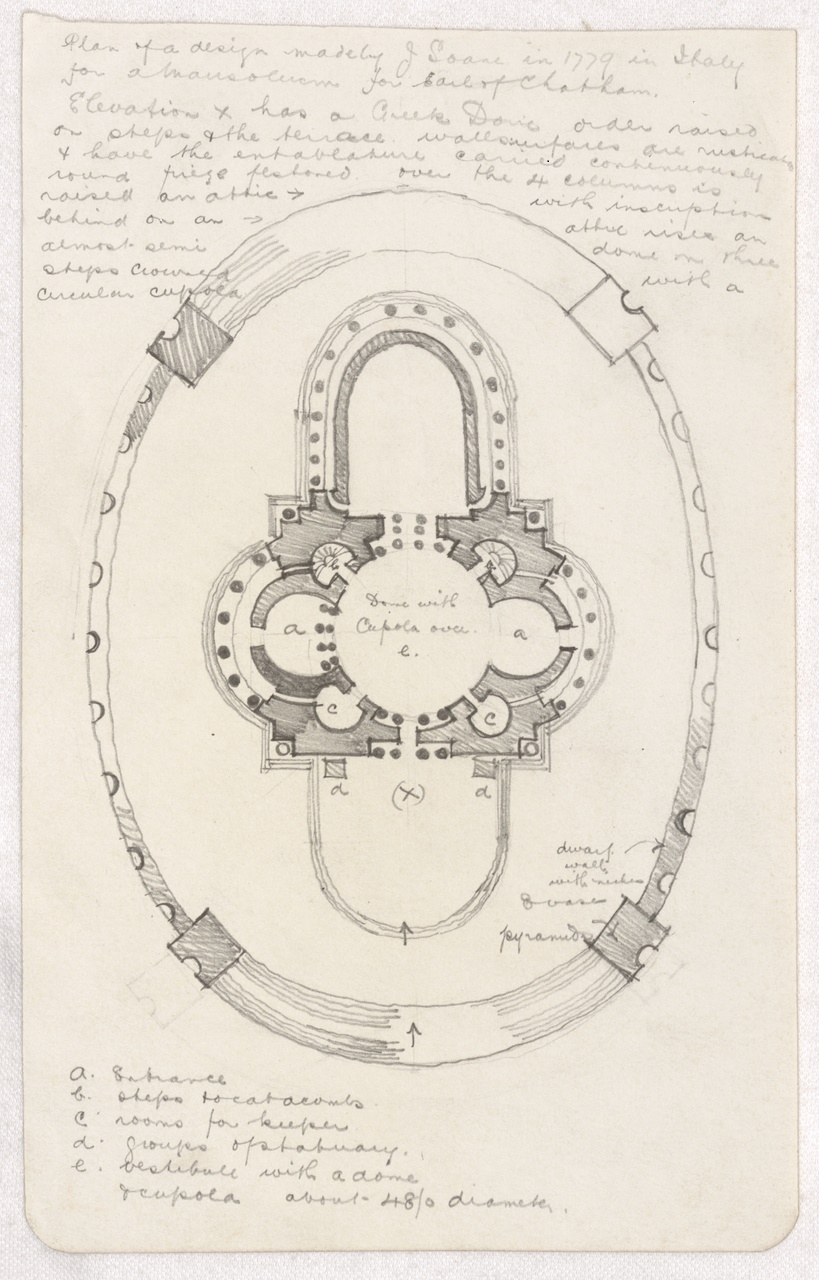
Australians, too, would make their own Grand Tours, drawing inspiration from echoes of the past. Born in Suva, Fiji in 1885, the Australian architect John Lionel Berry (1885-1962) would make his own version of the Grand Tour, travelling to England to complete his architectural education. Berry’s early work would be influenced by what he saw there, drawing on English Georgian architecture, an interest shared with his colleague William Hardy Wilson. Yet we know Berry also engaged with Soane’s work, and the two Soane sketches in this exhibition – the plan for a mausoleum at Chatham and a drawing of the corner rotunda at the Bank of England – come from Berry’s collection. Echoes of the Grand Tour can be seen in Berry’s work into the 1920s. The Ku-ring-gai Council Chambers, designed by Neave & Berry in 1928, with its medallion-crusted loggia, echoes the Ospedale degli Innocenti in Florence.
The travels of British aristocrats from the seventeenth to nineteenth centuries might seem remote to us today. Yet echoes of the Grand Tour and its architectural preoccupations echo in the present. Classicism, and its spread across the world through colonisation and conquest, is increasingly being re-examined by scholars through new lenses.8 Things collected by Grand Tourists are the subject of ongoing disputes about the repatriation of artefacts, none more so than the Parthenon Marbles still held by the British Museum. The appropriation of classicism in contemporary culture wars has become increasingly contentious in recent years. The question of classicism was most recently relitigated in January of this year through the Trump administration’s memorandum on ‘Promoting Beautiful Federal Civic Architecture’, which requires US federal government to ‘be visually identifiable as civic buildings and respect regional, traditional, and classical architectural heritage’.9 Just as they did for travellers in the eighteenth century, the ruins of the past loom large in the architectural imagination and discourse of the twenty-first century. The works on display at this exhibition invite us to, like Gibbon, sit musing amidst the ruins.
Endnotes
[1] Edward Gibbon, Miscellaneous Works of Edward Gibbon, Esquire, with Memoirs of His Life and Writings (J.J. Tourneisen, 1796), 124.
[2] Ibid., 137.
[3] James Buzard, “The Grand Tour and after (1660-1840)”, The Cambridge Companion to Travel Writing, ed.Peter Hulme and Tim Young (Cambridge University Press, 2002), 38
[4] Lola Kantor-Kazovsky, Piranesi as Interpreter of Roman Architecture and the Origins of His Intellectual World (L.S. Olschki, 2006), 75.
[5] Cited in Dorothy Stroud, Sir John Soane, Architect (Giles de la Mare, 1996), 31.
[6] Other tourists did not content themselves with engravings and plaster casts. As Ottoman rule weakened in Greece, Britons and other Europeans would collect statues, obelisks, and even the façades of temples, depositing them in museums in London, Paris, and Berlin.
[7] Oliver Bradbury, Sir John Soane’s Influence on Architecture from 1791: A Continuing Legacy (Routledge, 2016), 14-16.
[8] John Summerson, ‘The evolution of Soane's Bank Stock Office at the Bank of England’, Architectural History 27 (1984):135.
[9] See, for example: Mark Bradley (Ed.), Classics and Imperialism in the British Empire (Oxford University Press, 2010);Phiroze Vasunia, The Classics and Colonial India (Oxford University Press, 2013); Soon-Tzu Speechley, Malayan Classicism: From the Architecture of Empire to Asian Vernacular (Bloomsbury Visual Arts, 2023).
[10] “Promoting Beautiful Federal Civic Architecture”, The White House Website, 20 January 2025, URL: https://www.whitehouse.gov/presidential-actions/2025/01/promoting-beautiful-federal-civic-architecture/.