This question of “reason” , this methodological question, is essential, now that history makes more and more frequent use of art images as documents or objects of specific study. This question of “reason” is essential, because through it we can reach a basic understanding of what the history of art expects from its object of study.
Georges Didi-Huberman, Confronting images, 2005.1
The reasons why
In the process of developing The Grand Tour, two overarching questions were asked by, and of, myself and my colleagues. First, why the Grand Tour? Why present an exhibition that ‘explores a cultural right-of-passage of informal education and secular tourism undertaken on the Italian Peninsular by, predominately, young British upper-class men during the eighteenth century’2 at the University of Melbourne today? Second, how should we do this? How do you interpret a small selection of historic European prints that hinge on a sprawling topic that ‘holds a multitude of contemporary complexities’3 to create a narrative that is respectful of the people and materials involved, and which seeks to have relevance in the face of a spectrum of colonial cultural debates circulating in present day Australia? The answer to the first question is simple, and involves a life spent curating collections and an act of enormous generosity. The answer to the second question is less straightforward, and provided the intellectual challenge that guided the methodology and aesthetic decision-making that underpins The Grand Tour’s curatorial rationale.
The genesis for The Grand Tour came in 2024, when Terence (Terry) Lane OAM (1946-2024) gifted a collection of 96 French, British, Italian, Dutch and Flemish prints, dating from the late-1500s to the mid-1900s, to the University of Melbourne. A curator of Australian and European decorative art, Lane worked at the National Gallery of Victoria while also compiling an expansive private collection of art, rare books and ephemera over the course of his life. The subject of the Grand Tour was an important part of his extensive collecting activity. Collected over a 20-year period, with the intention that it would eventually reside at the University of Melbourne to be used for research and teaching, the Terence Lane Collection provided the rich contextual framework for the exhibition currently on display in the Noel Shaw Gallery at the Bailleu Library.
The decision to frame The Grand Tour from an historical perspective, showing us how it appeared − and was presented back − to those who participated in it, is a decision based largely on the make-up of Lane’s collection − itself almost certainly based on the 1996 exhibition Vase & Volcanoes: Sir William Hamilton and his collection, curated by Ian Jenkins and Kim Sloan for the British Museum, London.4 It is important to make clear, though, that The Grand Tour is not the exhibition that Terence Lane would have made had he been given the opportunity to do so. Visiting Terry in his beautifully decorated house in Carlton, it was clear that he loved and lived the life of the modern seventeenth-century collector. Sadly, we can now only speculate that had he curated this exhibition, it would have been a much grander, lavish and more colourful affair.
In many ways The Grand Tour is an experiment in exhibition-making. Not because it is an exhibition of modern avant-garde or contemporary art, or because it sets out to reimagine once more how historic artefacts, like mirrors, reflect their contemporary audience. But rather, because it involved my colleagues and I testing a number of working hypothesis for the first time; namely, how to use this specific collection to develop an exhibition from the ground-up in response to interest from faculty. Demonstrating how this group of images could be used in practice was a way for us to realise Lane’s hope for the collection and embed the Archives and Special Collections in the work of the academy.
In its final expression, The Grand Tour is more a reflection of my curatorial voice than any others. Trusted to guide the curatorial process, I brought the practical experience I gained through working with major public collections of European art in large Australian cultural institutions together with my knowledge of the creation, circulation and survival of printed images. Applying my grappling with academic critiques of judgment and the history of art history to my aesthetic preference for clarity, the result was 77 prints, books, archives, photographs and cultural artefacts selected from across the University’s collections and grouped simply under the titles: Architecture, Art & Archeology, The Collectors and The Grand Tour.
Art images as documents
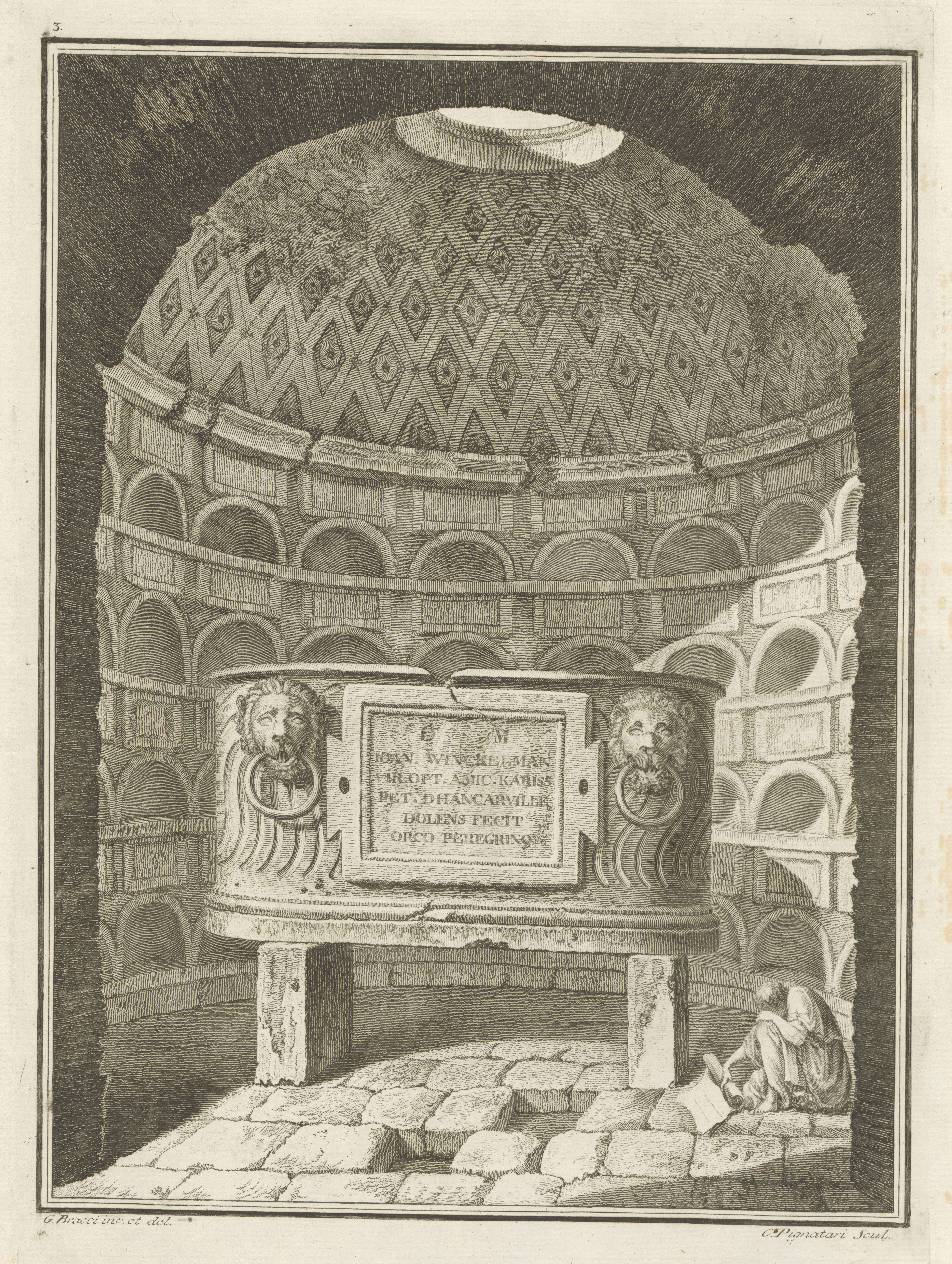
The Grand Tour is not an exhibition that coheres around singular great works of art or artists. Rather, it brings together their copies to create what French archaeologist and theorist Antonie-Chrysostome Quatremère de Quincy (1755-1849) may well have called ‘a body out of what had been a pile of debris.’5 Many of the prints in the Terence Lane Collection were originally bound in books and never intended to be exhibited or read in isolation from the text they were designed for. Other works in the exhibition came from larger print sets and series, or even architectural structures which have been pulled down, taken apart and sold to collectors. Fragmented and displaced, what survives of these images and the objects they depict now reside in collections around the world, where they are reconfigured in ways that would be largely unrecognizable to their makers.
Including objects spanning from c.350 BCE until the late twentieth century, the exhibition offers what could only ever be described as the tiniest insight into a specific history of European ideas too vast to even pretend to be able to encapsulate. What then is the role of the curator if not to make an informed selection that includes some things and excludes others? It was important for me to create an exhibition that could be taken in and navigated simply. Privileging my point of view as a university collection curator and not an academic, I chose in large part to neither explicitly celebrate nor critique the history and material I worked with. Rather, I have attempted to refrain from reinforcing clichés in favor of highlighting aspects that point to the ongoing influence of this period, and the potential inherent in every one of these objects to lead to wider, far-reaching cultural debates.
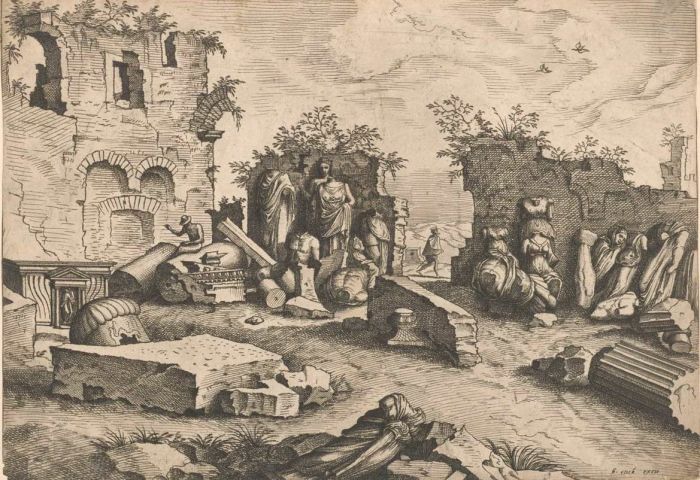
Offering one example of many to be found throughout The Grand Tour, among the earliest images on display are four prints from the large folio Several important monuments of Roman antiquity, with vivid perspectives, skilfully designed to imitate the real thing, also known as the Large book of ruins. Published by Flemish artist Hieronymous Cock (1510‑70) and his wife Volcxken Diericx (c.1525-1600) in Antwerp in 1551, the book was made as part of a commercial enterprise catering to the burgeoning European print collector’s market. There is no definitive evidence that Cock ever visited Italy, and the evocative images of decay and dereliction he created for the Large book of ruins were designed to appeal to the growing interest in ‘ruin mania’, which emerged concurrently from the mid-sixteenth century, and which inspired many Grand Tourists to set out in search of the ‘real thing’.
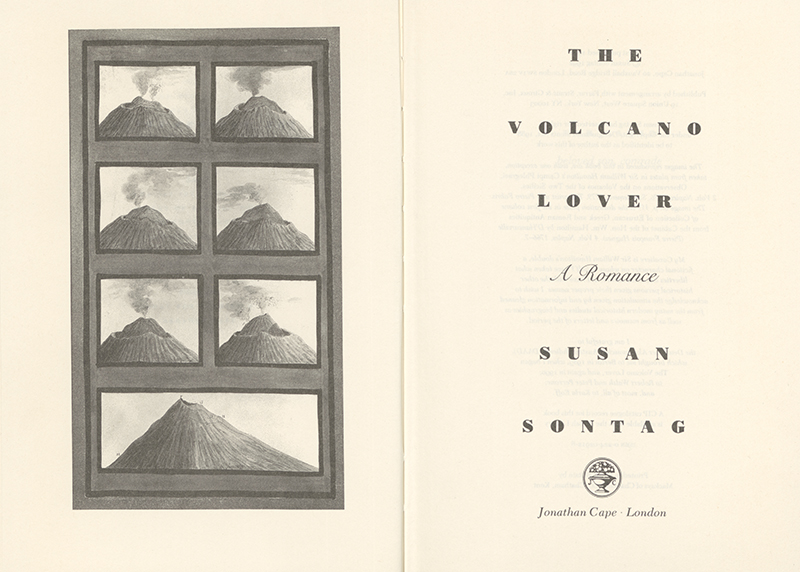
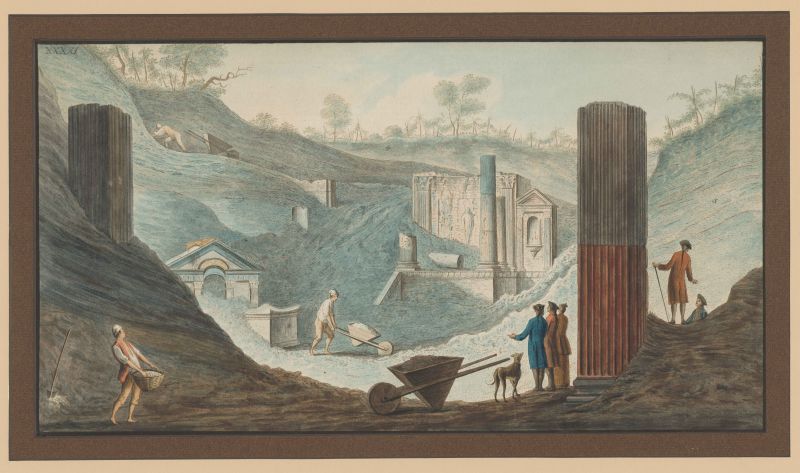
Sitting on the far side of this history is the most recently made work included in the exhibition, a first edition of The volcano lover: a romance, published in 1992 by North American cultural critic Susan Sontag (1933-2004 ). Sontag’s book has been paired in a case alongside a 1962 facsimile of Campi Phlegraei: Observations on the volcanos of the two Sicilies, as they have been communicated to the Royal Society of London, written by William Hamilton (1730-1803) and illustrated by Pietro Fabris (active c. 1756-84). Hamilton, one of the key protagonists of Sontag’s novel, was Envoy Extraordinary to the Kingdom of the Two Sicilies (1764-1800) and worked in Naples alongside Fabris, to produce one of the most beautiful natural history publications of the eighteenth century. Black and white reproductions of Fabris’ illustrations of Vesuvius erupting appear throughout the novel’s chapter title pages, while a single hand-coloured engraving removed from an original 1775 edition of Campi Phlegraei, and featuring The excavation of the Temple of Isis in Pompeii, hangs on an adjacent wall in the exhibition. Positing Cock’s early-modern construction of images and knowledge against Sontag’s postmodern fiction of collecting and memory, is a small example of the contradictory, unstable and malleable nature of these images and the historical narrative readings contained within The Grand Tour.
What the history of art expects from its objects
Centering firmly on the activities undertaken during the Grand Tour, the exhibition is about much more than the seventeenth and eighteenth century ‘golden age’ of British tourism. Presented in gratitude and acknowledgement to Terry Lane, The Grand Tour was built from the foundation of a small, perfectly formed collection 20 years in the making. Apparent in the overwhelmingly positive response we received from the University of Melbourne academics to the content of the Terence Lane Collection, the ideas coursing through this material ran so deep we could not expect these images to say all there is to be said in one exhibition. The Grand Tour offers instead an introduction to a body of work that can be studied, taken apart and reconstructed by the academy, students and other curators for years to come.
Endnotes
[1] Georges Didi-Huberman, Confronting images: questioning the ends of a certain history of art, trans John Goodman (The Pennsylvania State University Press, 2005), 4.
[2] See Sally Foster, “Introduction” in The Grand Tour, exhibition in the Noel Shaw Gallery, University of Melbourne, 2025.
[3] Ibid.
[4] See Ian Jenkins and Kim Sloan, Vases & Volcanoes: Sir William Hamilton and his collection (The British Museum Press, 1996). Unfortunately, I was never able to confirm this with Terence Lane, and it is my conjecture based on the checklist of works in the exhibition cartalogue.
[5] See Georges Didi-Huberman, The surviving image: phantoms of time and time of phantoms. Aby Warburg’s history of art, trans.Harvey Mendelsohn (The Pennsylvania State University Press, 2017), 3. In the introduction to The surviving image Didi-Huberman quotes from An analysis of time (1769), in which French archaeologist and theorist Antonie-Chrysostome Quatremère de Quincy (1755-1849) eulogised German-born Neoclassical art historian Johann Joachim Winckelmann (1717-68), author of History of Ancient Art (1764), as having created ‘a body out of what had been a pile of debris.’