Print Collecting: Then & Now
Rethinking Print Collecting
The Prints and Drawings Collection was established in 1959 through the gift of approximately 3,700 European ‘old master’ prints and drawings dating from 1460 to 1850 by Dr John Orde Poynton AO CMG (1906-2001). This foundational gift formed the basis of a teaching collection for the University, the art historic content of which was comparable to print collections found in art galleries, museums, and universities globally.
In the intervening years the collection has grown through gifts and acquisition to some 12,000 objects. Its value to the University remains as an object-based learning resource, but interest in how the collection can be used to benefit research and teaching now extends across academic disciplines to include the arts, humanities, and social-sciences, as well as applied and natural-sciences.
One of the most pressing questions for curators who have worked with the collection in more recent years has become how to continue to grow and shape a collection modeled on art historic conventions established in western Europe in the fifteenth century. One answer lies in diversifying the make-up of the collection - by acquiring works of art made by people not previously represented in the collection; and another in the re-interpretation of the existing collection - as both a limited document reflective of historic collecting and teaching practices, and by a re-assessment of the criteria we apply to determine the significance of the material we hold.
The selection of prints on display in Assemblage are reflective of both diversification and interpretation. Acquired between 2021 and 2024, they represent contemporary Indigenous Australian printmaking from the Torres Strait and historic western European printmaking from Renaissance Italy to late-eighteenth Spain and Britain. Individually and collectively, they speak of art history, artists, collectors, and donors; print publishers, commercial art markets and industry; taste, quality and value; personal experience and cultural mythology; knowledge, power, and education.
Exhibited works
-
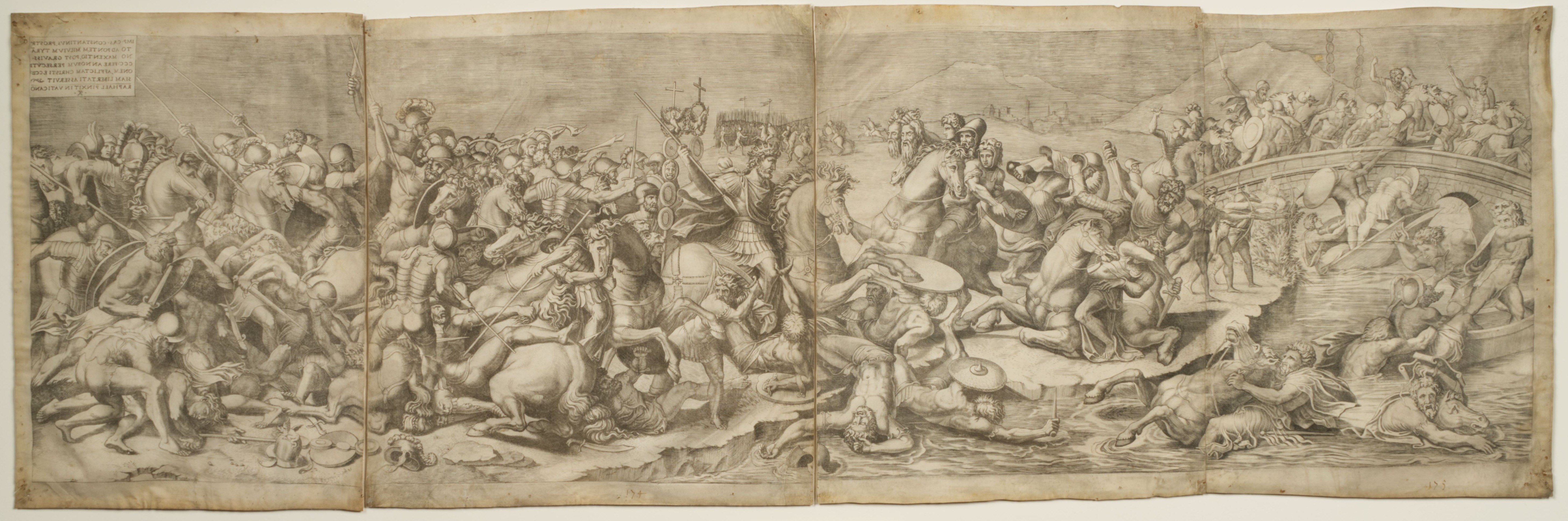
Monogrammist SK (engraver)
c. 1530-c. 1580
after Raphael Sanzio (artist)
Italy (Duchy of Urbino), 1483-1520The Battle of Ponte Milvio, c. 1550
Engraving printed from four plates on vellum
Counterproof, first of two statesPrints and Drawings Collection
Purchased through the Library Endowment Trust, 2021This print is believed to have been copied from a lost modello (intermediary drawing) designed by Italian Renaissance artist Raphael for a large fresco commemorating Roman Emperor Constantine I (c. 272-337 CE) and his army’s defeat of rival Emperor Maxentius (c. 283-312 CE) on the Milvian Bridge in Rome on 28 October 312 CE. The fresco, which was completed four years after Raphael’s death by his pupil Giulio Roman, decorates the walls of the Sala di Constantino (Hall of Constantine) in the Vatican.
Raphael has been described as the first artist to realise the potential of prints being made after his designs to propagate recognition and generate artistic fame. Prints were officially, and unofficially, created after Raphael’s paintings and drawings during the artist’s lifetime, with many being distributed among collectors and artist’s workshops across Europe. Printed from four copper plates on vellum (animal skin), this rare counterproof, or reversed impression, of the print’s first state was made around 1550 by a printmaker known only by the monogram SK, and was almost certainly commissioned specially for a wealthy private collector.
-
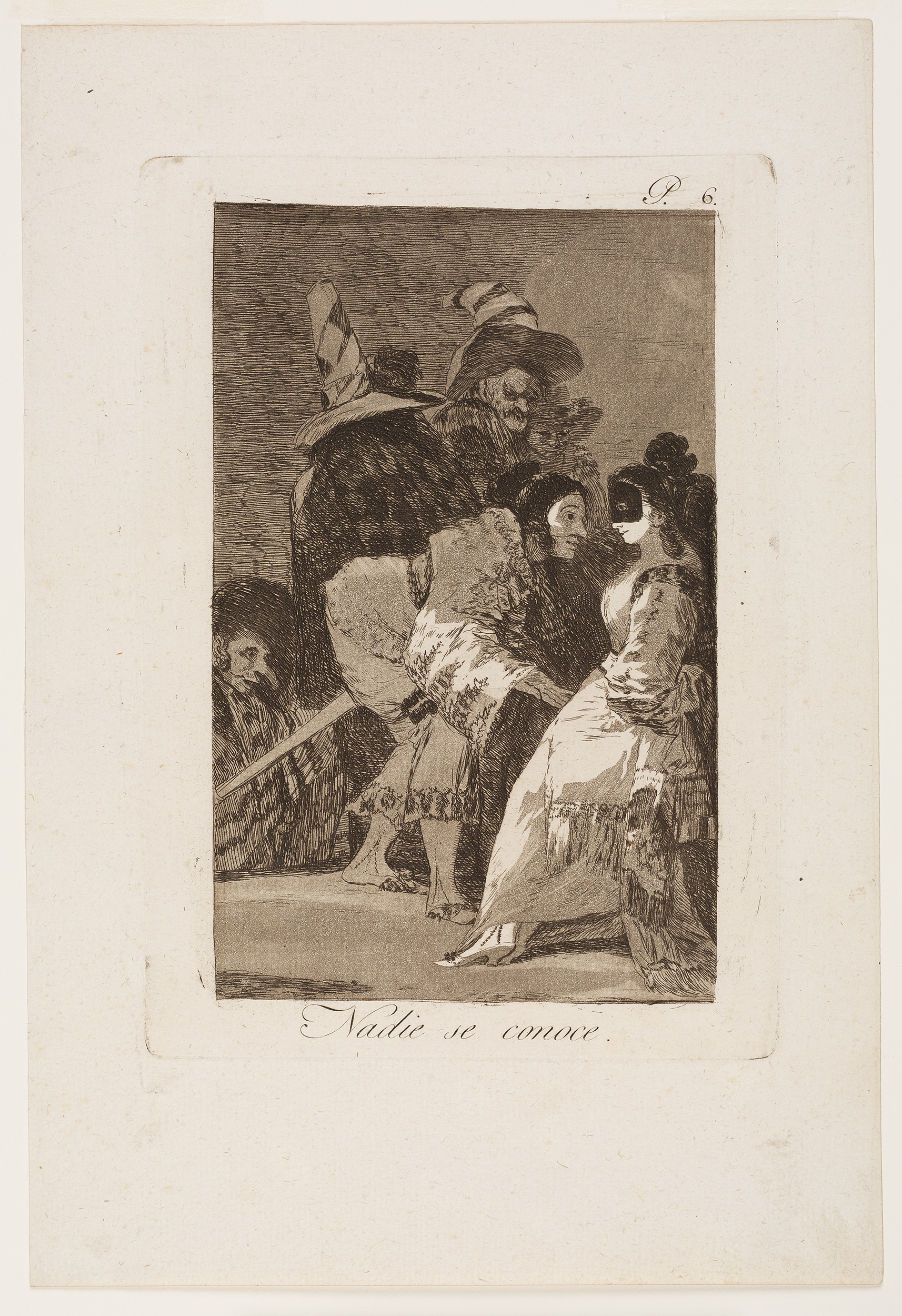
Francisco de Goya (artist and publisher)
Spain, 1746-1828Nadie se conoce. [Nobody knows himself.], 1797–98
First edition published 1799
Etching, aquatint, burnisherPrints and Drawings Collection
Purchased through the Library Endowment Trust, 2024Francisco de Goya was Painter to the King of Spain, working in the courts of Charles III (r. 1758-88), Charles IV (r. 1788-1808) and Ferdinand VII (r. 1808/1813-33). During his life, he grappled with reconciling the aesthetics of privilege and poverty, diplomacy and war, with the cultural aspirations to reason sought by proponents of the European ‘Age of Enlightenment’.
Both this print and its companion in the exhibition, Que viene el Coco. [Here comes the bogey-man.], belong to Los Caprichos [The Caprices], a series of 80 plates created in Madrid between 1797-98. This was the first of Goya’s four major print series and arguably his most technically innovative and inventive graphic work. Designed as a sequence of sardonic illustrations of human irrationalities and prejudices rooted in ignorance, social customs and self-interest, Goya wrote of this image, ‘The world is a masquerade. Face, dress and voice, all are false. All wish to appear what they are not, all deceive and do not even know themselves.’
-
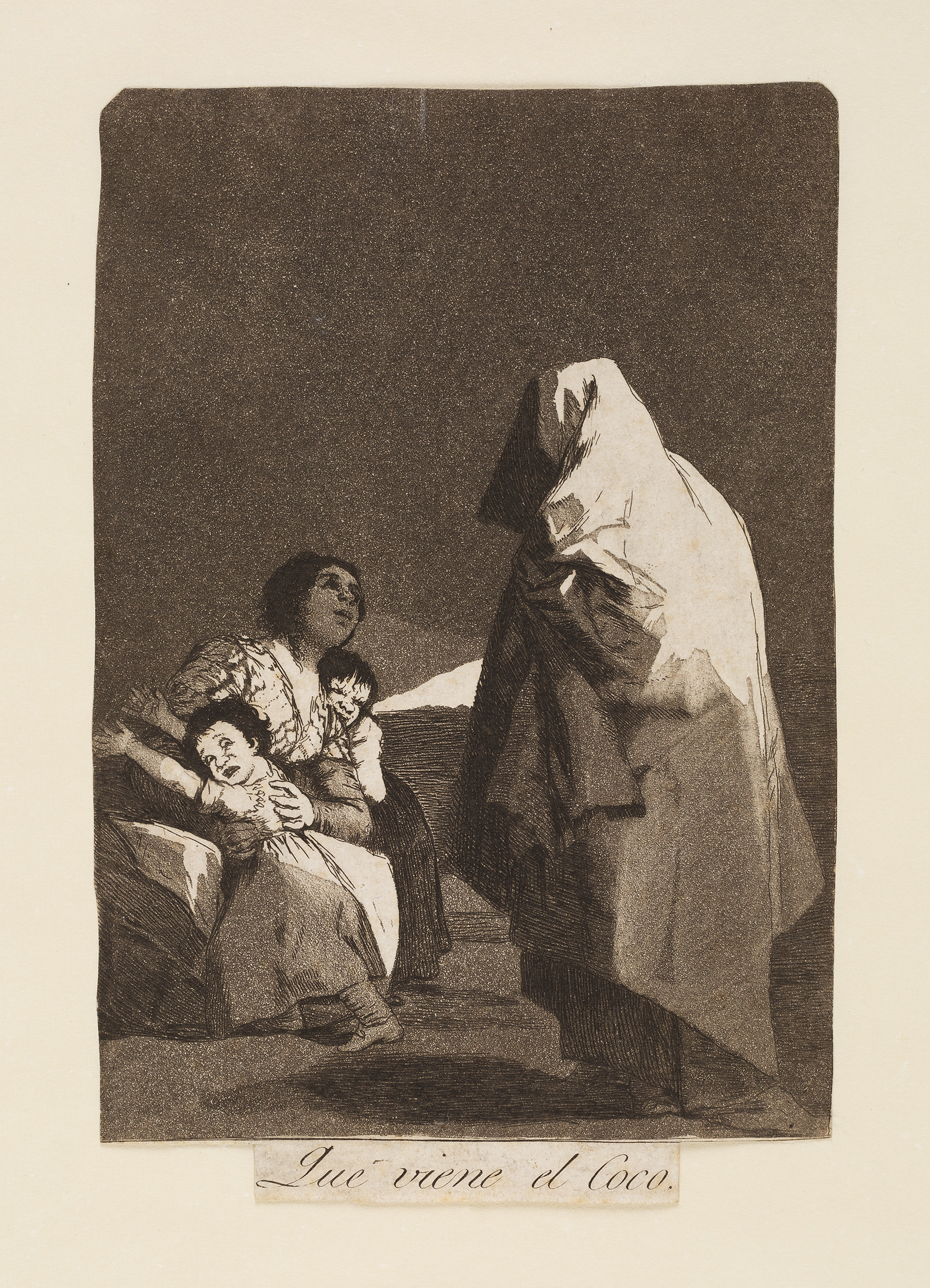
Francisco de Goya (artist)
Spain, 1746-1828Que viene el Coco. [Here comes the bogey-man.], 1797–1798
Published after 1805
Etching, aquatintPrints and Drawings Collection, 1984
Que viene el Coco. [Here comes the bogey‑man.] is an earlier acquisition to the Prints and Drawings Collection, included as it offers an opportunity to demonstrate two different approaches to print collecting.
While series such as The Caprices were published as a set, individual works were often removed from their original context to be sold by art dealers. As they circulated among collectors, it was common practice to mark prints with hand-written inscriptions or collector’s stamps. In accordance with the tastes and customs of the nineteenth century, it was also typical for collectors to cut the margins from a sheet to the edge of the plate-mark, or printed image. While annotations and collector’s marks are now highly valued for the important information they reveal about the provenance of works, rare uncut sheets such as the one on which Nadie se conoce. [Nobody knows himself.] (the companion piece to this work in the exhibition) is printed are the most prized among collectors.
-
Glen Mackie (Kei Kalak)
Australia (Yam Island, Torres Strait), 1975-Kawai (The Black Dogai), 2011
Linocut
Edition 10/35Prints and Drawings Collection
Purchased through the Library Endowment Trust, 2024Glen Mackie (Kei Kalak) is a Iama (Yam) man from the Kala Lagaw language group of the Torres Strait Islands, who has been active in the Torres Strait Islander printmaking movement since the 1990s. The movement emerged in Cairns, North Queensland, in the mid-1980s and by the late 1990s had developed into a distinct style that is now widely recognised as belonging to the Torres Strait Islander tradition. Mackie uses the graphic minar, or infill-design, style in combination with the sharp lines of the linocut to great visual effect: representing his family totemic designs, recounting ancestral stories, depicting the archipelago of islands and waters of the Torres Strait and creating his own imaginative geometric patterns.
The dogai (witch-like) figure seen here reoccurs throughout Torres Strait Islander art. In Mackie’s print, the ‘wicked black dogai’ emerges from the sea around the reef at Gebar (Two Brothers Island) where they terrify the community before being defeated by a boy who shoots an arrow through their heart. This print is one of nineteen Torres Strait Islander works to enter the collection between 2016 and 2022, which were acquired for their ability to offer an important contemporary comparison to the visual story telling of mythology found throughout the historic European works in the Prints and Drawings Collection.
-
Thomas Evans (publisher)
England, active 1803-1815The odd-dealer, 1807
John Grouse & Mother Goose, 1807
Widow Waddle, of Chickabiddy-Lane, 1807
The shipwrecked cabin-boy, sung by Master Smalley, in Mother Goose, 1808
The conjuror, c. 1805/06
The scolding wife, c. 1805/06
Lilies and roses, c. 1805/06
The girl of my heart., c. 1806/07
Hand-coloured etchingsPrints and Drawings Collection
Donated through the Australian Government’s Cultural Gift Program by Elizabeth Lane in memory of Richard Lane, 2021