Intersecting artforms in inter-War Paris
The Rare Music collection has made the acquisition of material published in inter-war Paris a priority in recent years. The period from 1921 to 1931, particularly, saw Paris the vibrant centre of avant-garde creativity, enriched by a growing and diverse expatriate population. This was a period when extraordinary artists worked together on collaborative projects - as exemplified in the phenomenon that was the Ballets Russes, where composers were co-creators not just with conductors and instrumentalists, but with storyline writers and choreographers, dancers and artist-designers. Controlling it all was the impresario Serge Diaghilev.
Rather than restricting acquisitions to notated music (scores and sheet music), the collection has embraced material that embodies music in a variety of ways: in an illustration or portrait, for example; or in costume design or an event program; as well as in song.
Underlying the selection of items on display was the intention to illustrate, in microcosm, the collaboration and interconnectedness that was widespread in Parisian artistic circles. The best-connected figure represented here is Jean Cocteau (1889–1963): in the role of poet, critic, editor, lyricist and visual artist.
The deluxe editions of books from the publisher Quatre chemins exemplify Cocteau’s reach. They were published just months after the first performances of the ballets Les Biches [The female deer] and Les Facheux [The annoying ones], part of a festival given by Diaghilev at the Monte Carlo casino in 1924. Here Cocteau writes articles discussing the music by Francis Poulenc and Georges Auric respectively, and he introduces the books’ exquisite reproductions of curtain, set and costume design by Marie Laurencin and Georges Braque.
Exhibited works
-
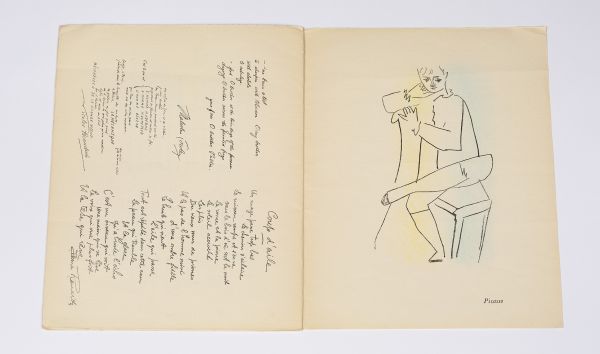
Natalia Gontcharova (artist)
Russia; France, 1881–1962
Pablo Picasso (artist)
Spain; France, 1881-1973Bal travesti transmental: organisé par l’Union des artistes russes …programme, 1923
Lithographs with pastel
François Bernouard, printerRare Music Collection
Purchased through the Library Endowment Fund, 2016A programme for a 1923 event raising funds for displaced Russian creative artists, this publication includes illustrations by Natalie Gontcharova, who contributed a drawing of Russian dolls, reflecting the doll-themed ballet performed with music by Marcel Mihalovici; and by Pablo Picasso, whose seated figure – hand-coloured – is thought to be a saltimbanque or entertainer. Other musicians supporting the event included Georges Auric, Erik Satie, Sergei Prokofiev, Maurice Ravel, Igor Stravinsky and Germaine Tailleferre.
-
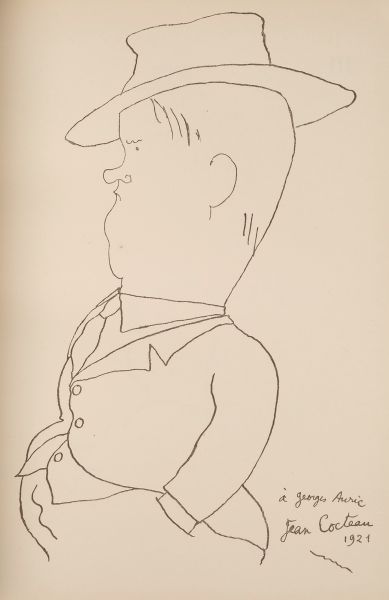
Jean Cocteau
France, 1889-1963Dessins, 1923 [1924]
Line block, signed copy
Paris: Librairie StockRare Music Collection
Purchased through the Library Endowment Fund, 2016Cocteau’s monumental book of 134 designs has many music-themed drawings, from portraits of his composer friends, Georges Auric and Francis Poulenc, through to surreal animal-instruments. Stravinsky playing the Rite of Spring shows a rehearsal with the composer at the piano, while conductor Pierre Monteux and the dancers are ranged behind him in an interconnected stream.
-
Georges Auric (composer)
France, 1899-1983
Jean Cocteau (author)
France, 1889-1963“La fête du Duc”, 1919
Letterpress
Aujourd’hui : revue des valeurs nouvelles paraissant quatre fois l’an, 1919
Paris: La belle EditionRare Music Collection
Purchased through the Library Endowment Fund, 2023The first and only issue of the periodical Today, with twenty contributors – musicians, writers and artists – promising, in the immediate post-war period, “new values”. Auric and Cocteau’s song, The Duke’s celebration, is fast paced, with Dadaist lyrics that include encounters with a stamping zebra, a snail with a doe’s neck and an injured but laughing dove.
-

Moïse Kisling (artist)
Poland; France, 1891-1953[Still life], 1919
Pochoir
Aujourd’hui : revue des valeurs nouvelles paraissant quatre fois l’an, 1919
Paris: La belle EditionRare Music Collection
Purchased through the Library Endowment Fund, 2023 -
Georges Braque (artist)
France, 1882-1963
Jean Cocteau (author)
France, 1889-1963
Louis Laloy (musicologist)
France, 1874–1944
Georges Auric (composer)
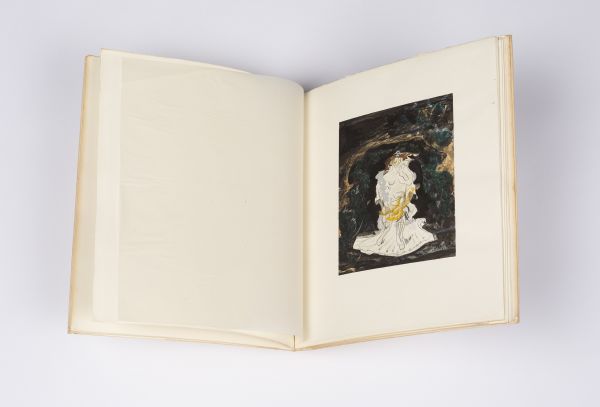
France, 1899-1983Deuxième masque, 1924
La Naïade, 1924
Collotype, pochoir
Les fâcheux: Theatre Serge de Diaghilew, 1924
Paris: Editions des Quatre CheminsRare Music Collection
Purchased through the Library Endowment Fund, 2020The ballet Les Facheux [The annoying ones] is an adaptation of Molière’s seventeenth century comedy-ballet for Diaghilev’s Ballets Russes. Braque’s design for the opening of the ballet depicts a naiad (or water nymph) emerging from the waters in a shell.
-
Marie Laurencin (artist)
France, 1883-1956
Jean Cocteau (author)
France, 1889-1963
Darius Milhaud (author)
France, 1892-1974
Francis Poulenc (composer)
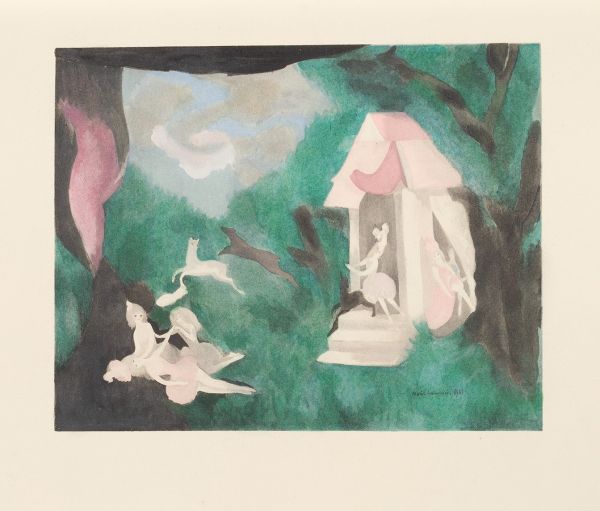
France, 1899-1963[Untitled], 1924
Collotype, pochoir
Les biches: Theatre Serge de Diaghilew, 1924
Paris: Editions des Quatre CheminsRare Music Collection
Purchased by Friends of the Baillieu Library in memory of Peter McInnes, 2019Diaghilev’s Les Biches (The female deer; colloquially, a coquettish woman) was composed by Francis Poulenc as an overture and sequence of dances; it has no discernible storyline. Its setting is a house party, where the guests flirt and enjoy a summer afternoon. Many of Marie Laurencin’s designs take the ballet’s name literally, with dancers shadowed by, or even intertwined with, deer.
-
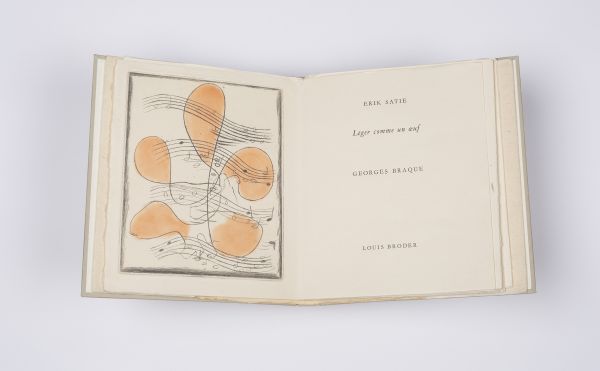
Erik Satie (author, composer)
France, 1866-1925
Georges Braque (artist)
France, 1882-1963Léger comme un oeuf, 1957
Etching
Paris: Louis Broder; printed by Crommelynck and DutrouxRare Music Collection
Purchased through the Library Endowment Fund, 2023In this etching Georges Braque responds to the title Léger comme un oeuf [Lightly, like an egg]: one of Satie’s many satirical – or simply unplayable – musical performance indicators or ‘expression marks’. This expression mark is from a piano piece of Satie’s, Sur un casque [On a helmet], and is written at a point where the pianist is asked to play loudly (and get louder) - a musical in-joke. The rest of this 'tribute' book quotes from Satie’s highly influential writings.