Shiba Kōkan (artist)
Japan, 1747-1818
Sumida River, c. 1771
Woodblock
Rare East Asian Collection
Purchased through the Library Endowment Trust, 2023
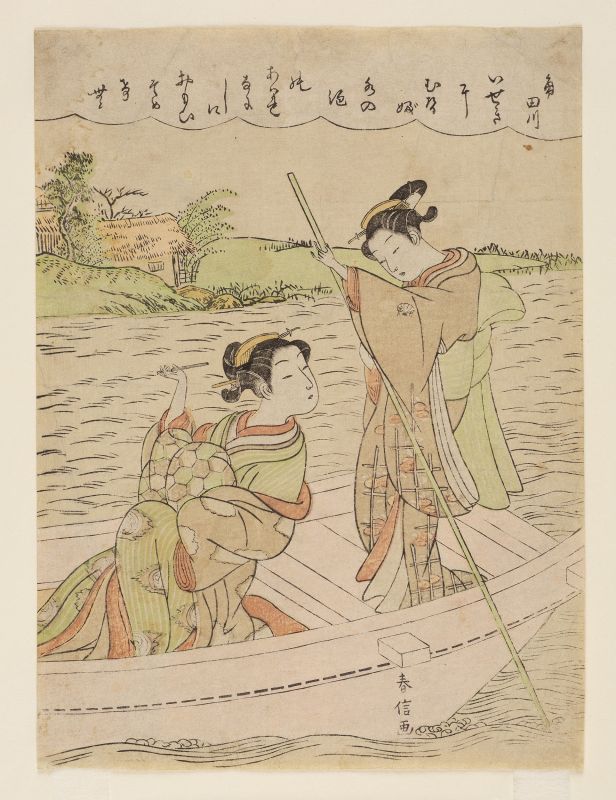
The poem inscribed at the top of this work reads:
角田川 / Sumidagawa / Sumida River
いせき[り]にむせぶ / iseki ni musebu / where foam from water contained
水の泡の / mizu no awa no / by the embankment
あわれなにしに / aware nani shi ni / begins, somehow, to reflect
おもひそめけむ / omoisomekemu / feelings I have about it.
春信画 / Harunobu ga / painted by Harunobu
(English translation: Waterhouse, David. The Harunobu Decade: A Catalogue of Woodcuts by Suzuki Harunobu and His Followers in the Museum of Fine Arts, Boston. Leiden: Hotei Publishing, 2013)
Shiba Kōkan was initially a disciple of the Kanō school who went on to study Chinese flower-and-bird paintings, and also cultivated a strong interest in the Western artworks introduced to Japan by Dutch merchants. As a result, his work demonstrates considerable stylistic variety. However, he is best known in connection with Suzuki Harunobu (1724–1770), who created multi-coloured prints in Edo period Japan.
Kōkan started making forgeries of Harunobu’s work immediately after the latter’s death, assimilating his style and composition. Later he began to experiment with his own ideas, but published under the name Harushige, pretending to be a disciple of the dead master. This print, signed with Harunobu’s name, is an example of Kōkan’s early forgeries, after an original design published in 1768.
The original Harunobu design was printed in the third volume of a book titled Ehon’yachiyogusa, which was published in the year 1768. The original illustration is across two pages in a horizontal format, and depicts a courtesan with her teenage apprentice (whose gender is ambiguous) enjoying themselves in a boat on the Sumida River. The background features only one willow tree over the river. Kōkan borrowed the two main figures and the boat, depicting them in exactly the same pose, but made several changes: the patterns of the kimono on the young woman on the left, and the obi on the apprentice on the right are completely altered; the faces of both figures are elongated, losing the playfulness of Harunobu's design; the spatial depth of the boat, clearly indicated in earlier work, is flattened; and the simple background is replaced with a rural village along the bank.
The poem translated above was written by Fujiwara no Morikata (1137-1178), a minister of the late Heian period.