Scene from Onbōbori: Yotsuya Ghost Story
Utagawa Kunisada (artist)
Japan, 1786-1865
Hori Take (Yokokawa Takejiro) (engraver)
Japan, active mid-1800s
Ebisuya Shoshichi (Kinshodo) (publisher)
Japan, active c. 1846-1883
Scene from Onbōbori: Yotsuya Ghost Story, 1861
Woodblock, triptych
Rare East Asian Collection
Purchased through the Library Endowment Trust, 2023
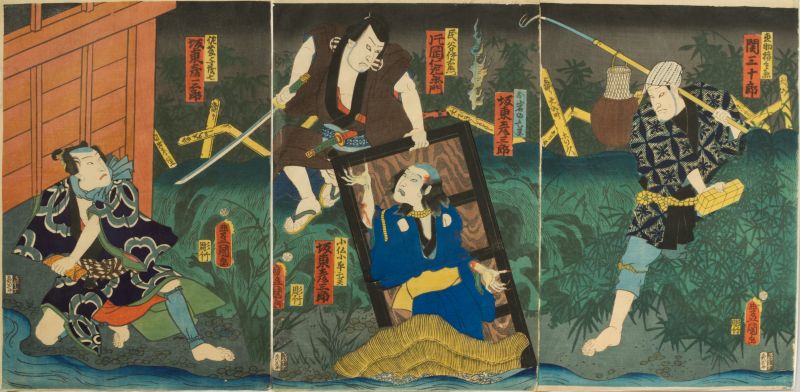
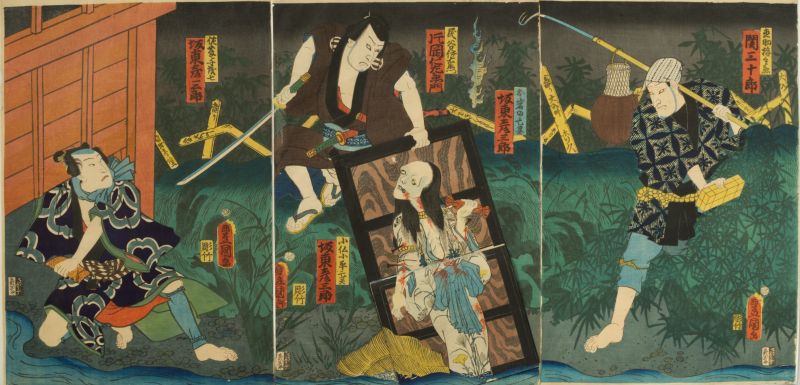
The kabuki play Yotsuya Ghost Story was first staged at the Nakamuraza Theatre in 1825. The play depicts the evil deeds of Tamiya Iemon who, falling in love with the granddaughter of a samurai, decides to poison his wife, Oiwa, who had just given birth. To justify his crime, Iemon kills Kobotoke Kohei - a thief he catches sneaking into his house - who he accuses of adultery with Oiwa. The bodies of Oiwa and Kohei were fixed to a door plank and dropped into the river, a customary punishment for adulterers.
This print shows the third scene of the play, Onbōbori, in which Iemon, fishing by the river, is confronted by the risen corpses of his victims. On the kabuki stage, Oiwa and Kohei were played by the same actor, whose face was shown through an opening on the plank; costumes for both roles were attached on either side. While the actor playing Iemon turned the plank on the stage, it was easy and quick for his partner to switch between the roles of Oiwa and Kohei. In an innovative piece of design, the central piece of the triptych imitates this with a flip-up panel.
The left and right panels of the triptych feature two other characters, Naosuke Gonbei and Satō Yomoshichi, who feature in the closing parts of this scene. Probing in the dark night with Iemon, they mistakenly exchange the items in their hands. This type of ‘silent play’ (danmari) was a specialty of kabuki theatre.
Utagawa Kunisada was famous for his depictions of kabuki actors, a genre he developed under Utagawa Toyokuni (1769–1825), who invented this style of portraiture, yakusha nigao-e (‘actor likenesses’). This type of print was exceptionally popular among Edo audiences; Kunisada was also known for his prints and drawings of beautiful women, erotica, fictional stories and an adapted version of the Tale of Genji.