Great Perfection of Wisdom Sutra
Unknown (engraver)
Japan, nd
Xuanzang (translator)
China, 602-664
Great Perfection of Wisdom Sutra, vol. 192, 1285
Woodblock
Kasuga-ban, Japan
Rare East Asian Collection
Purchased through the Garlick Memorial Fund, 2023
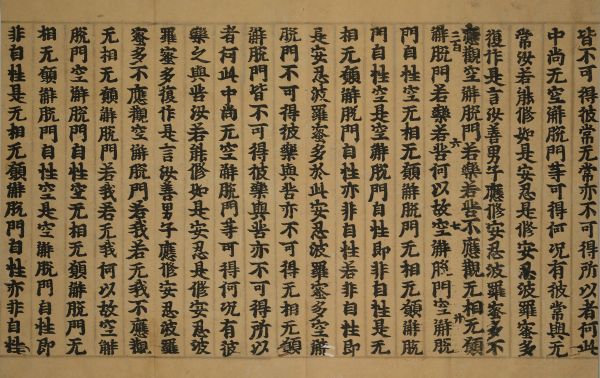
All editions of the Buddhist canon published after the year 730 CE open with the Mahāprajñāpāramitā, or Great Perfection of Wisdom Sutra, brought to China and translated from Sanskrit by the Tang (618–907 CE) priest Xuanzang. The completed Chinese edition of the sutra comprises 600 scrolls, which were disseminated throughout Chinese-speaking lands. The sutra was recited in state rituals for protection of the country, and elimination of natural disasters and calamities, and was also extensively copied by both ecclesiastical and aristocratic Buddhists as a religious act that would grant them personal redemption and rebirth in the heavens.
This edition of the sutra was not hand-copied, but printed from sets of blocks carved by the Kofuku-ji Temple in Nara, Japan between 1222-27. Blocks such as these were in common use during the early Kamakura period (1185–1333). Each line of the scroll contains 17 characters and red dots are used to mark the sentences.
At the end of the scroll, there is a short colophon saying it was donated by a young woman from the noble Tachibana clan, whose members often held important positions in the Japanese government. Scrolls bearing the same name are found in Kyushu University Library, Tsurumi University Library, museums and personal collections. The colophon on the scroll in Tsurumi University specifies that it was gifted in the eighth year of Kōan era (1278-1288), enabling us to narrow down the date this copy was printed.