Adding references
There are a number of ways to get references into Zotero. Find which work best for you.
-
If you can’t find a reference online, you can manually add references to Zotero.
- Open Zotero.
- Select the New Item icon
- Choose the appropriate reference type (book, journal article, etc).

Once selected, you will be given appropriate fields to fill out. You will need to fill out the minimum information required for your citation style.
-
The Zotero Connector will try to harvest information on a webpage. Use this tool to add material to your Zotero library. Zotero must be open to harvest information.
The Zotero Connector icon can be found in the following places:
Chrome - to the right of the address bar
Firefox - in the top right corner of the window
Safari - to the left of the address bar.
The appearance of the Zotero Connector changes depending on what information Zotero can detect on the page. When no details are detected, it will display the red 'Z' icon. When multiple references are detected, it will show a folder icon . When Zotero detects one reference, the icon will change to reflect the type of item. For example, a book icon when details of a book are detected, a scales icon when a legal source is detected, a printed page when a journal article is detected.
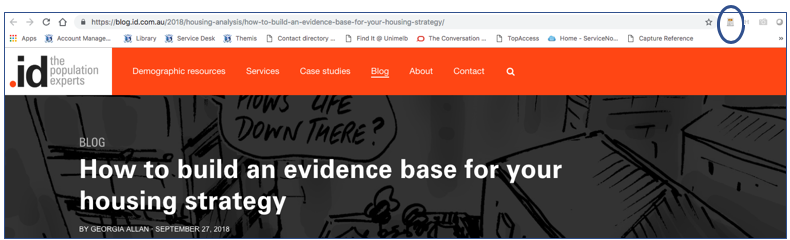
To save information from a page to your Zotero library, click on the Zotero Connector. By default, it will save the item into the selected collection folder, but another collection can be chosen from the dropdown menu that appears while the item is saving.
When saving from a page with multiple references, a check box will pop up to select which references you want to save.
Where available, the full text of the article will also be saved in your library attached to the record.
Note: Always check the information saved as sometimes Zotero harvests incomplete information, or can't download the PDF.
Issue with Science Direct: The Zotero Connector does not currently download PDFs from Science Direct.
To work around this download the PDF separately and drag the PDF onto the parent item you saved.
-
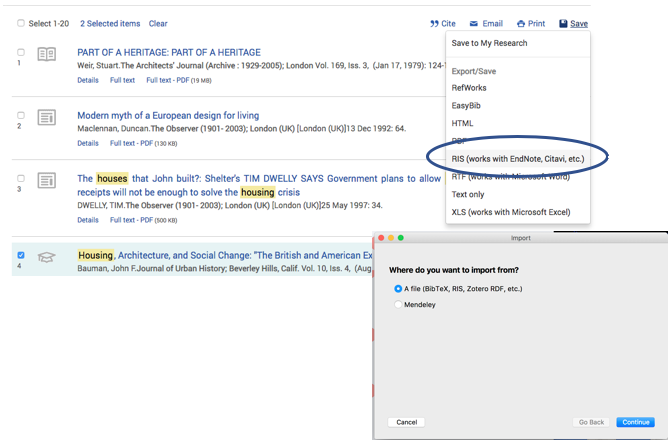
To save records to Zotero from a database:
- Mark the records you want to save
- Select the Export option in the database
- Choose Endnote/RefMan/RIS/Zotero (depending on the database) as the Export option, then Export
-
PDF documents saved to your computer can be dragged and dropped into the centre panel of Zotero. The program will then try to detect the publication details from any metadata in the file, create a record and link the file to the record.
Note: Not every file will have the required metadata for Zotero to detect. Some files will work, others won't. Some files will give incomplete or incorrect data. Always check and edit the bibliographic information that has been added.
-
- Quickly add references to Zotero using their ISBN, Digital Object Identifier (DOI), or PubMed ID.
- To add a reference via one of these identifiers, click the “Add Item by Identifier” button at the top, type or paste in the identifier and select Enter
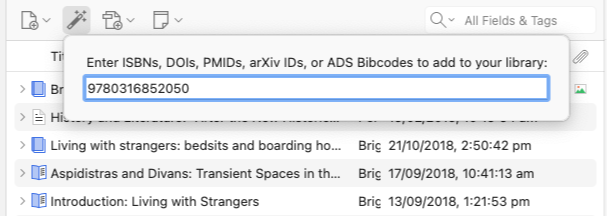
Add multiple references by identifier with DOI import
You can add mulitple references at once using the browser connector's 'Save to Zotero DOI' option, which is great for saving reference lists. Note, this importer will only work from a website, not from a PDF, and will only detect and import references with a DOI.
To save references from a website you must have the Zotero browser connector installed. Instead of clicking the connector icon, right click anywhere on the webpage, select 'Zotero Connector' > 'Save to Zotero' > 'Save to Zotero DOI' option from the menu. If multiple DOIs are detected, a pop up box will appear where you can select which items to import.
-
You can retrieve the full text articles from the University of Melbourne Library subscriptions by setting up a Library Link.
- In Zotero, go to Settings (Windows: under Edit menu | Mac: under Zotero menu)
- Choose the General tab
- Under the heading Locate, use the Resolver pull down menu to find the University of Melbourne. (Select Oceania - Australia - University of Melbourne)
New Library system update: the resolver for locate has to be added as custom resolver until further notice. Follow the instructions above, but at Step 3 select Custom, then paste the url below in the Base URL box:
https://librarysearch.unimelb.edu.au/openurl/61UMB_INST/61UMB_INST:NDE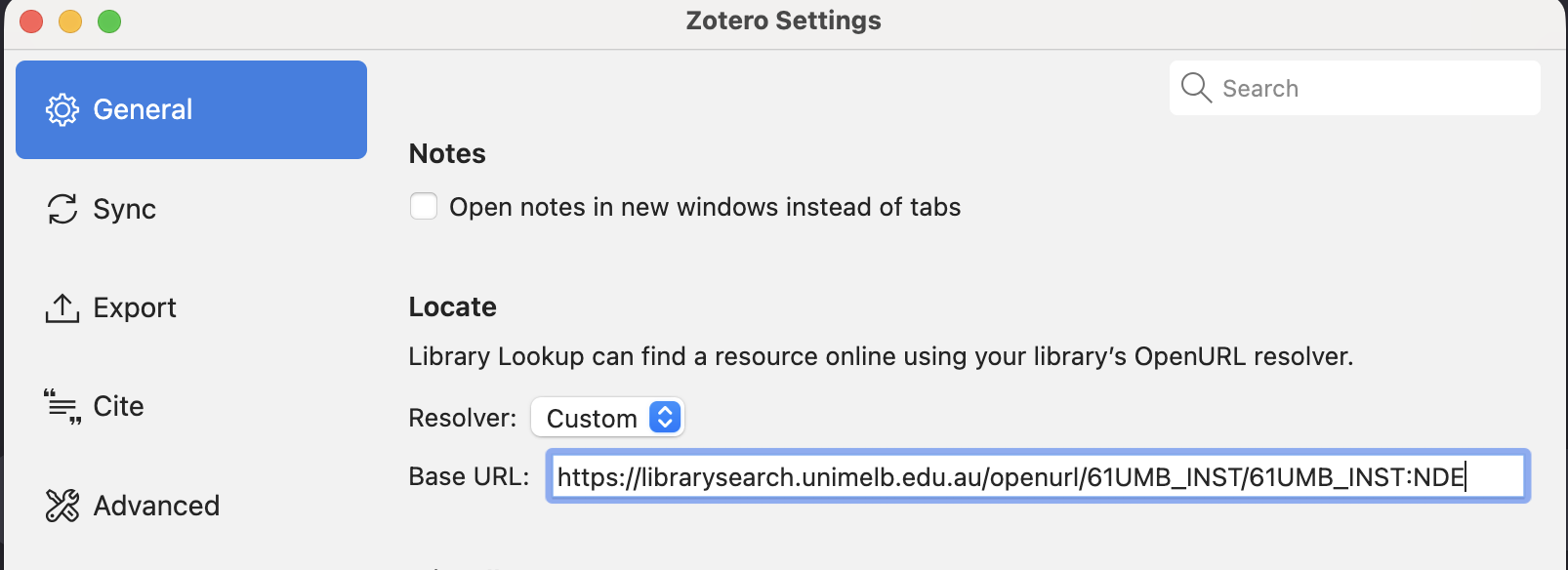
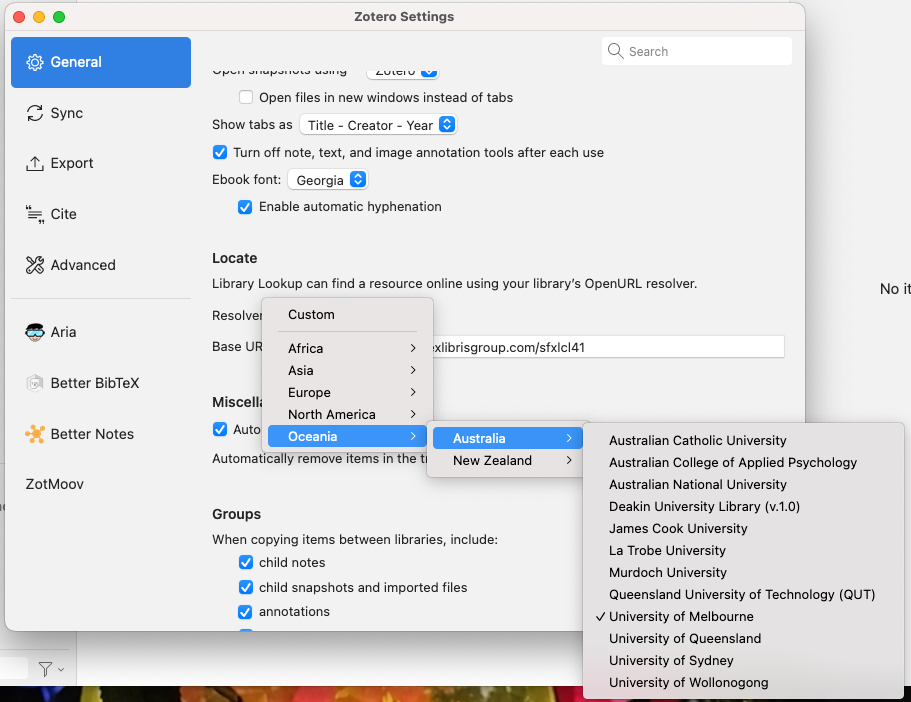
Once this is set up, select any reference in Zotero and click the locate icon (arrow in a grey circle) in the right hand menu and select: Library Lookup
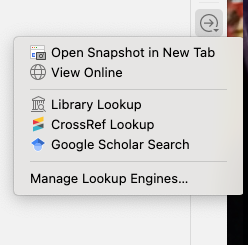
A Find It @UniMelb window will then appear listing links to items held in the Library database subscriptions.
-
- Zotero allows you to import records from journals or websites via RSS feeds.
- To add an RSS feed:
- Go to the journal website
- Find the RSS feed (may be on the front page or in a menu)

- Right click on RSS and select Copy link address.
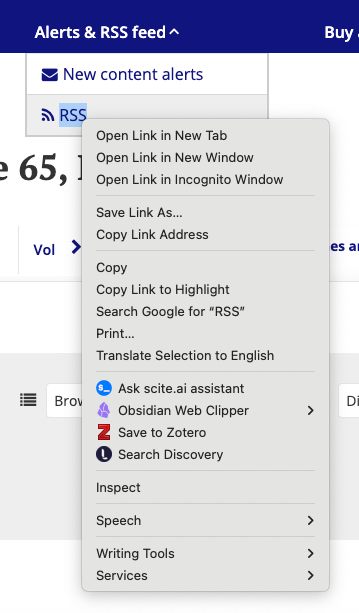
In Zotero:
- Select File - New Library - New feed - From URL
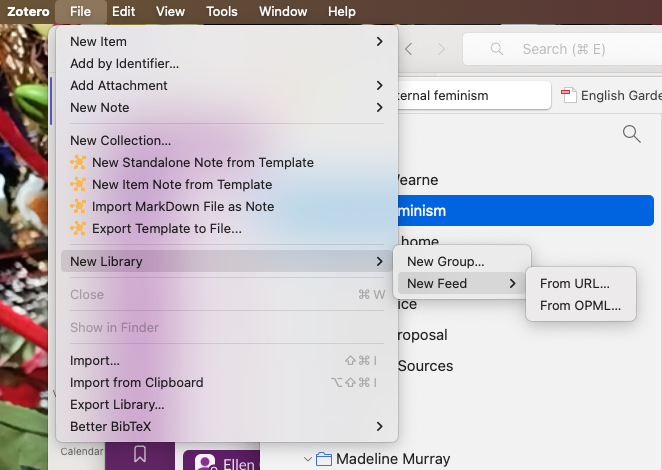
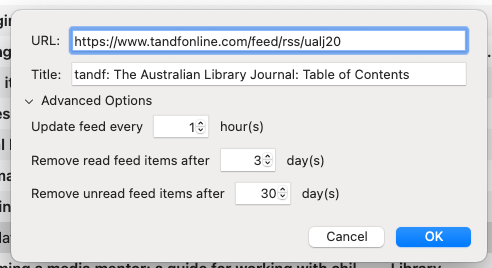
- Paste the URL into the box and edit the title if required
- Click on Advanced options to select the frequency of updates and removal of read and unread items
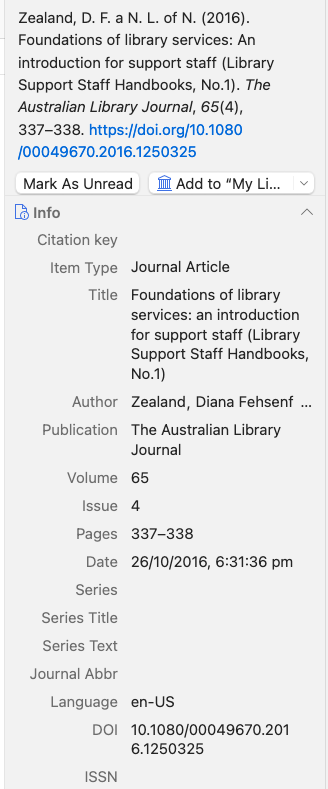
- Items from the RSS feed are not automaitcally added to your library. Look at the details of each item and select Add to "My Library" to save the item to your Zotero library.
-
- You can export your Readings Online subject reading list for import to Zotero.
- See the Readings Online instructions to 'Export your reading list'.
- Choose the .ris file format option for export to reference manangement software (ie Zotero)
- The readings list can now be imported into Zotero.
- In the Zotero menu click File > Import (or CTRL + Shift + I)
- In the 'Where do you want to import from?' window, tick 'A file (BibTeX, RIS, Zotero RDF, etc.)'. Click 'next'.
- Find the file location (e.g., Desktop or Downloads folder) where you have stored the .ris file with your Readings Online readings exported earlier. Click 'open'.
- In the Import options window tick 'place imported collections and items into new collection'.
- The Import complete window confirms how many items were imported. Click 'Finish' to complete the process.
- View the references from your reading list that you have imported. You can add PDF files of any of the readings you have saved to their references.
-